
Dante and crowds

Share

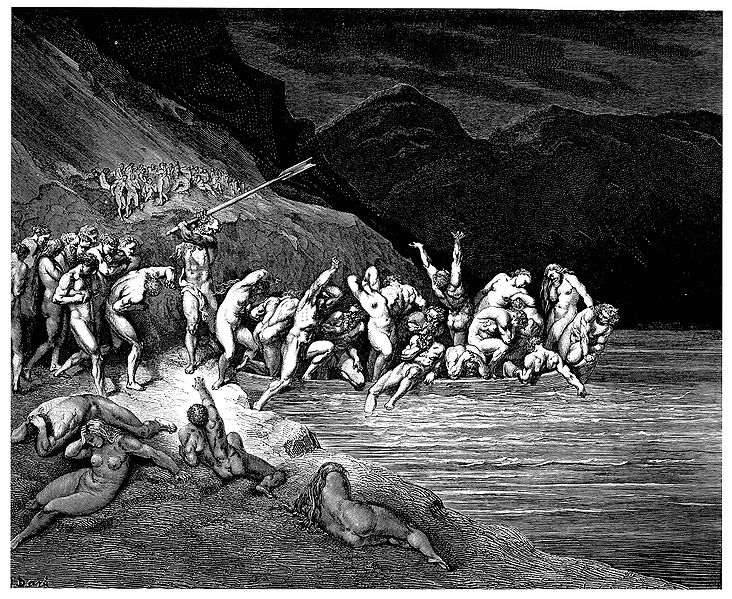
Gustave Doré's version of Canto III: "...like a bird at its call."

Dante‘s Divine Comedy is brimming with crowd scenes.  Take this one, in Canto III of the Inferno, as Dante visits the damned souls who are waiting to be ferried to hell:

Come d’autunno si levan le foglie
l’una appresso de l’altra, fin che ‘l ramo
vede a la terra tutte le sue spoglie,
similemente il mal seme d’Adamo
gittansi di quel lito ad una ad una,
per cenni come augel per suo richiamo.

In Charles Singleton‘s translation: “As the leaves fall away in autumn, one after another, till the bough sees all its spoils upon the ground, so there the evil seed of Adam: one by one they cast themselves from that shore at signals, like a bird at its call.”

In a recent lecture, Robert Harrison pointed out the classical sources for the image of leaves: Aeneas sees the same infernal scene in his visit to the underworld in Book 6 of the Aeneid.  Since Virgil was by Dante’s side during his otherworldly excursion, the comparison would have been on his mind. Here’s Virgil’s version (in Robert Fitzgerald‘s translation)

..as many souls
As leaves that yield their hold on boughs and fall
Through forests in the early frost of autumn,
Or as migrating birds from the open sea
That darken heaven when the cold season comes…

Individual, particular names (Photo: Creative Commons)

But Robert noted that Dante put a new twist on Virgil’s old image, “It’s a traditional epic simile – but he singularizes it.”  Robert compared it to the Vietnam Veterans Memorial, whose massive presence resolves, as you draw nearer, into thousands and thousands of individual, particular names.

So the Inferno is composed of carefully delineated individuals – the mass “that swirls unceasingly in that dark and timeless air, like sand when a whirlwind blows” never entirely fades into facelessness.

•••

In all the images of leaves, sand, and birds, this one could easily be overlooked:

E come li stornei ne portan l’ali
nel freddo tempo, a schiera larga e piena,
così quel fiato li spiriti mali
di qua, di là, di giù, di sù li mena;

“And as their wings bear the starlings along in the cold season, in wide, dense flocks, so does that blast the sinful spirits; hither, thither, downward, upward, it drives them.”

It certainly grabbed me: My daughter, Zoë Patrick, is a “birder,” and during a recent trip to Golden Gate Park, she pointed out the drab and speckled birds who could be identified (she said) because they look like “flying cigars.”

They are apparently not native here: a Bronx drug manufacturer, one Eugene Schieffelin, decided to import them, in an effort to have all the birds from William Shakespeare‘s works in the U.S.

Shakespeare, you see, chose to include the starling in Henry IV, when another soldier, the fiery Hotspur says, “The king forbade my tongue to speak of Mortimer. But I will find him when he is asleep, and in his ear I’ll holler ‘Mortimer!’ Nay I’ll have a starling shall be taught to speak nothing but Mortimer, and give it to him to keep his anger still in motion.”

That’s because starlings can be taught to talk – see the video below of a starling saying, “Give me a kiss, baby.” Or go here to see a video of an even more voluble starling besotted with its own name, “Damar.”

But why did Dante’s choose starlings for his metaphor of movement?  Christian Stanley Ciesielski let me know what a “murmuration” of starlings can do – see the first video below for that, too.

As Christian suggested, “Imagine a whole murmuration of ‘Give me a kiss, baby.'”   Another expression of “the Love that moves the sun and the other stars.”

50th anniversary of René Girard’s Deceit, Desire, and the Novel gets kisses and punches

Share

Josh Landy’s practical application of Girard’s “mimetic theory”

2011 marks the 50th anniversary of the publication of René Girard‘s Deceit, Desire, and the Novel – and if you don’t think that’s a big deal, try looking at the website here for scheduled celebrations at Stanford, Berlin, São Paulo, Cambridge, and Yale.  Berkeley symposium is described  here.

I can’t say I sampled many of the events, but I did drop by for a few of the Stanford talks, notably Robert Harrison‘s opening and closing remarks, and Josh Landys anti-Girard talk, “Valentine’s Day,” especially since Josh said he had written his remarks with me in mind (we had quarreled somewhat over at Arcade months ago, which is how we met).

Robert noted that René is a leading Christian thinker – “to what degree is that a stumblingblock?” he asked.  He said “René is one of the titans of the 20th century – of whom there are few.”

Yet “Girard’s standing is in doubt,” he said. “Precisely the Christian framework within which people understand Deceit, Desire, and the Novel can turn people off.”

The conference, to circumvent the perceived problem, limited its scope to the 50-year-old book  they were celebrating, considering René’s mimetic theory and “the invidious nature of human desire,” but banishing his theories about the scapegoat mechanisms and civilizations from the event.  Robert wanted to explore “to what extent one doesn’t have to buy into the whole theory,” since modern people don’t want “to submit to a totalizing theory.”

“Girard does not believe the truth of literature is confined to the text,” said Robert.  “He believes that the truth has to be wrestled from concealment.”

Hence, he is “pressing to uncover the structure of certain psychological laws … the primary site of revelation.”  He is trying to learn “the truth that applies to human religions in general.”

Noting that “very, very few anthropologists give any credence” to René’s thoughts on the anthropology of religion” because “he comes to anthropology as an amateur” (René called it “poaching” when he spoke to me), Robert compared him to  Heinrich Schliemann, the German businessman who was right about Troy, but whose successful amateur attempts to excavate destroyed important archaeological layers of the real Troy.

“Even if it’s true, they will not take him seriously.”

I did, also, attend a few of the events in Berkeley.  The two gatherings – one at Berkeley; one at Stanford – were like night and day.  The Berkeley gathering focused on the theological aspects of René’s work, as well as the literary, with presentations on Girardian connections with Simone Weil, Molière, Rousseau, and others.  The Berkeley crowd was older, and predominantly male; the Stanford crowd was younger, trendier, with more women.  But there was an more profound split in orientation, which has interesting presentiments for the thinker’s legacy.

At Berkeley, I scribbled a few of René’s sayings in my notebook, as they were related by others.  “Philosophers never include themselves in their philosophy.” “Laughter means a denial of reciprocity.” “Escaping from mimesis is something only geniuses and saints can do.” “I am really a positivist, but I’m too ashamed to admit that – it is such a peasant thing to be.” “All art is incarnation.”

Robert Hamerton Kelly, at Berkeley, trumped all with his quote, when René said of his work, “I really shouldn’t have called it a theory – but every French intellectual has to have a theory.  It’s just a few observations of human behavior.”

“That took the wind out of my sails,” he said.

Robert Harrison, Atlantis, Athens, and us: “The communication of the dead is tongued with fire”

Share

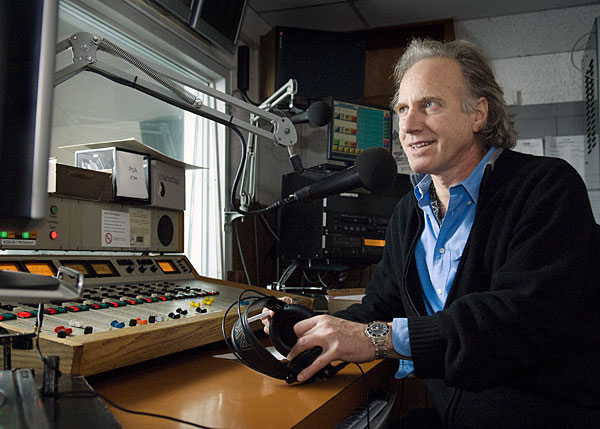
Robert Harrison, DJ for radio show "Entitled Opinions" (Photo: L.A. Cicero)

Before I attended the Workcenter’s I Am America the other night, I stopped by Cubberley Auditorium, where Robert Harrison was speaking about the communication between the living and the dead.  How could one resist such an intriguing topic?

T.S. Eliot said that “The communication of the dead is tongued with fire beyond the language of the living.” But the program was tamer: “the most ancient vocation of poetry – whether lyric or epic – is to keep open the channels of communication between the past and the present.”

Alas, because of the 8 p.m. curtain on the other side of campus, I didn’t get much farther than Rush Rehm‘s introduction (he called Robert “the most valuable humanist at the university”) before I had to dash.  But Robert kindly left me an intriguing scrap of what he’d said, inspired by Plato‘s Timaeus.

It begins with Critias telling Socrates an “old world story” that he had heard from his grandfather, who was over 90. The grandfather had heard it from his father, who had heard it from Solon the sage, who had heard it from an old priest during his visit to the Egyptian city of Sais.

...and Socrates told it to him.

“Athens, he declares, is even more ancient in its founding than the city of Sais, but the Greeks have no memory of its origins, due to the annihilations of its former civilizations.  These annihilations, brought on by periodic ‘declinations’ of the heavenly bodies, unleash ‘a great conflagration of things upon the earth.’ It was one of these conflagrations that destroyed Atlantis, an ancient civilization of which Solon’s Greek’s have no memory, even though it was their forefathers who thwarted the transoceanic Atlantean conquest of Europe.”

The old man concluded: “and so you have to begin all over again like children, and know nothing of what happened in ancient times, either among us or among yourselves.”

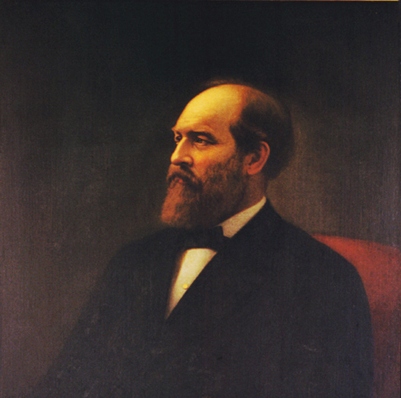
Then Harrison continued:  “Today we have the privilege of seeing this volcanic process at work up close, in technicolor, as it were, as the entire Christian-humanist civilization that slowly consolidated itself in the wake of Rome’s collapse unravels before our eyes.  It was said of President James Garfield that in moments of boredom or to amuse his friends he would take a pencil in each hand and compose sentences in Greek and Latin at the same time.

Ambidextrous

“If one considers that, as a student, Thomas Jefferson used to translate the Greek Bible into Latin, and vice versa, one realizes to what extent the ‘heavenly declinations’ have unleashed their fury upon the American presidency.

“It was not so long ago that a university professor in the classroom would typically leave Greek and Latin quotes untranslated. Then he began to provide a translation for the Greek but not for the Latin. Nowadays he must tell his students that there was once such a thing as the Greek and Latin tongues, that there was once a place called Athens, and so forth. Shortly the professor won’t know even that much. Oh he’ll know it, in a way, but he will not know what to make of it, and when you don’t know what to make of something you eventually forget about it.”

“By Love Possessed”? René Girard and John Freccero on Francesca da Rimini

Share

By literature possessed?

Patrick Hunt is off on his usual wanderings — this time he’s in London till the end of the month, but he did take time to drop me a quick note when he was  “again reminded how profound René Girard‘s impact has been on literature – not to mention other disciplines – in this Dante essay by John Freccero on Francesca da Rimini“:

The phenomenon of mimetic desire is at the center of the work of René Girard, one of the most powerful theorists of culture of our time. Perhaps because his early work on the novel has been overshadowed by his profound influence in anthropology, social studies and comparative religion, few students of Dante seem to know his essay of fifty years ago, dedicated to the canto of Francesca. In the briefest of terms, his point was that the desiring subject imagines, as does Francesca, that desire springs spontaneously from within, while the truth that is revealed by Dante and the greatest of novelists, is that desire is always triangular, “mediated” by the desires of the other—in this case, as in the case of Don Quixote, by a book. In a few mordant pages, Girard debunked the romantic reading of Francesca’s story, showing that it was simply a repetition of her own initial mystification. When Girard wrote, the best-selling love story of the time was entitled By Love Possessed; Girard’s title was polemic, summing up the delusion propagated by all such “romance” stories: “By Literature Possessed.” His point was that desire is essentially imitative, searching for a model, and that literature provides it with an imaginary map. Dante’s text was not complicit in “romantic” deception. On the contrary, Francesca’s last words exposed the roman as a panderer and seducer, leading the lovers to their destruction. Her story anticipated those of Chaucer, Shakespeare and Cervantes in the genre of the “anti-roman.”

Patrick added,  “I’ve heard Freccero lecture on Dante at Stanford, and only wish I’d heard Girard as well on Francesca and Canto 5 of the Inferno. I’ve written poems on this story – seemingly like everyone else! – and the tale of Francesca is nigh well eternal, as you know, and not just from Robert Browning onward. One magister’s encomium to another: from Dante to Girard to Freccero and this forthcoming book also has an excellent new essay by Robert Harrison on this same never-ending story. The haunting Ingres painting on this Dante passage is one of my absolute favorite ekphrases.”  Not to mention Tchaikovsky‘s opera.

Patrick’s own edited volume on the subject, Critical Insights:  The Inferno, will be out in September.  It includes Freccero’s essay.

Actually, I studied Dante with the world-renowned expert Freccero years and years ago — he assigned the Charles Singleton prose translation, he said, because we should never give up on learning the Italian.  I remember him emphasizing that the Paolo Malatesta, far from being the George Clooney of an earlier era, has become the voiceless lunk by Francesca’s side, and her attitude towards him is almost contemptuous.   “Amor condusee noi ad una morte.”

Making Waves

Share

Camarillo, Edelstein, Wampole, the Harrisons

Glass Wave, the “cerebral rock” group that links great classics to modern music, is continuing to make waves with its new CD.  An article appeared in the San Jose Mercury here:

A rakish band of Stanford professors and their cronies is rocking out through tune after tune in a university rehearsal space on a hot spring afternoon. No, this is not your typical rock band — its founding guitarist-songwriters are professors of literature, scholars of Dante and the French Enlightenment. …

As the band huddles to discuss its recording project (available on iTunes and from Amazon with samplings available at www.glasswave-band.com), electric bassist Tom HarrisonRobert [Harrison]‘s 54-year-old brother and a professor of literature and film at UCLA — says, “The literary arts are in decline. People don’t read anymore. So this is a tribute to the culture we teach. It’s an ideological statement.”

“I’d say it’s a salvage operation,” says brother Robert.

“Or a cultural transmission,” Tom adds.

And also in the Palo Alto Weekly here:

The band took the name “Glass Wave” from Ezra Pound’s “Cantos.” It echoes the sea-and-water theme that permeates the album, which begins with the wordless “Balena,” and includes the actual sounds of a humpback whale. The album concludes with “Moby Dick,” which tells Melville’s whale tale from the perspective of the great white.

While they’re not about to give up their day jobs to cash in as rock stars, and they laugh at the idea of making money from the album, the scholars in the band were musicians before they were academics. The Harrison brothers, who are the sons of an American father and an Italian mother, spent their high-school years in Rome. With their blond hair and American looks, they made “decent money” pretending to be touring rock musicians who had just flown in from the States. But if they inadvertently lapsed into fluent Italian at the end of a concert, they had problems getting paid.

Failing that, read my own story, here — or listen to Rush Rehm interview Glass Wave here.

“Cerebral rock” in the news…

Share
cd_glasswave_news

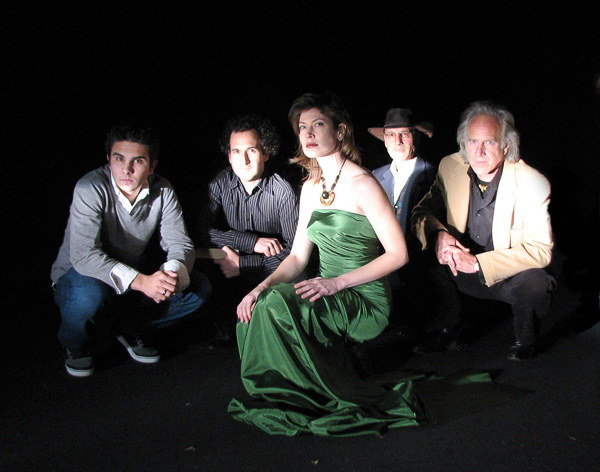
Camarillo, Edelstein, Wampole, Harrison & Harrison

“There are plenty in higher education who devote themselves to interpreting rock and roll as literature. Fewer devote themselves to the interpreting literature as rock and roll,” says Steve Kolowich in today’s  Inside Higher Ed.  Read the rest here.

He writes about the newest attempt, “Glass Wave,” a group that has just released a CDRobert Harrison (the Book Haven has discussed him here and here); his brother Thomas Harrison, a literature professor at UCLA (he’s taught courses on the music of Pink Floyd); Enlightenment scholar Dan Edelstein; and chanteuse Christy Wampole, a doctoral candidate in French and Italian with a background in cabaret; and Colin Camarillo, a Bay Area jazz drummer.  Last month, I wrote about the “Glass Wave” project here.

Harrison told Kolowich: “The lyrics can be absolutely fantastic. But if the music sucks, it’s going nowhere.”