
Byron’s wreath, today’s poets

Share

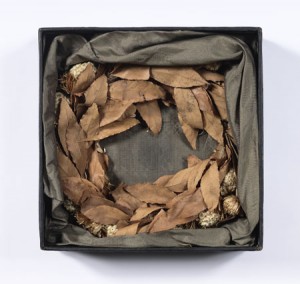
byronwreathLord Byron died in Greece, 1824.  His body was returned to England by sea on the brig Florida. Mourners lined the streets of London as the black-draped coffin and catafalque went to Great George Street, where it lay in state for a week.

The Greeks of Missolonghi had this laurel wreath (left) made for the coffin — he had been something of a freedom fighter in Greece. The laurel wreath of Byron was eventually returned to the people of Greece.

160  years later, archaeologist and author Patrick Hunt held it in his hands:  “In its old box, all dusty, faded and dried out, yet still intact and said to date from 1824, was this incredible treasure, poetic but real. I will never forget that this box was then placed in my hands.”
fields

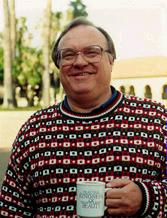
Ken Fields, earlier wreathed

So much so that he has reinstated the custom of laurels for his colleagues.  Weaving European laurels from his “Homeric” garden, he wreathed Al Young, then poet laureate of California, in 2007. He followed with British poet and Persian translator Dick Davis, poet Ken Fields, and Pulitzer prizewinning poets W.S. Merwin and  Ted Kooser, a former U.S. poet laureate.

Earlier this month,  he bewreathed John Felstiner (right), author of Can Poetry Save the Earth? (NPR discussed the book last April — podcast and story here.)
davis

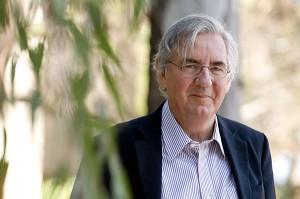
Dick Davis, another wreathed poet (Photo: Linda Cicero)

“I’ve been reading John’s work for decades, from his Neruda translations and essays on poetry to his articles in the American Poetry Review and many other achievements, so he’s formative to my own growth as a poet,” said Patrick. “He either knows personally or has worked with every other poet who has been recently wreathed in this revival of the classical tradition. Last but not least, he’s been a great encouragement to many poets who hold him in highest esteem.”
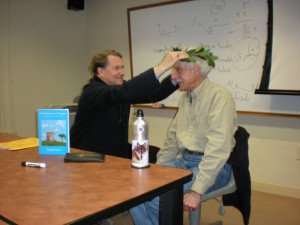
Hunt wreathes Felstiner earlier this month

Hunt wreathes Felstiner earlier this month

“John is not only a muse but a kind man,” he concluded.

John looked “historically right” for the occasion, which took place before a joint meeting of two of John’s current Stanford poetry classes, Patrick told a brief history of ancient laureates with laurel wreaths, also about having held Byron’s wreath in Greece in 1984 and how life-changing that event was. “Then I mentioned how this ancient tradition was being revived in some way with modern poets by using the laurel tree in our Homeric garden. Then John was wreathed…”
Dana Gioia to receive Laetare Medal

Share
dana

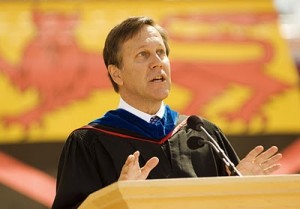
Dana Gioia (Photo: L.A. Cicero)

Poet Dana Gioia will receive this year’s Laetare Medal award at the Notre Dame University’s 16 May commencement.  Gioia is former chairman of the National Endowment for the Arts, as well as a poet, essayist, translator, librettist, and man of letters.

The Laetare award, instituted in 1883, is the U.S. Catholic Church’s oldest and most prestigious honor. Following the medal’s presentation, Gioia will offer an address alongside the commencement’s main speaker — this year, Brian Williams, anchor of the NBC Nightly News.

Previous  winners include John F. Kennedy, Sargent and Eunice Kennedy Shriver, Dorothy Day, Walker Percy, Dave Brubeck, Sister Helen Prejean, Daniel Patrick Moynihan, Helen Hayes, and Clare Boothe Luce.  You can read more here.

Gioia’s appointment to the NEA was about the only popular move made by the Bush administration, and one of the few that worked out well. Business Week hailed Dana in 2006 as “The Man Who Saved the NEA.

The award made headlines last year when Mary Ann Glendon declined the honor a month after her selection, and a few weeks before the ceremony.  Because of that, you’d have expected the award announcement this year to have made a little bit more noise.  But hardly a word so far — not even from the usually loquacious New York Times.  A google alert for my own name gave me a heads-up — many of the news clippings so far are citing my 2003 Commonweal article about Dana, which you can read in full here, and so I quickly emailed my congratulations to the poet, who now divides his time between California and Washington D.C.

I met Dana over a decade ago, when I was a free-lance journalist and cold-called him in his Santa Rosa home — a tiny photo of it here, with my profile in 2000.  If awards are given for one of the most generous spirits I know, it should go to Dana, patron saint of free-lance literary journalists looking for good sources and story ideas.  He is even better as a friend.

Linda Cicero’s photo above is from his address at the Stanford University commencement in 2007.  I wrote about that, too, here.

Congratulations, Dana!

The “Sheriff of Emptiness”

Share
ryan_news

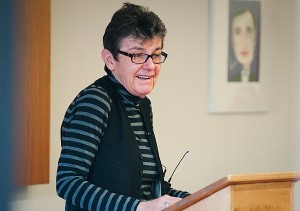
Kay Ryan (Photo: L.A. Cicero)

Kay Ryan, our current U.S. poet laureate, calls herself the “Sheriff of Emptiness.” I wrote about her today here.

I met Kay years ago, through Dana Gioia, another North Bay poet.  We had an interview at Kay’s Fairfax home in July 2004.  I had described the meeting in my notes this way:

“Ryan is waiting for me, but not idly.  She is re-grouting the colorful Puebla-style tiles, on the risers of her entryway.  She is short and solidly built.   In khaki shorts and a black t-shirt, however, she appears scrappier, more muscular than she might appear more fully dressed at her readings.  Her longtime companion, Carol, is in Mexico, and Kay is alone in her brisk, clean house.  She is alone, except for Wally, a pale-colored, ancient cat who is mostly bones and fur  – so old he has lost most of his senses, but not his sense of friendliness, and is nevertheless currently in disfavor.”  [He had urinated on something, as I recall — ED.]

Wally, alas, died soon after my visit.  But my connection with Kay lasted longer.  I remember her recalling her family’s move to the Mojave: “It was hot, it was empty.  I didn’t have any friends.  And it took me awhile to come to like it.  But now I really do feel I have the desert in my blood.”  Much like her poem “Blandeur,” she said,  “ I like the emptiness, I like the lack of features.  I like its featurelessness.  I like how any event is a big event.”

And I remember this comment about her 30-year teaching stint at the College of Marin:

Back to Marin .. you teaching remedial writing?

I teach very basic English skills.

I think the way you described it when I first met you was, “My Friend, the Comma.”

I introduce them to the concept of indenting.  We learn to capitalize certain words, and not capitalize others.  I go up through the paragraph – writing a paragraph with a topic sentence and primary supports.

Who are your students?51VW9lkcaxL._SL500_AA240_

They range from high school students to people in their fifties.  Many second-language students.  Lots of people who got off-course one way or another, through drugs, or through just a variety of difficulties in their life, so they didn’t get basic skills.  I like the people I work with.  I’ve never wanted to teach any advanced courses.  I like the sort of life-and-death teaching.  These are survival courses.  And I don’t like spoiled people.  I don’t like to do for people what they could do for themselves.  These people aren’t spoiled.  They’re not saying, “Entertain me.” They’re here to get what they need to have their gardening business.  Some are going ahead in school.  But for some…to get a job at Long’s.  To be able to write a note at the bank where they work.

I still admire Kay’s respectful and thoroughly practical outlook towards teaching the students who need it most.

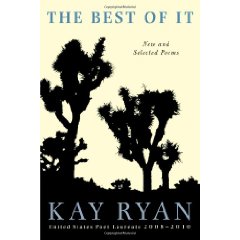
Speaking of the desert — here’s the cover of Kay’s new book, out this month:  The Best of It: New and Selected Poems.