
“Notoriously tricky territory”: Elizabeth Conquest on the literary legacy of Robert Conquest, a long marriage, and lots of letters

Share


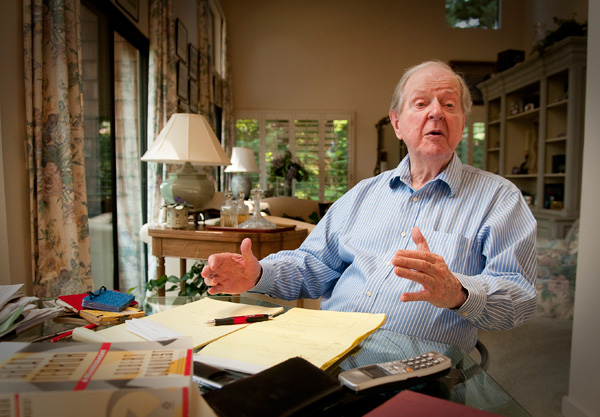
A marriage that was a “long conversation” … and plenty of papers, too. (Photo: L.A. Cicero)

We’ve written about historian and poet Robert Conquest before – most notably for the Times Literary Supplement here, but also here and here and here, among other places. About his widow Elizabeth Conquest – a.k.a. “Liddie” Conquest – we’ve said comparatively little. That’s about to change. She will be one of the panelists at the Another Look book club on Monday, April 30, discussing Philip Larkin‘s early novel A Girl in WinterBut you might also turn to the pages of the Tunku Varadarajan‘s article in this weekend’s Wall Street Journal, titled:  “The widow of historian and poet Robert Conquest talks about his legacy – which includes three books still forthcoming”.
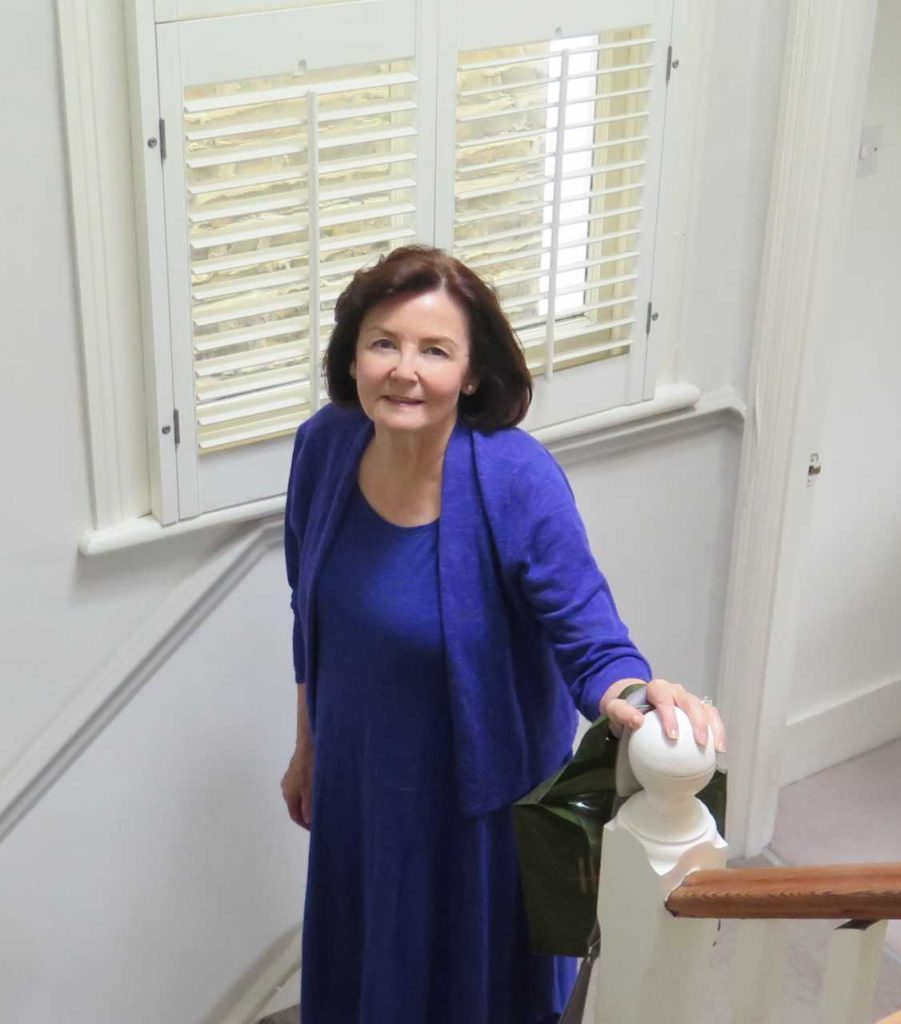
Liddie Conquest in London.

Robert Conquest was the first historian to chronicle Stalin’s murderous havoc. His book “The Great Terror,” published in 1968, was among the 20th century’s most influential works of investigative history. Yet Conquest was also a seriously accomplished poet and a prolific letter-writer. His correspondence includes letters to Amis and Larkin (880 pages to the latter alone), as well as to the novelist Anthony Powell and poets including D.J. Enright, Thom Gunn, Vernon Scannell, Wendy Cope and others …

Banker boxes full of papers cover practically every flat surface in the Conquest household. Sideboards, tables, floors and shelves—all heave with typed and scribbled sheaves. Not only is Mrs. Conquest readying “The Great Terror” for its 50th anniversary edition this fall, she’s editing his complete poems—more than 400, some never published—for publication next spring. She’s also editing his memoirs—he died with one chapter unwritten—as well as a fat volume of his correspondence.

“There are thousands of pages of letters that he wrote,” Mrs. Conquest says. “Bob warmed up before a day’s work by writing letters. He would sit at his typewriter and he’d fire off.” Toward the end of his life, he would dictate email messages to Mrs. Conquest, who sent them from their shared account. “He was never really fond of trying to figure out the computer.”

The lot of a literary widow, Mrs. Conquest says, “is not a happy one, for she must master the management of her husband’s literary estate.” But she doesn’t sound grumpy when explaining that she has a veto over the use of his writings, including the power to say yea or nay to any requests to reprint them. This is all “notoriously tricky territory,” Mrs. Conquest concedes, and such widows have “long been caricatured in writerly circles as pantomime villains”—the younger wife who “single-mindedly devotes her remaining decades after her celebrated husband’s death to championing his artistic legacy and slaying those who dare to question it.”

One of the many comments the combox: “Mrs. Conquest seems to be an absolutely wonderful woman.” We couldn’t agree more. Read the whole thing here.
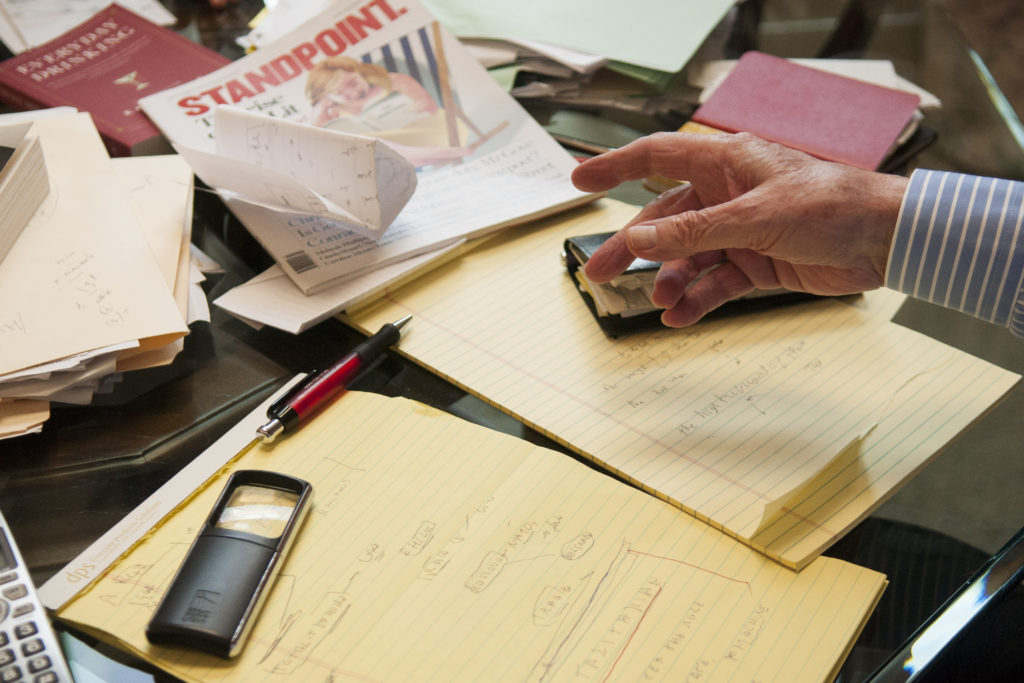
More papers: Conquest at work. (Photo: L.A. Cicero)
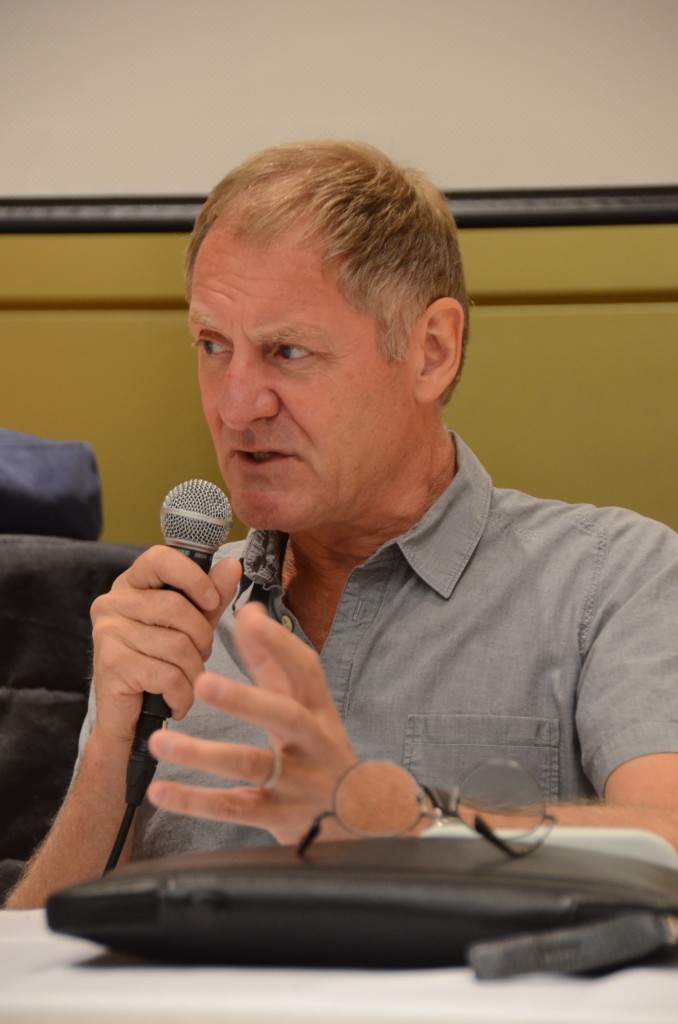

Biographer Andrew Motion remembers Larkin: “he was 53 coming on 153…and he looked like God.”

Share


AMotion1 copy

Love at first sight. (Photo: Gerry Cambridge)

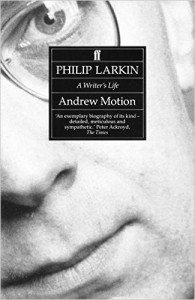
Sir Andrew Motion, former British poet laureate, read Philip Larkin‘s poetry in school and “immediately fell in love with him” – fell in love with him, despite obvious differences in their poetry and outlook. Eventually, Motion became an executor following Larkin’s death in 1985, and then his biographer. His 1993 Philip Larkin: A Writer’s Life won the Whitbread Prize for Biography.

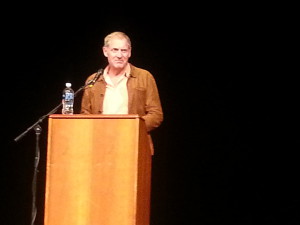
The youthful enthusiasm that became a sort of vocation left him feeling “fascinated, privileged, lucky.” Motion, currently teaching at Johns Hopkins University, told the story to an audience at the West Chester Poetry Conference last week. One of the conference founders, California poet laureate Dana Gioia, was interlocutor for the discussion.

That early affinity was part of the reason why Motion accepted an appointment at the University of Hull in 1976, when he was only 24 – Larkin was the university librarian at Hull. But proximity didn’t guarantee access. “Bad luck,” a colleague told him, explaining that Larkin hated everyone at the university, especially those who teach English.  “You’ll never meet him,” he was warned.

The colleague was wrong. The encounter finally happened at the university pub. “There he was,” Motion recalled. “He looked very much like I was expecting – and not as I expected. Taller, bulkier, looming, funeral-suited.” Larkin was fatherly, downright biblical – “he was 53 coming on 153.”

“He was ten years younger than I am now, and he looked like God.”

DGioia1 copy

Gioia (Photo: Gerry Cambridge)

The god-like Larkin took a huge swig of beer and it went down the wrong way.  Motion began thumping him on the back. “That was an icebreaker,” he recalled. Here was another: when Motion mentioned that his father was a brewer, “Philip’s face absolutely lit up.”

While Larkin was seen as austere and forbidding, when he was among friends, “he was the most charming man, deeply funny.”

Motion was later asked to be one of Larkin’s literary executors. “I said I would do it but please would he not die,” he said. Motion also warned Larkin to discard anything he didn’t want preserved – “he was to understand I would not throw anything away.” Motion was as good as his word: he saved many of Larkin’s papers from imminent destruction after his death. (But not before his diaries were shredded, page by page.)

Motion was perfectly positioned, after the nine-year friendship, to become Larkin’s biographer. “When Philip died, his Number One girlfriend” – presumably Monica Jones – “was sitting in a chair, smoking herself to death, sozzled, with unkempt hair, and dropping ashes on the floor.” She picked up Larkin’s address book and threw it at him. “Everyone you need to talk to is there,” she said.

20160608_212620

Reading his poetry (Photo: Anna Yin)

“He lived a very very discreet life,” said Motion. “He had lived his life in extraordinarily discrete compartments. We all do that to some extent.” All biography is a kind of invasion of the subject, however, and Motion had pangs of guilt.

“I had series of very peculiar dreams during period of writing about Larkin.” In one, Motion was speaking in an auditorium – and Larkin was sitting in the audience. Motion was remorseful in the dream, thinking, “Oh shit. I’d say none of this when he was still alive.” It was the guilt working through itself, he said.

Finally, Larkin appeared to him in a dream, with a collar made of hay. Motion interpreted that  “as a vision of him saying, ‘It’s okay.’”

larkinbookWhen Motion was named poet laureate, following the death of his predecessor, Ted Hughes, he redefined the role from a lifetime position to ten-year term. He said this allowed consideration of younger people for the office, and brought more vigor to the role.
His signal achievement was the creation of the Poetry Archive, a web-based library of English language poets reading their own work. It currently includes 400 recorded voices, and attracts 300,000 visitors a month. “I’m very proud, very pleased about the archive. It’s done a lot of good in the world,” he said.

It also refutes an argument that “come round like a sock in the washing machine” – that is, the claim that people don’t read poetry anymore. “We should probably cheer up,” he said. “More people listening to poetry than ever before, via things like archive.”

Postscript on 6/15: You may have observed that the earlier headline said “looked like a god.” I received this note from Gerry Cambridge (who took some of the photos above): “Cynthia great to meet you at West Chester. A wee observation: Andrew Motion actually said ‘… and looked like God’, not ‘…a god’. Which I think is funnier, if more risqué in some quarters.”

Philip Larkin on WWI: “Never such innocence again.”

Share
philip-larkin-1943-006

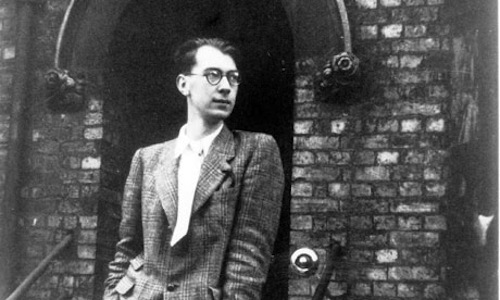
Larkin at Oxford in 1943, before “the failures and remorse of age.”

W.H. Auden‘s “September 1, 1939” was a World War II poem, without a single gun in it, and then had a powerful revival on 9/11. The New York Times recounted its newfound fame:

”Auden’s words are everywhere,” wrote the author of a ”Letter From New York” in The Times Literary Supplement of London. At least a half-dozen major newspapers reprinted ”September 1, 1939” in its entirety. It was read on National Public Radio. It was introduced into hundreds of chat rooms on the Internet. In the Chicago area, the Great Books Foundation and The Chicago Tribune sponsored discussions of it. Students at Stuyvesant High School, four blocks from ground zero in Manhattan, produced a special issue of their school newspaper (which The New York Times distributed to its readers in the metropolitan area) prominently featuring one of the poem’s most familiar lines, ”We must love one another or die.”

Surely, however, it shared the somber honors with Adam Zagajewski’s “Try to Praise the Mutilated World,” which appeared on the back cover of the New Yorker after 9/11.

zagajewski

Praising the mutilated world…

Could the poem for World War I be Philip Larkin‘s MCMXIV? It’s getting a lot of play this month, during the centenary of the beginning of the Great War.  The poem was first published in 1964, fifty years after the events it describes, in the collection Whitsun Weddings. 

A few words from critics about Larkin that I found along the way: Andrew Sullivan feels that Larkin “has spoken to the English in a language they can readily understand of the profound self-doubt that this century has given them.” X.J. Kennedy wrote that Larkin’s oeuvre is  “a poetry from which even people who distrust poetry, most people, can take comfort and delight.” J. D. McClatchy said that Larkin wrote “in clipped, lucid stanzas, about the failures and remorse of age, about stunted lives and spoiled desires.”

XCMXIV is only one remarkable sentence long  (mind the punctuation), and describes the enlistment of naïve young men at the war’s outset. Read it, and hear it, in the video below.