
Old friends, new friends, and more from the Monterey Coast

Share

When he wasn't starting forest fires, he was here.

Old friends, new friends:  Thursday’s post about reconnoitering with an old friend James Bryant, thanks to an Islamic prayerbook, fell into grateful and unfamiliar hands.

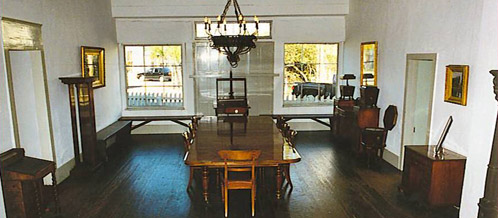
I received a pleasant note from Dwight Green, who was on his way to Monterey about the time he ran across my jottings.  He was already planning to visit the Robert Louis Stevenson house, where the author chilled while  awaiting the divorce of his wife-to-be. (“Yeah. It was complicated,” says Dwight.) I was pleased to discover that Dwight is a kindred spirit in the blogosphere: he runs the excellent blog, “A Common Reader”  – so you can read about his whole visit here.  He also points out that there’s some fascinating background about Stevenson’s stay in California here, But thanks to my heads-up, he also stopped into Carpe Diem and, given its excellent selection on California and the American West, resolved to save his pennies for the next visit.  (He also stopped into another Book Haven – no relation.)
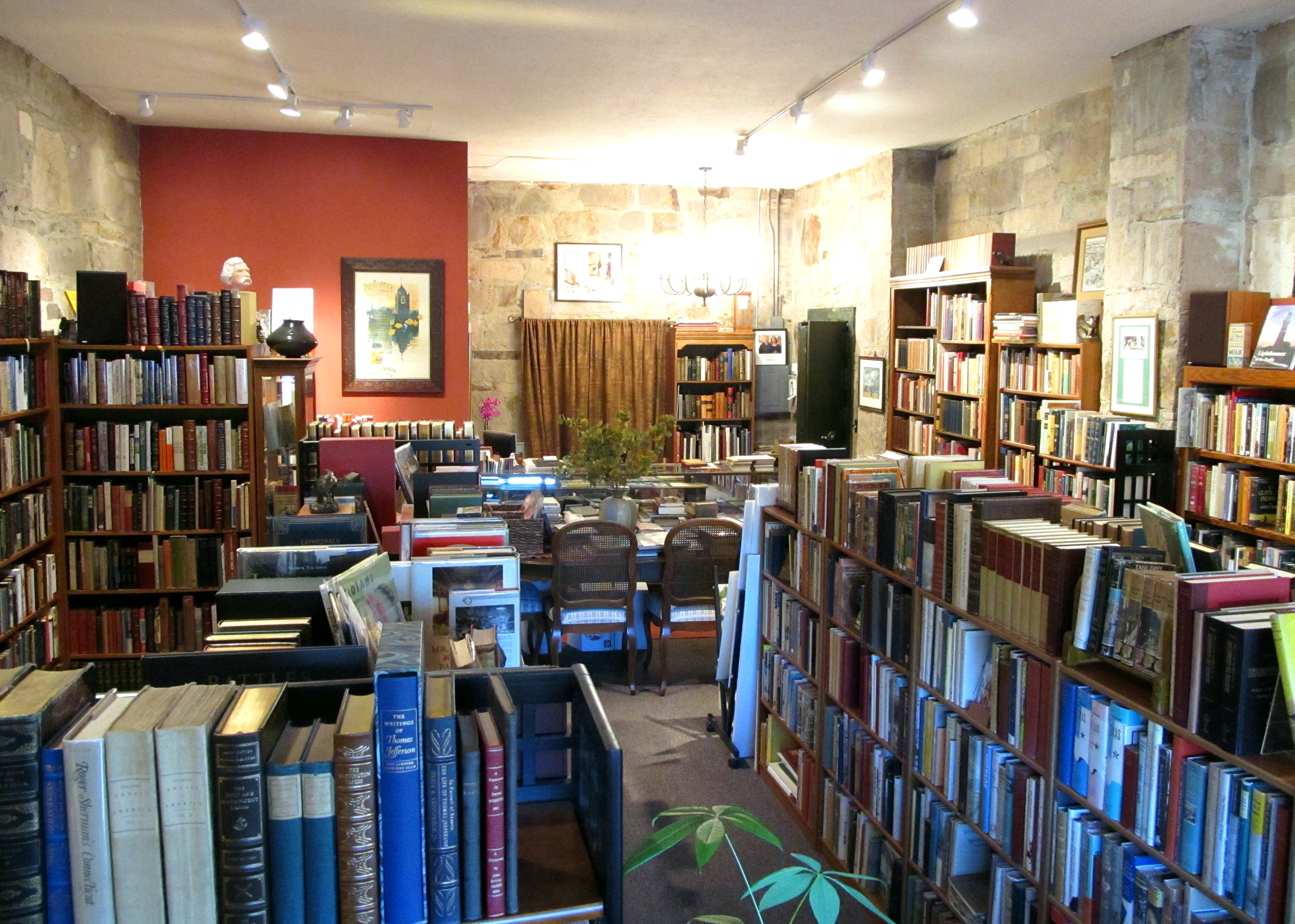
The crowded shelves of Carpe Diem

And do yourself a favor and make a visit to this rugged stretch of the Pacific coast yourself: “The waves which lap so quietly about the jetties of Monterey grow louder and larger in the distance; you can see the breakers leaping high and white by day; at night, the outline of the shore is traced in transparent silver by the moonlight and the flying foam; and from all round, even in quiet weather, the distant, thrilling roar of the Pacific hangs over the coast and the adjacent country like smoke above a battle.”

Meanwhile, what is it about famous authors and forest fires?  Are they just more careless than other people?  I wrote about Mark Twain, Henry David Thoreau, and burnt acres on the Fourth of July here – now this from the Robert Louis Stevenson website:

While in Monterey, RLS also started a forest fire. He was fascinated by the many fires that spring up in the Californian forests and wondered whether it was the moss growing on the trees that first caught fire. The moss did catch fire – and quickly spread. RLS later described the incident in “The Old Pacific Capital” (1880).

Otherwise, I’m having a quite day, transcribing notes and revising a draft. Hope you are enjoying Bastille Day in a livelier way.

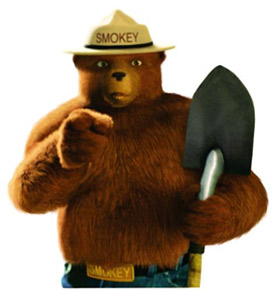
They started more than literary firestorms: Twain, Thoreau meet Smokey the Bear

Share

Fire and the 4th go hand in hand

Traditional 4th of July celebrations involve fireworks, campfires, sparklers, gunfire and cannons, and all sorts of other incendiary tomfoolery.  What better way to celebrate than with the tale of two inadvertent literary firebugs?

Twain scholar Shelley Fisher Fishkin apparently agrees, according to her new post on the Library of America’s “Reader’s Almanac” blog.

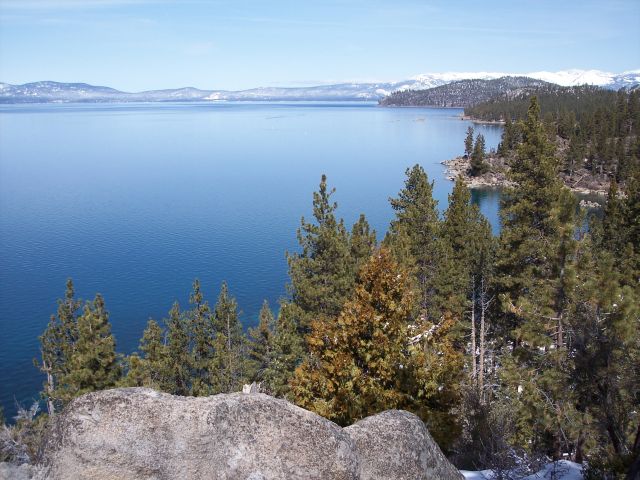
Here’s the story:  Through their own naïveté and carelessness, Mark Twain burned 200 acres of forest around Lake Tahoe. He failed to break Henry David Thoreau‘s earlier record of setting 300 acres of his beloved Concord woods aflame.

“Yet each man kills the thing he loves,” wrote Oscar Wilde.  He might have had Twain in mind, for Twain loved Tahoe with a passion that all later lakes failed to arouse.  Italy’s famous Lake Como was as nothing.  The renowned Sea of Galilee was a downright disappointment.  (I understood this completely when I saw the mud puddle called the Jordan River.  Where was the mighty, rolling river of the spirituals?  It occurred to me as I gazed at the sluggish, fetid waters that the slaves had the Mississippi in mind.)

“Three months of camp life on Lake Tahoe,” wrote the dazzled Twain in Roughing It, “would restore an Egyptian mummy to his pristine vigor, and give him an appetite like an alligator. I do not mean the oldest and driest mummies, of course, but the fresher ones.”

America's answer to Como, Galilee

Yet he built a campfire on the shore one autumn day in 1861 and left it unattended while he returned to his boat.  A gust of wind did the rest.

Seventeen years earlier, a stray spark from Thoreau’s campfire started a conflagration.  According to Shelley:

Both writers were struck by the “glorious spectacle” (Thoreau’s words) of the fires they had started; Twain found the “mighty roaring of the conflagration” to be “very impressive.” Neither Thoreau nor Twain showed much remorse for the destruction he had caused. “I have set fire to the forest,” Thoreau wrote in his journal six years later, “but I have done no wrong therein, and now it is as if the lightning had done it.”

Twain, at least, has not been forgiven.

Said Shelley:  “Last week I asked a firefighter at Fallen Leaf Lake, in the Tahoe Basin just south of Lake Tahoe, whether Mark Twain was still persona non grata in the area. He nodded grimly.”

Having fled my own home with suitcases and pets during two wildfires in that part of the world and stayed at home for a third close call, I can understand the firefighter’s umbrage.

Read the whole cautionary tale here.

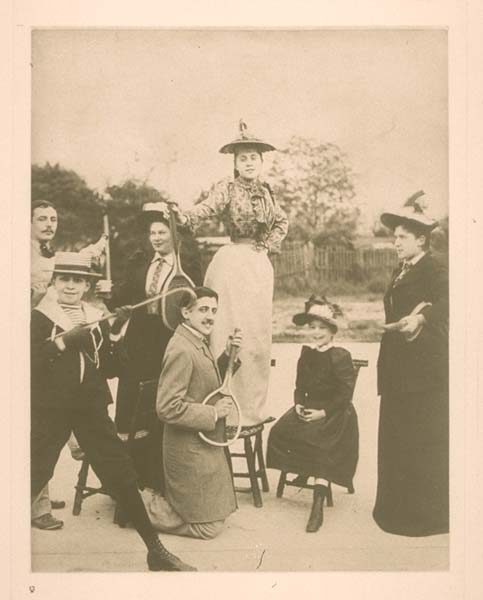
Marcel Proust playing air guitar

Share

OK, you’ve got to see thisSusan Sontag in a bear suit.  Flavorwire has Annie Leibovitz‘s photo of her partner thus outfitted – but go to the source, which is here, for a gallery of Leibovitz’s portraits, including some magnificent ones of Sontag.

Flavorwire’s “Extremely Silly Photos of Extremely Serious Writers” features Sontag as Exhibit #1, but some of them are more or less unsurprising. Mark Twain playing billiards, Ernest Hemingway kick a can, Hunter Thompson with an inflatable woman, Colette dressed as a cat – but this one takes the cake: Marcel Proust playing air guitar on Boulevard Bineau with his friends in 1892 (his mimetic beloved Jeanne Pouquet in center).  At this time of the photo, he was known as a snob, a dilettante, and a social climber.

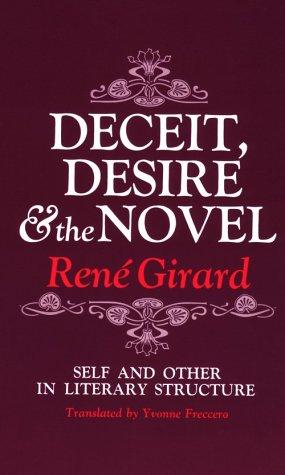
But the somehow sad image brought back the words of René Girard (recently the subject of a post here) from his landmark Deceit, Desire, and the Novel, which celebrated its 50th anniversary since publication a few months ago. His words:

“The sterile oscillation between pride and shame is also found in Proustian snobbism. We shall never despise the snob as much as he despises himself. The snob is not essentially despicable; he tries to escape his own subjective feeling of contemptibility by assuming the new being which he supposedly procures through snobbism. The snob thinks he is always on the point of securing this being and behaves as if he has already done so. Thus he acts with intolerable arrogance. Snobbism is an inextricable mixture of pride and meanness, and it is this very mixture which defines metaphysical desire. …

“The snob bows before a noble title which has lost all real value, before a social prestige so esoteric that it is really appreciated by only a few elderly ladies. … The snob seeks no concrete advantage; his pleasures and sufferings are purely metaphysical.”

The anonymous photo is from the Bibliothèque Nationale de France, which, incidentally, also has the René Girard archive.

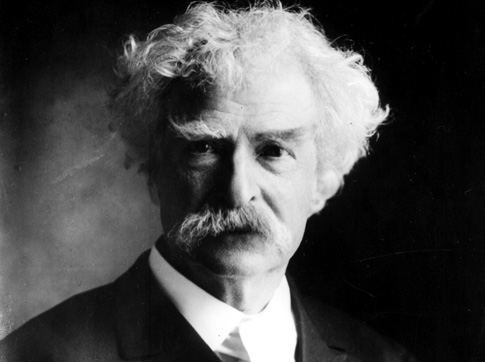
Mark Twain, filmed by Thomas Edison in 1909

Share

My peregrinations around the internet led me to this charming footage of Mark Twain, filmed by Thomas Edison at the author’s estate in Stormfield, Conn., in 1909 – one of the many wonders of youtube. Twain is shown walking around his home and playing cards with his daughters Clara and Jean. The flickering is caused by film deterioration.  This is the only known footage of the author of The Adventures of Huckleberry Finn. It is, of course, a “silent.”

A long day and a late night – more later.  I’d be curious, however, to hear what Twain expert and friend Shelley Fisher Fishkin thinks of this short film, 1 minute and 48 seconds long.

Sir Walter Scott’s Ivanhoe: Did they take out the “J” word, too?

Share

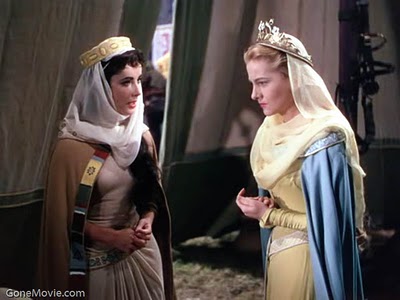
Liz Taylor and Joan Fontaine: 'scuse me, who's the heroine here?

Some time ago, we launched a firestorm about the controversial new edition of Mark Twain’s Huckleberry Finn that eliminates the “n” word altogether.

Now Sir Walter Scott‘s Ivanhoe is taking a thumping.  Apparently, modern readers find the 1819 novel, set in 12th century England, too ponderous and verbose.

According to an article in the Telegraph, a Scottish professor, David Purdie, has solved the problem with a pair of scissors:  he spent 18 months snipping it from 179,000 words to a mere 80,000:

While Prof. Purdie has retained the antiquated writing style used by Sir Walter, he has taken out the swathes of punctuation which extend the novel.

He said: “Very few people read Scott these days because he’s long and wordy and difficult for the modern ear and modern attention span.

“In the early 19th century, a comma was placed after every phrase, which makes it tedious reading.

Eliminating commas, however, does not account for cutting it down to less than half.  Last time I checked, commas didn’t count as words.

Some have questioned whether the book is so close to death that it needed this kind of life-saving surgery. Said, Professor David Hewit of Aberdeen University,  “The idea that Scott is neglected, no, it’s not neglected at all,” he said. “Ivanhoe is being well read.” He said that Penguin editions for the book had sold around 100,000 copies in the last decade, with worldwide sales of around 200,000 copies.

Moreover famous fans of Ivanhoe include Tony Blair, who said it he would take it to a desert island with him, and Ho Chi Minh, who praised medieval gallantry shown in the novel, as channeled by the Victorians.

Purdie appeared to have found an unexpected champion over at Billevesées. Blogger William V. Madison wrote about the novel earlier this month:

The plot that thrilled generations of readers is in constant struggle with Scott’s prose, which is verbose in the extreme. A character may typically take a long paragraph just to tell another to make haste, and my second-hand paperback edition provided very few notes (mostly Scott’s own, along with a thin glossary) to explain obscure terminology. (No attempt was made to explain the constant misuse of participles for past tense: “He sprung forth,” e.g.) Scott lards the story with “poetic” descriptions and song lyrics, and toward the end of the book, when poor Rebecca awaits her doom, Scott meanders off for several scarcely relevant chapters, sabotaging his own suspense. The resolution of the plot, hitherto relatively plausible, depends on one improbable death and an even more outlandish resurrection.

However – surprise! – Madison changes his tune:

In short, modern readers will find the odds stacked against them. And yet the damned thing does work. Almost against my will, I found myself caught up in the story, and this is largely due to Scott’s characterization, which in a couple of cases — notably the Jews, Isaac of York and his daughter — proves quite compelling. We feel so strongly the injustices they suffer that we care about what happens to them.

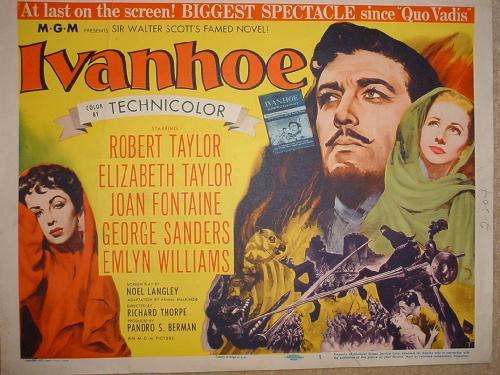
So much so that Scott complained after the novel was published why Ivanhoe didn’t elope with the Jewish Rebecca, rather than the boring shiksa Rowena.  That was even before the MGM movie that put a luscious Elizabeth Taylor in the supporting role.

It’s a fun read – Madison, I mean, not Ivanhoe (which I managed to read and enjoy as a teenager without too much trouble) – check out the whole thing here.  Madison even answers the eternal question why the evil Templar Brian de Bois-Guilbert doesn’t ravish Rebecca, as he had originally planned. It’s included in a long-lost fragment of the novel here.

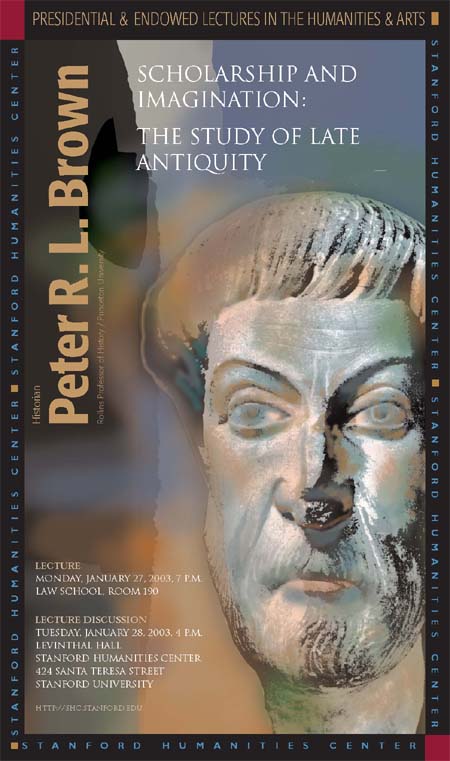
Postscript on 1/31:  A belated hat tip to Kevin Rossiter for the Telegraph article.  He put his own p.o.v. succinctly:  “I just object to the idea of making any work of literature ‘more accessible.’  Peter Brown gave a lecture at Stanford a couple of years ago and addressed the question, ‘Why would anyone want want to study late antiquity?’  He used a phrase I like a lot – he said late antiquity had a ‘salutary strangeness.’  I think that’s what great literary works often have, too.  A healthy departure from the unexamined and comfortable.”  See more on Peter Brown of Princeton’s lecture here.

The n-word controversy: Mark Bauerlein wraps it up in The Chronicle of Higher Education

Share

Earlier today, a friend mentioned that Mark Twain once said something like, “The easiest way to be recognized as a leader is to find a parade and get in front of it.”  I can’t find the quote anywhere — but as Ken Kesey said, I’m sure it’s the truth, even if it didn’t happen.

And it’s especially fitting in a day the Book Haven achieved a brief flicker of fame via Mark Bauerlein in The Chronicle of Higher Education‘s “Brainstorm” blog here. He retraced our steps in the Huck Finn and the n-word kerfuffle — “as far as I know, the controversy began with a blog post by Cynthia Haven here” — and then follows the twists and turns through Sam Gwynn‘s concerns and Alan Gribben‘s explanations to conclude masterfully:

Haven’s selections are illuminating, for in Gribben’s and Gwynn’s explanations the whole problem crystallizes. When Gwynn puts the n-word in CAPS, he registers its force, which explains why he feels justified in deleting it.  This is, however, to give the term a moral meaning that it does not deserve. Yes, the n-word has moral meaning, but in the classroom it should be circumscribed by its historical existence. To grant it so much power today, at this moment, is to be captive to the power it possessed in 1884 and in 1950.

Likewise, when Gribben terms the n-word ”now-indefensible,” he assumes a moral stance toward it that is misdirected. No teacher should approach the language in a book written more than 100 years ago as in a condition of defensible or indefensible. Assigning a work is not the same thing as endorsing it. It is to hold the work up to analysis.  Furthermore, one of the lessons of the assignment should be to recognize that one can analyze something that one deplores. Simply deploring it is not enough, we should tell our students. The deletion of the n-word in the novel does the opposite, teaching students to consult their sensitivities more than their intellects.  Thanks, Cynthia, for bringing the action into the light.

And thank you, Mark, for framing the history so succinctly and the issues so thoughtfully.  We now return to our accustomed obscurity.