
Who knew that Stalin was a lit critic?

Share

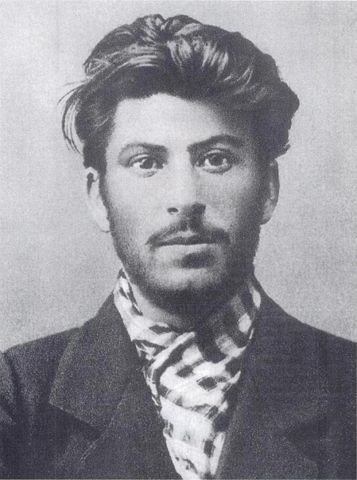
Everything you wanted to know and lots, lots more. (1902 photo)

Just can’t get enough of Jozef Stalin?  Yale University Press is putting lots more online.  Two decades ago, who would have thought that visitors to a public library could  pore over Stalin’s marginalia and notes? Thanks to an effort by the press and the Russian State Archive for Social and Political History,  Stalin’s personal archive has been digitized, including of thousands of documents, letters, and books. You can read about it here.

According to Vadim Staklo, who heads the project, the Stalin archives are the latest in a research and publishing program that has its roots in the Annals of Communism series that Yale started in the early ’90s, which has already unearthed rich material from the Communist Party archives. Said Staklo:

“The popular perception of Soviet leaders mainly comes from the movies – you know, sclerotic stodgy men with thick eyebrows and golden stars on the lapel,” says Staklo. “In real life however many early Bolshevik leaders were very active, lively unorthodox people from very different walks of life. Some were refined intellectuals, others came from humbler origins, some were good writers… and some knew how to draw. These are the images people drew in the margins during the long hours of party meetings. There are caricatures, and also satirical depictions of current events and issues. They went unseen for decades as most of the artists fell victim to repression. They’re not just pictures however – they tell a story about early Soviet politics and personal relations on the Bolshevik Olympus, and the problems they had to deal with on the daily basis.”

There was, for example, the man Lenin called “The Golden Boy of the Revolution” – Nikolai Bukharin.  We wrote about him here. He probably had lots of marginalia, too.  That might be why Stalin had him executed in 1938.

“The common perception is that Stalin was brutal, paranoiac and senseless. But if you read the notes he was making you can see that, yes he may have been brutal and paranoiac – but he was not stupid. For example, he was very keen on the arts as the most important vehicle for propaganda and he read every important play or screenplay offered by a theater or screenwriter. He read them carefully, and wrote long letters to the authors or producers with his comments. He also personally supervised and heavily revised the Short Course In The History of the Communist Party of the Soviet Union. This was one of the most important books in the USSR, and you can see that it went through many drafts and that Stalin essentially rewrote the entire volume completely.”

One rather wishes, in fact, that he had been less attentive.  His interest in Osip Mandelstam and his poems – in particular, some verse ridiculing the Soviet chieftain – proved fatal.   (Mandelstam wrote that the words and influence of this “Kremlin crag-dweller” and “peasant-slayer” on literature were “leaden,” his “fat fingers … greasy as maggots.”)  Mandelstam died in a transit camp in the same momentous year that killed Bukharin – 1938.

In a recent interview with Chris Wiman, who recently published some “versions” of Mandelstam’s poems, the editor of Poetry Magazine was asked: “Was there a sense in which the horrors of the Stalinist era ‘made’ Mandelstam as a poet?”  Wiman replied:

Honestly, I don’t think so, though they certainly made that one poem. The horrors have made the legend of Mandelstam and are inevitably the lens through which we read his work and life. But if there had been no Stalin and no purge, Mandelstam still would have been a poet of severe emotional and existential extremity.

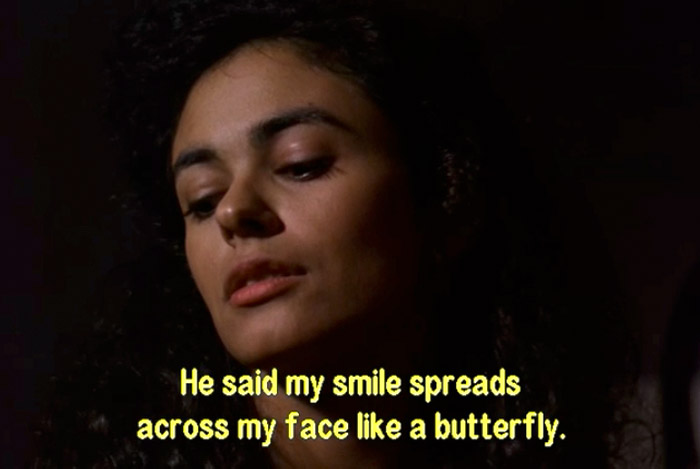
"The Sun!"

Then there’s this: Mandelstam was an artistic genius, the sort that any century produces only a handful of. If he hadn’t been driven mad and killed by Stalin, he might have managed to write something of Dantean proportions, that sort of huge unity and music. Dante, after all, was one of his literary gods: one of Mandelstam’s best pieces of prose is also one of the best essays on Dante ever written.
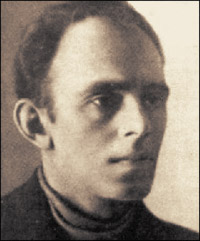
Joseph Brodsky would have agreed: ‘It’s an abominable fallacy that suffering makes for greater art. Suffering blinds, deafens, ruins, and often kills.  Osip Mandelstam was a great poet before the revolution. So was Anna Akhmatova, so was Marina Tsvetaeva. They would have become what they became even if none of the historical events that befell Russia in this century had taken place: because they were gifted.  Basically, talent doesn’t need history.”

In any case, Mandelstam had the last word after all.  Poets always do.

The ranks of human heads dwindle: they’re far away.
I vanish there, one more forgotten one.
But in loving words, in childrens’ play,
I shall rise again, to say – the Sun!
Another souvenir from Paris…

Share

My charming host

I’ve received another souvenir from Paris, following last month’s talk at the American University on “Old Wine in New Bottles: Literary Journalism as Cultural Translation.” This time the ever-gracious Center for Writers and Translators has added a few sound clips from the workshop session.

They described them this way:

She joined us to discuss the changing face of cultural and literary journalism, touching on Twitter, Polish poets Czesław Miłosz and Adam Zagajewski, her memories of studying with Joseph Brodsky at the University of Michigan, the unexpected heroism of Marina Tsvetayeva‘s husband, and how to review books that don’t exist.

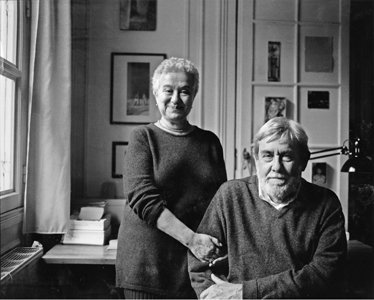
The sound clips are on the CWT website here. I share the new site with translators Richard Pevear and Larissa Volokhonsky discussing Nikolai Leskov. (I’ve written about the translating duo here.)

Dynamic duo

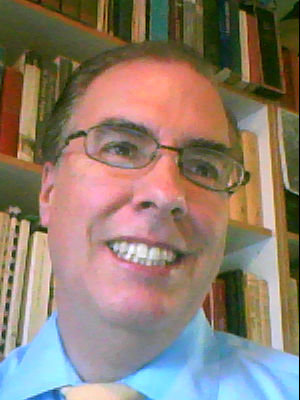
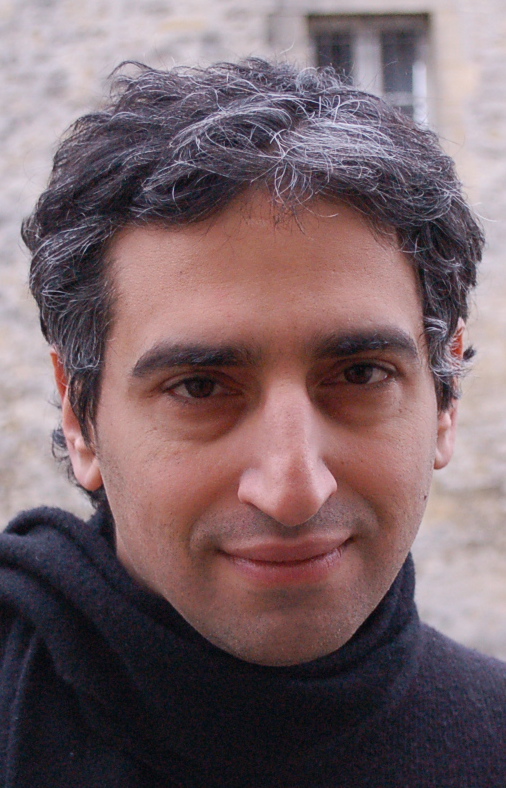
Meanwhile, my correspondence with my charming host for the visit, Daniel Medin, yielded this photo, more flattering (and more true-to-life) than the one I’ve used in earlier posts.

Daniel, by the way, is associate professor of comparative literature at the American University, associate editor of the Cahiers Series (we’ve written about that here), and the European editor of Quarterly Conversation (which I discussed here).

(Special thanks to Madeleine LaRue for coordinating the website effort!)

Pablo Neruda: Greatest pick-up artist evah?

Share

The conversation erupted on my Facebook page, debating the eternally recurring subject of unjust Nobel awards. It’s recently been revealed that J.R.R. Tolkien had been snubbed by the Nobel committee because his writing wasn’t up to snuff.

Other poor Nobel choices came to mind among my FB friends – the 1971 Nobel to Pablo Neruda over Tolkien?  Or over W.H. Auden, for that matter?  Or Jorge Luis Borges?  Or Vladimir Nabokov?

Another Nobel laureate, Octavio Paz called Neruda “the greatest bad poet of the century,” a much-repeated soundbite that sticks.  Yet Nobelist Gabriel García Márquez called him “the greatest poet of the twentieth century – in any language.” To which one can only reply Osip Mandelstam, W.H. Auden, Marina Tsvetaeva, T.S. Eliot, Czeslaw Milosz.

Our view of Neruda is now inevitably colored by his Stalinist politics.

Apologists say the Stalinists couldn’t possibly have known about the murderous excesses of the U.S.S.R.  Couldn’t possibly have known?  Despite a generation of slaughtered, imprisoned and exiled writers from Russia?  Despite a man-made famine that starved millions?  Despite the writings of Robert Conquest?  If Neruda had any questions, all he had to do was ask Czeslaw Milosz, who defected in 1950.  Instead, he infamously penned a denunciation of Milosz as “The Man Who Ran Away.”

There is nothing so dangerous to us as the thing we do not want to be true, the thing we turn our backs to.

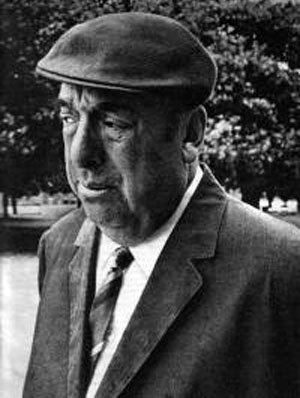
Not bad for a dumpy-looking guy

In time for the 2004 Neruda centenary, Stephen Schwartz (not a literary critic, but a conservative political commentator), wrote in a seminal article that has been cited all over the internet:

There is probably no more chance of halting this current binge of Neruda worship than there is of banishing the cicadas, but, still, the truth does need to be said: Pablo Neruda was a bad writer and a bad man. His main public is located not in the Spanish-speaking nations but in the Anglo-European countries, and his reputation derives almost entirely from the iconic place he once occupied in politics – which is to say, he’s “the greatest poet of the twentieth century” because he was a Stalinist at exactly the right moment, and not because of his poetry, which is doggerel.

So does Neruda’s poetry have a future?

Eternally.  On Facebook, my friend Kevin assured me that Pablo Neruda has enduring market value in the Spanish-speaking world for his … pick-up lines. Not bad for a dumpy-looking guy (see right).

Hard to argue that point – an award-winning film was made on precisely that subject, Il Postino/The Postman.  The plot: nerdy Italian postman wants to pick up pretty girl.  He befriends the exiled Neruda and voilà!  Plagiarism is born in a small Italian village.

As Schwartz himself admitted:

Yes, his work is still plagiarized by teenage boys in Latin America, who see his Twenty Love Poems and a Desperate Song and figure there is nothing wrong with borrowing from it–just as one poem in the book is itself stolen from Rabindranath Tagore – and presenting its overwrought lines to their girlfriends. But if those boys grow up to be serious writers, they leave Neruda behind.

No luck with the line

But Kevin had a story of his own.  During a summer studying at the London School of Economics, an attractive young Spanish woman caught his eye.  How to attract her attention? His friend Pedro (there were a lot of Spaniards around that summer)  said it was very important to open with a sure-fire line.  Neruda was the ticket.

A dormitory lunchroom discussion of Neruda and the art of line-by-line seduction followed.  The young woman demanded an example of a florid Iberian pick-up line: “Let me hear it.”

Kevin recalled the line Pedro had taught him:  “The sentence would be something like “Oh, cielito mío, que Dios me dió” [Oh, my little heaven, given to me by God].

“It’s the cheesiest thing in the world.  And she said, ‘Wow, that’s really good.’”

Did he get the date?  No.  But he learned his lesson: “That’s how it’s done in España.”