Sara Kramer of the NYRB Classics dropped me a line yesterday to let me know that my submission for “A Different Stripe” had worked its way to the top of the “Coffee and Classics” stack (that must be some backlog; it’s been five months); see it online here. (And send your own submissions to this address.) The book I featured is Vassily Grossman‘s Life and Fate. Helen Pinkerton sent us a mini-review here, calling it “possibly the greatest novel I have ever read”. The wartime book was judged so dangerous in the Soviet Union that not only the manuscript but the ribbons on which it had been typed were confiscated by the the state. Many readers are coming to share Helen’s opinion about its greatness. Author Martin Amis, for example, said that “Vasily Grossman is the Tolstoy of the U.S.S.R.”
Meanwhile, the submission gave Sara a chance to reread the bleak Christmas scenes from the book:
The soldiers … dragged another crate up to the stove, prised open the lid with their bayonets and began taking out tiny Christmas trees wrapped in cellophane. Each tree, only a few inches long, was decorated with gold tinsel, beads and tiny fruit-drops.
The general watched as the soldiers unwrapped the cellophane, then beckoned the lieutenant towards him and mumbled a few words in his ear. The lieutenant announced in a loud voice:
“The lieutenant-general would like you to know that this Christmas present from Germany was flown in by a pilot who was mortally wounded over Stalingrad itself. The plane landed in Pitomnik and he was found dead in the cabin.”
—Vasily Grossman, Life and Fate, translated by Robert Chandler
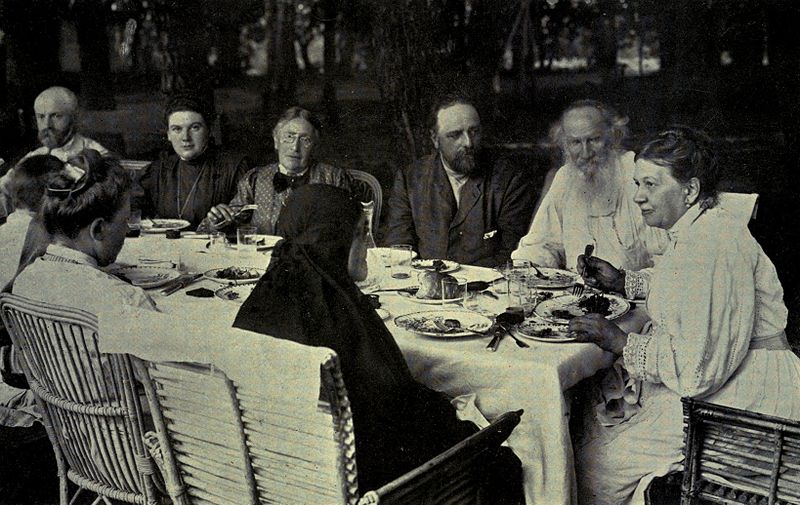
The family circle at Yasnaya Polyana, about 1905, before the nutters took over.
We’re rather on a Leo Tolstoy kick over here, aren’t we? But how can we help ourselves? We just found these two film clips of the author’s last days. Lots of snow and horses, as you’d expect – then Tolstoy in death, laid out on a bed with flowers, and the funeral procession, with what looks like thousands of peasants.
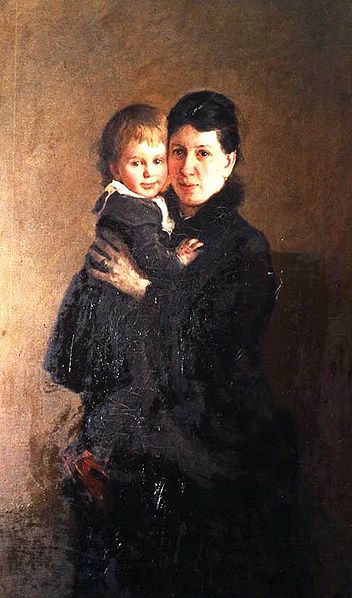
Sophia and daughter Alexandra in a portrait by Nikolai Gay
The first clip is taken from 1969 BBC series Civilisation: A Personal View by Kenneth Clark, and the longer, Russian clip is second (it includes earlier footage from 1908). The 82-year-old writer died at the out-of-the-way rural train station in Astapova, weakened by his sudden decision to renounce everything and hit the road. According to Sir Kenneth Clark in the video, “He left his wife, his comfortable estate and his wealth and traveled 26 hours to Sharmardino, where Tolstoy’s sister Marya lived, and where he planned to live the remainder of his life in a small, rented hut.” (Thanks, Open Culture, for bringing the clip to our attention.)
Comfortable? We think not.
Of particular note is the first clip’s comments on Tolstoy’s “demented” wife Sophia. She’s taken a lot of bad press over the years, but she finally has a champion: Alexandra Popoff, author of 2010’s Sophia Tolstoy: A Biography, writes on her Sophia Tolstoy website: “She was central to his creativity and it is impossible to imagine his life and works without her.” According to the biographer:
Sophia was judged by her final year with Tolstoy and by people hostile to her — the great man’s disciples, particularly Vladimir Chertkov, a vain man who wanted to establish himself as the person closest to Tolstoy. He led a smear campaign against Sophia and described Tolstoy’s marriage as martyrdom.
To understand why there are still many misconceptions about Sophia and her role we need to know that for most of the twentieth century it was impossible to publish essential documents in her favor. …
The character of this remarkable woman was unlike the portrayals. She handled Tolstoy’s publishing affairs and their family’s business affairs, while also raising a large family. I was impressed with her capacity for hard work: a mother of 13, who herself nursed and educated their children, she was also a successful publisher, translator, and photographer. A lot of her labor went into Tolstoy’s novels, which she copied and produced. She also worked alongside Tolstoy during the famine relief.
The comment rather puts the lie to this one, by James Meek in a Guardian article giving Anna Karenina another reading: “I’m not sure Tolstoy ever worked out how he actually felt about love and desire, or how he should feel about it. He was torn between compassion and moral rigour, between lust and self-denial, between loving his wife and being bored by her. His uncertainty is reflected in the dual portrayal of his wife in Anna Karenina – as the virtuous, somewhat frumpy Dolly, worn out by childbearing, like the woman his wife was when he was writing the book, and as the feisty, pretty teenager Kitty, like the woman his wife was when he married her. They must have seemed to contradict each other, yet each was true to her time; and Tolstoy, for all that he was a master of time, was only a slave to truth.”
Surely if he were a slave to truth he would have noted that frumpy older wives hadn’t necessarily bargained for paunchiness, baldness, flatulence, snoring, and flourishing mid-life nose hair.
As is often the case, Tolstoy’s enemies were no more alarming than his so-called friends, for instance, the pilgrims who swarmed Yasnaya Polyana: a shifting mass of philosophers, drifters, and desperados, collectively referred to by the domestic staff as “the Dark Ones.” These volatile characters included a morphine addict who had written a mathematical proof of Christianity; a barefoot Swedish septuagenarian who preached sartorial “simplicity” and who eventually had to be driven away “because he was beginning to be indecent”; and a blind Old Believer who pursued the sound of Tolstoy’s footsteps, shouting, “Liar! Hypocrite!”
Meanwhile, within the family circle, Tolstoy’s will was the subject of bitter contention…
“You are certainly my most entertaining student,” said my adviser when I told her my theory. “Tolstoy— murdered! Ha! Ha! Ha! The man was eighty-two years old, with a history of stroke!”
“That’s exactly what would make it the perfect crime,” I explained patiently.
The incomparable patron saint of bloggers, Dave Lull, alerted me to a Guardian interview with one of Britain’s foremost playwrights, Tom Stoppard, who created the screenplay for the latest film version of Anna Karenina, which we wrote about yesterday.
I don’t think Tom Stoppard quite gets it. “What Tolstoy is on about is that carnal love is not a good idea,” he says, although Tolstoy seemed to have a pretty good idea what it was about in Anna Karenina and War and Peace (before marrying the vivacious Natasha off to the rather inept Pierre, with whom she’s rather happy by the end). Stoppard seems to miss the point that almost all societies except our own regarded unregulated passion as a kind of madness, and a destructive force in society. After all, Anna’s young son is left motherless at the end of the novel, and a good many other lives are disfigured. Tolstoy might have argued that there is no such thing as a personal life, and personal choice. That’s why he has the Levin chapters.
There’s the additional problem that the Levin chapters of the novel contain many long discussions about local government, and estate management. “It’s as though,” Stoppard jokes, “Tolstoy took the big essay at the end of War and Peace and said to himself, ‘I’d better spread this through the whole story next time.'”
But Levin (modelled on Tolstoy himself) is important. The parallel, shy relationship between Levin and Kitty (superbly played by Domhnall Gleeson and Alicia Vikander) is used by Tolstoy to counterpoint Anna’s affair. “For a while,” Stoppard continues, “I thought we should ignore everything and just go hell for leather, and into, and through, and out of, this relentless love affair. I was going to make it like a very fast modern movie, which was all about being in lust.” In the end, he says, “wiser counsels prevailed, including my own”.
Apparently, the proscenium arch, stage device the film uses was not Stoppard’s idea at all, but rather director Joe Wright‘s, which comes rather as a relief.
“He called me up, and said, ‘Can I see you urgently?’ He came round with a big file and exhibited his idea – essentially that the Moscow and St Petersburg scenes should take place in a 19th-century theatre – on my kitchen table.”
Was this to do with budget problems? Stoppard shakes his head. “Joe needed a concept to get excited about doing the novel as a movie. I think he talked to Keira about it – Pride and Prejudice had worked out really well for them – and this was what he came up with.”
Once again the proscenium arch is hot news. It sounds a lot like Ingmar Bergman‘s Magic Flute of 1975. It was hot news way back then, too, and made for a charming production of Mozart. Since we are speaking of happy marriages … Levin’s, anyway … I include a clip below of the sweet and magical reunion of Papageno and Papagena at the end of the opera. Hard to top that one for marital bliss. Meanwhile … Jude Law. I’m now convinced he’d be a dynamite Alyosha (moving from Tolstoy to Dostoevsky). I don’t think his Karenin is “pinched and prim” at all (according to Peter Bradshaw in the Guardian review), given the total destruction of his life Karenin is facing – see what you think in the clip below, which includes a typically Tolstovian lecture on fidelity and love, although I don’t see why cattle have to be insulted.
The Telegraphseems to be going all-out for the new film of Leo Tolstoy‘s Anna Karenina, which premiered in London today. David Gritten‘s article on the film yesterday linked to a range of video clips and earlier articles.
Here’s Gritten’s verdict:
“Whatever faults Tom Stoppard may possess as a screenwriter and Joe Wright as a director, timidity cannot be counted among them. Their collaboration in bringing Tolstoy’s imposing Anna Karenina to the big screen is one of real audacity: even on the rare occasions it falters, you have to applaud the ambition.
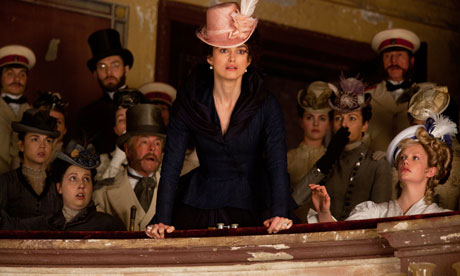
“Between them, Wright and Stoppard have filleted and condensed this doorstep of a novel into two hours of screen time, fashioning it into a swirling, swoony, achingly romantic tragedy. Stoppard’s witty conceit is to present the story of doomed heroine Anna literally as a piece of theatre, played out beneath a proscenium arch with its own backstage, curtain and audience. But magically and playfully, Wright’s cameras open up the confines of the stage to expansive, exterior vistas. It’s dazzling to watch.”
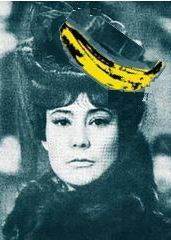
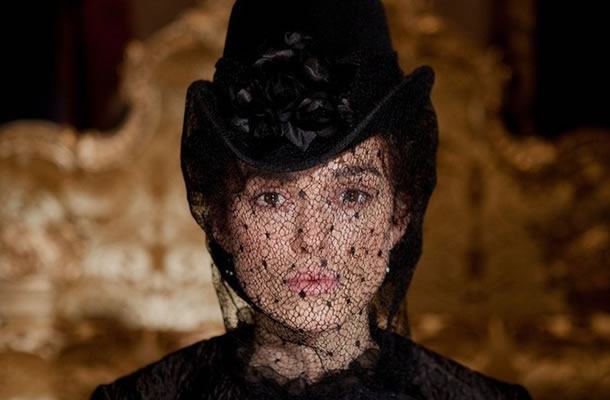
Keira Knightley imitating Banana Karenina
A few days ago we suggested Jude Lawfor Alyosha Karamazov. Apparently, he’s more of a Tolstoy man; according to Gritten: “Jude Law pleasingly reins himself in as her husband Karenin – a dull, virtuous public man.”
Says the Top Banana: “I think Jude Law as Karenin is casting genius! I’m curious if they chose him for his ears, and also if they did anything special to make them stick out more. I kept trying to freeze the trailer to get a better look, but the ears always got away! Maybe I need a new video card.”
“I also appreciate how, according to the Telegraph review, Wright and Stoppard ‘filleted and condensed this doorstep of a novel into two hours of screen time.’ I think filleting a doorstep must have been an artistically exhilarating project. I hope very much that this phrase will soon be adopted into wider circulation.”
"Why did people ever like novels to begin with? Because they used to love lies? No way."
I somehow missed the kerfuffle about Mike Daisey’s “monologue” about the terrible working conditions in Apple’s Chinese factories, “The Agony and the Ecstasy of Steve Jobs.” Another chapter in the long history of fabricated memories, which became the subject of a painful retraction last month.
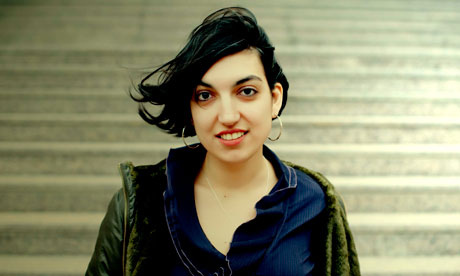
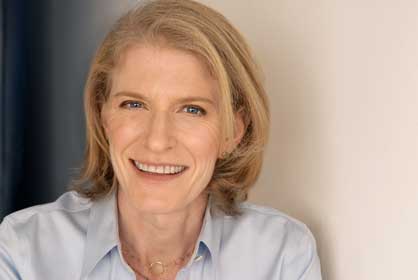
Is the truth more compelling than any attempt to fictionalize it? “That’s what I always tell myself when I’m being fact-checked, and some detail I was attached to turns out not to be true,” she told interviewer Sean Carman. “I’m initially disappointed, and maybe discouraged that now there’s more work for me to do, but I know that 99.9% of the time there’s actually something there, in the truth, that’s more interesting than whatever I or anyone else can make up.
“When you invent something, you’re drawing on reservoirs of knowledge that you already have. It’s only when you’re faithful to the truth that something can come to you from the outside. … something maybe less neat but richer and stranger.”
In general, she’s more interested in the audience for fibs, rather than the fibbers themselves, and “figuring out why and how anyone believed it – why they needed to believe it”:
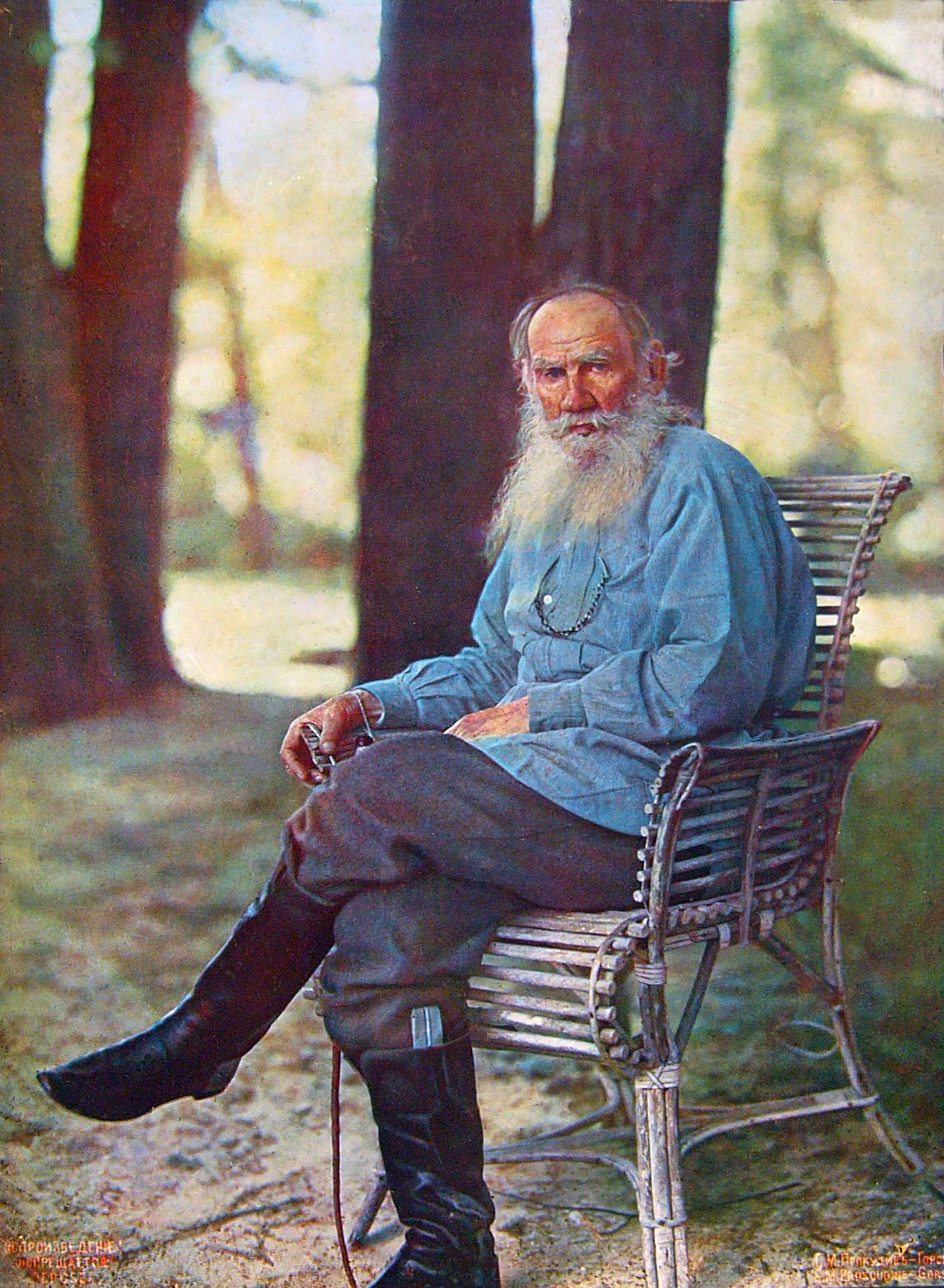
He did his homework. (Russia's first color portrait, 1908)
They want it to be true. And it’s actually an odd thing to want. The rationale is that people these days are no longer interested in novels, because we live in a newsy age, we care about facts, we care about the truth. But I mean, why did people ever like novels to begin with? Because they used to love lies? No way.
When you’re reading a novel, I think the reason you care about how any given plot turns out is that you take it as a data point in the big story of how the world works. Does such-and-such a kind of guy get the girl in the end? Does adultery ever bring happiness? How do winners become winners?
Just because a book is labeled as a novel, you don’t assume it happened in La La land and has nothing to do with reality. It just means that the novelist has processed, consolidated, or edited his experiences and observations, to tell a story. Which obviously happens in a memoir, too. It’s a difference in degree, not a difference in kind. That’s why I find it weird when you walk into a bookstore the most privileged distinction is between fiction and nonfiction.
When Tolstoy wrote War and Peace, he did a ton of historical research about Napoleon – he spent ages in archives, reading letters and diaries, many of them written by his wife’s relatives. In general, in his career, he borrowed a lot of plot details from the lives of his in-laws. I bet if Tolstoy was writing now in America, there would be a lot of pressure on him to do War and Peace as a nonfiction book – like, tracing the domestic and personal life of his wife’s grandmother through journals and letters, interwoven with his own philosophical musings about the Napoleonic wars. But Tolstoy didn’t think he was detracting from the truth-telling power of his book by writing it as a novel.
Final excerpt:
We hear a lot these days about two opposing tendencies in literature. On the one hand, there’s a tendency away from the novel, toward nonfiction. On the other hand, there’s a tendency away from objective journalism, toward memoiristic or essayistic nonfiction. They’re opposing tendencies, but they both reflect an anxiety about how much we can trust facts. We expect facts to give us objective truth, but objective truth keeps eluding us. We move away from the novel, because the novel isn’t factual; but in our nonfiction writing, we feel constantly compelled to cast doubt on our access to objective facts. We hire teams of fact-checkers to track them down. Fact-checkers do a lot of great work, but they can’t solve the nature of reality for us.
We all feel a little burned out after New Year’s celebrations, and I’m no exception. So here are some notable literary resolutions to fortify and inspire you for the coming year:
No commas, please
Ben Greenman, author of the short story collection What He’s Poised to Do: “I want to reread all the Emily Dickinson poems, in order, at a slow enough rate that I understand them but a fast enough rate to keep it exciting. It’s not as easy at it sounds. And I also plan to think about why, in a time of reduced attention spans, short stories aren’t getting more traction.”
Elissa Schappell, author of the short story collection Blueprints for Building Better Girls: “It’s the Russians. It’s always the Russians. Oh yes, I’ll read the Russians in the summer months. Two summers ago, I developed such a bad case of Tolstoy‘s elbow from hauling around War and Peace I could barely flip through a magazine. The summer before Crime and Punishment doubled as a drinks tray at a lawn party, and when I got spooked staying alone at a friend’s summer house, I kept it by the door as a weapon. This year, however I’m more hopeful–I’m starting, more appropriately, in winter. Beginning tomorrow I’m going to make Anna Karenina my new BFF.”
The Russians are coming
James Hannaham, author of the novel God Says No: “This year I want to figure out why, when an author says the phrase ‘working on a story collection,’ as in ‘I’m working on a story collection,’ everyone in publishing reacts as if they have instead heard the phrase ‘molesting several children.’ And I will continue to pray for the demise of e-books, or at least the demise of the stupid fear that they will replace printed books.”
Richard Lange, author of the 2013 novel Gather Darkness (Mulholland): “I’m going to reread Moby Dick, Crime & Punishment, and The Scarlet Letter. Every time I go back to books that I loved as a kid, I learn more about myself as a writer now.”
Marisa Silver, author of the short story collection Alone With You: “Read more poetry. Use fewer commas.”
Meanwhile, Dave Barry reviews 2011: “It was the kind of year that made a person look back fondly on the gulf oil spill”:
Multiple committees, strongly held views
This was a year in which journalism was pretty much completely replaced by tweeting. It was a year in which a significant earthquake struck Washington, yet failed to destroy a single federal agency. …
But all of these developments, unfortunate as they were, would not by themselves have made 2011 truly awful. What made it truly awful was the economy, which, for what felt like the 17th straight year, continued to stagger around like a zombie on crack. Nothing seemed to help. …
As the year wore on, frustration finally boiled over in the form of the Occupy Various Random Spaces movement, wherein people who were sick and tired of a lot of stuff finally got off their butts and started working for meaningful change via direct action in the form of sitting around and forming multiple committees and drumming and not directly issuing any specific demands but definitely having a lot of strongly held views for and against a wide variety of things. Incredibly, even this did not bring about meaningful change. The economy remained wretched, especially unemployment, which got so bad that many Americans gave up even trying to work. Congress, for example.

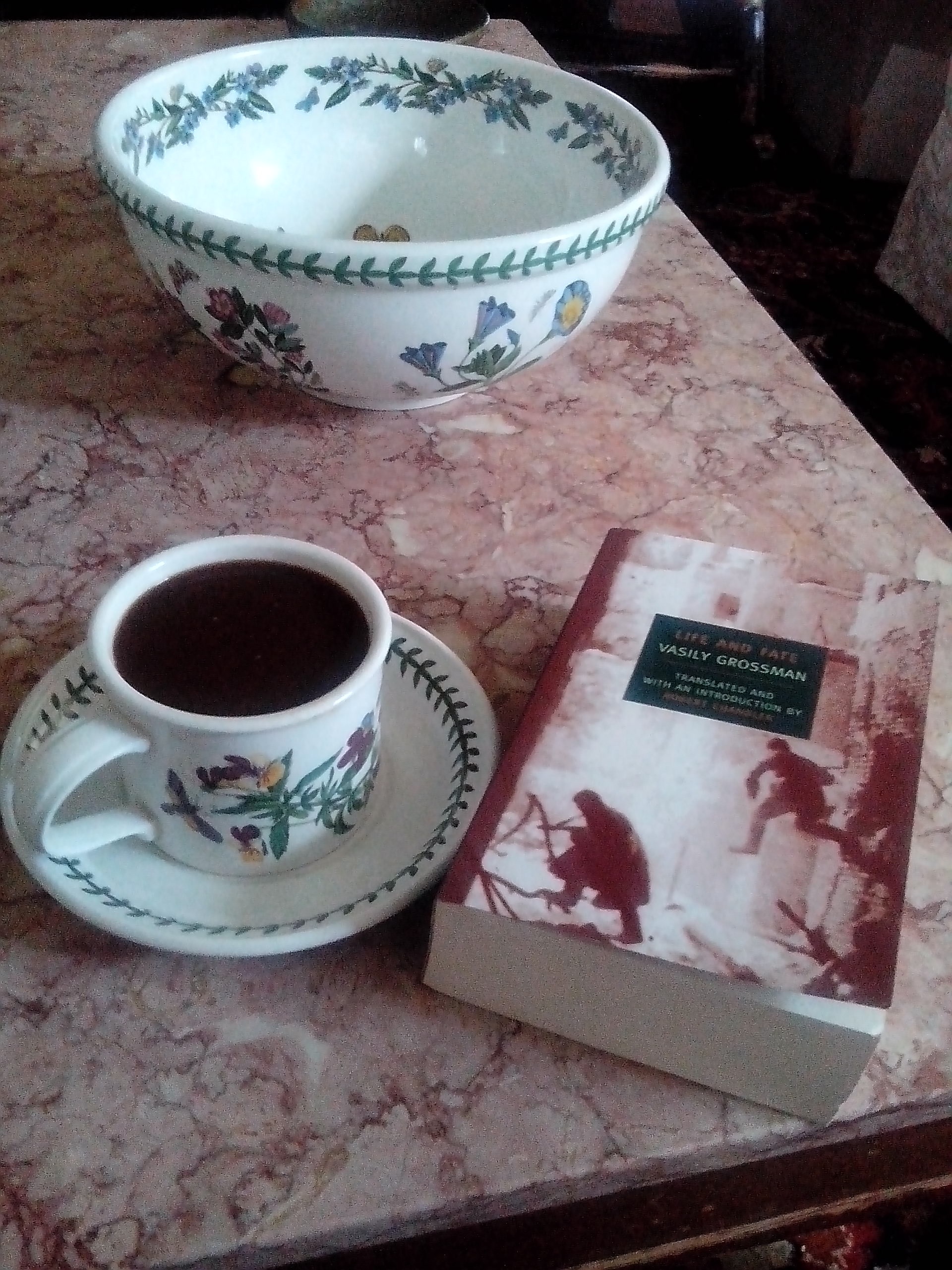 Sara Kramer of the NYRB Classics dropped me a line yesterday to let me know that my submission for “A Different Stripe” had worked its way to the top of the “Coffee and Classics” stack (that must be some backlog; it’s been five months); see it online here. (And send your own submissions to this address.) The book I featured is Vassily Grossman‘s Life and Fate. Helen Pinkerton sent us a mini-review here, calling it “possibly the greatest novel I have ever read”. The wartime book was judged so dangerous in the Soviet Union that not only the manuscript but the ribbons on which it had been typed were confiscated by the the state. Many readers are coming to share Helen’s opinion about its greatness. Author Martin Amis, for example, said that “Vasily Grossman is the Tolstoy of the U.S.S.R.”