

Poet D.A. Powell: “Why not celebrate?”

Share

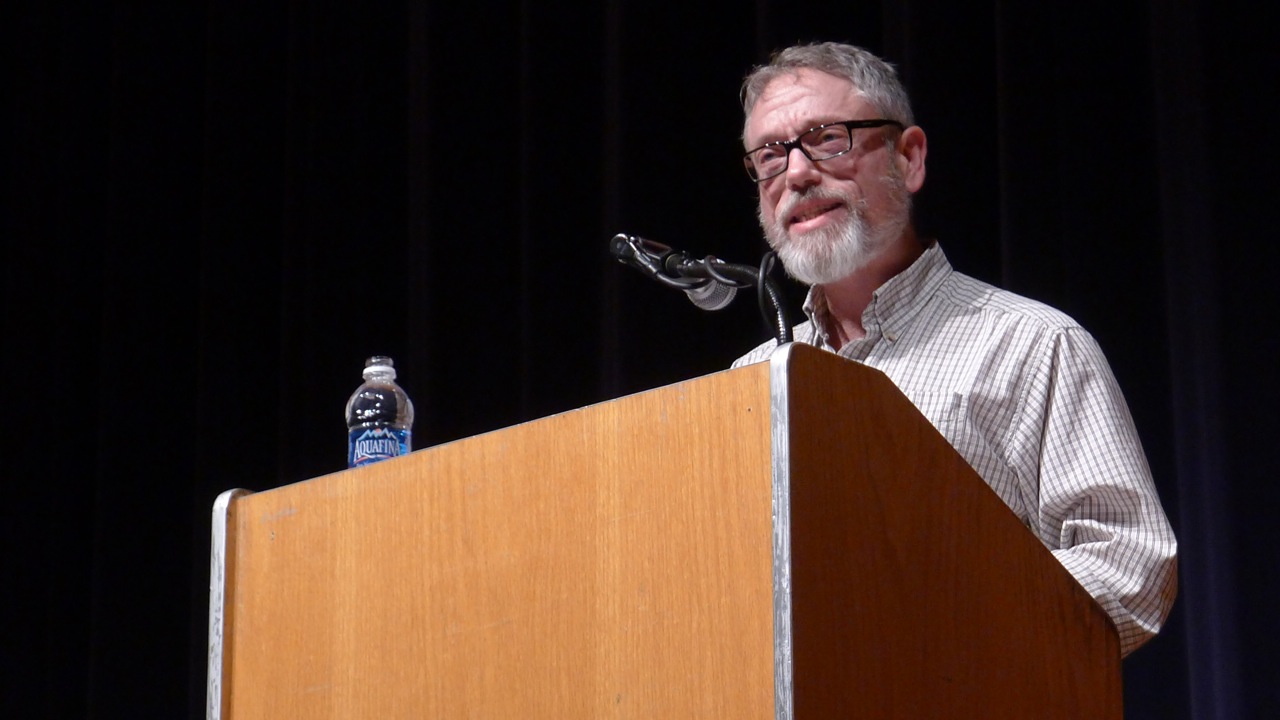
D.A. Powell: Career as playwright nipped in the bud (Photo: Ken Fields)

Poet D.A. Powell didn’t begin as a poet.  Early on, he said, “I conceived of myself as a budding playwright.”  He told a noon gathering at Stanford today that he “has some sense of pride” in getting a “D” in his collegiate playwriting class — “but I may have gotten an ‘F,'” he admitted ruefully.

At that time, he was into “absurdist drama” — “plays where people sat around and talked about nothing — and talked about how nothing nothing was.”  The feedback: his plays lacked conflict.

Powell recalled that Sergei Eisenstein learned while editing and cutting his films that he needed to use first person, second person, and third person — something Euripides accomplished with a chorus. He recalled a portion of Eisenstein’s Battleship Potemkin that shows, in the first shot, meat full of maggots, in another shot men looking through the entryway at the chef, and in the third shot, a bubbling caudron, to show the meat “is being cooked for consumption of sailors who are angry.  It’s emotional equivalent is anger coming to a boil.”

“The poet needs something else that balances the drama,” he said.  “You have to be willing to be the scenery and the antagonist as well.”  He quoted Robert Hass saying “a good poem contains its opposite.”

Powell’s first three books —  Tea (1998), Lunch (2000), and Cocktails (2004) — have been considered a trilogy for the AIDS pandemic.  His most recent book, Chronic (2009) received the Kingsley Tufts Award and was nominated for a National Book Critics Circle Award.  He’s working on another, which he read from last night.  The photo comes to me courtesy of Ken Fields, who sent it to me after after Powell’s reading.  Alas, some other deadlines had consumed my evening, so I couldn’t attend, but I was able to catch a few minutes of today’s colloquium.  As I left, he was responding to a student who asked him about the distinction between art, popular culture, and camp in his work.

“When you’re being completely camp, you’re not completely aware of it,” he said.

He discussed the “doubt and mystery of one’s own aesthetics” and “finding note of authenticity within the detritus of society.”

Pay It Forward was a “terrible, terrible film,” he said — yet he recalled crying while watching it.  “Instead of being embarrassed by it, why not celebrate it?”
“Literature does not die because nobody writes, but when everybody writes” — Nicolás Gómez Dávila

Share

In his library ... where else?

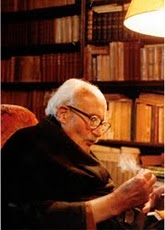
This is too much fun to pass up.  Ever hear of Nicolás Gómez Dávila (a.k.a. “Don Colacho“)?  I hadn’t, either. So thanks be to Anecdotal Evidence and Patrick Kurp for bringing him to my attention.  (There’s a super-duper website on Gómez Dávila here.)

The Columbian writer (1913-1994) led a life of leisure:

“Gómez Dávila generally only visited the office once a week at midday for about ten minutes, in order to tell the business manager to increase profits, before going out to lunch with friends at the Bogotá Jockey Club, where he was an active member, playing polo and even serving as an officer for a while. (He had to give up polo, though, after injuring himself on his horse—he was thrown off while trying to light a cigar.)”

He is known mostly for his aphorisms:

“Literature does not die because nobody writes, but when everybody writes.”

“Why do people write when they have nothing worthwhile to say and are unable to say it? The same reason we sing in the shower, when at least we have the courtesy to keep the door closed.”

“Clarity is courtesy. Muddle is ill-mannered.”

“The soul grows inwards.”

“Modern man deafens himself with music in order not to hear himself.”

“Journalism is writing exclusively for others.”

“Among the inventions of human pride, one will finally slip in which will destroy them all.”

“A genuine vocation leads the writer to write only for himself: first out of pride, then out of humility.”

“Whoever says that he ‘belongs to his time’ is only saying that he agrees with the largest number of fools at that moment.”

“The criterion of ‘progress’ between two cultures or two eras consists of a greater capacity to kill.”

“The word ‘modern’ no longer has an automatic prestige except among fools.”

“Individualism is the cradle of vulgarity.”

“Our last hope lies in the injustice of God.”

Patrick ends with a quote from Yvor Winters,  from his introduction to The Quest for Reality: An Anthology of Short Poems in English (1969), which he edited with Kenneth Fields:

“Our best writers live fully in the knowledge that language is at once personal and public; they know that only by precisely controlling the public medium of language can they realize private experience. For each of us language is the essential intermediary between the isolated self and the world of others; rather than trammeling the mind and affections, it sets them free, giving them proper objects.”

Let me end with a final aphorism that intrigued me:

The artist does not compete with his fellow artists; he does battle with his angel.

It reminded me of a similar thought Robert Hass told me a decade ago:

You know, to write a book of poems is to wrestle with an angel, and the first part of the task is to figure out what angel you are wrestling.

More on Gómez Dávila here.  And more from my Hass interview in my forthcoming book, An Invisible Rope: Portraits of Czesław Miłosz.
.
.

Immortality, poetic and otherwise

Share

Abraham Verghese reviews Pulitzer prizewinning author Jonathan Weiner‘s curious book about a more secular brand of life everlasting, Long for this World: The Strange Science of Immortality, in the New York Times here:

“We get old because our ancestors died young,” Weiner writes. “We get old because old age had so little weight in the scales of evolution; because there were never enough Old Ones around to count for much in the scales.” The first half of life is orderly, a miracle of “detailed harmonious unfolding” beginning with the embryo. What comes after our reproductive years is “more like the random crumpling of what had been neatly folded origami, or the erosion of stone. The withering of the roses in the bowl is as drunken and disorderly as their blossoming was regular and precise.”

I wondered if Weiner had ever studied Carl Jung, whose description of purpose during our long path on the descending arc of life is somewhat less glum, and makes more and more sense to me as the years progress.  The book concludes:

“The trouble with immortality is endless. The thought of it brings us into contact with problems of time itself — with shapeless problems we have never grasped and may never put into words. Our ability to exist in time may require our being mortal, although we can’t understand that any more than the fish can understand water. What we call the stream of consciousness may depend upon mortality in ways that we can hardly glimpse.”

Provider of grace notes

Most people don’t seem to know much why they’re alive, so I’ve always wondered why more-of-the-same has always held such allure. Leave it to the eloquent Dr. Verghese to supply the grace note:

As a young physician caught up in the early years of the H.I.V. epidemic, I was struck by my patients’ will to live, even as their quality of life became miserable and when loved ones and caregivers would urge the patient to let go. I thought it remarkable that patients never asked me to help end their lives (and found it strange that Dr. Kevorkian managed to encounter so many who did). My patients were dying young and felt cheated out of their best years. They did not want immortality, just the chance to live the life span that their peers could expect. What de Grey and other immortalists seem to have lost sight of is that simply living a full life span is a laudable goal. Partial success in extending life might simply extend the years of infirmity and suffering — something that to some degree is already happening in the West.

***

Finally.  Finally.  A biographer is thoroughly exploding the Myth of Amherst.  Emily Dickinson is not the Belle of Amherst … the Dickinson siblings struggled with volcanic emotions, as anyone exposed to Austin and Mabel can attest.  But was she epileptic?  Lyndall Gordon explores the possibility in Lives Like Loaded Guns: Emily Dickinson and Her Family’s Feuds (reviewed by Christopher Benfey) in the New York Times here.

I discussed the tormented Dickinson family in a Times Literary Supplement article, “Letter from Amherst,” in 2003.  Alas, it is behind a paywall now, never to be seen again except to subscribers.

***

Patrick Kurp considers Helen Pinkerton‘s “Redtailed Hawk,” a poem she wrote for Kenneth Fields, at the blog “Anecdotal Evidence” here.  Patrick had his own encounter with a somewhat similar bird:

“The kestrel flew around the room close to the walls like a bat, in a tight orbit of disciplined panic. Moths bump off walls and lamps but raptors are always predators. Their competence is savage, even the kestrel’s, a small hawk with a songbird’s voice. He had escaped a park ranger readying him for visitors. …”

Read Pinkerton’s poem, from her collection Taken On Faith here.