Congratulations, Kay Ryan and A.E. Stallings!

Share

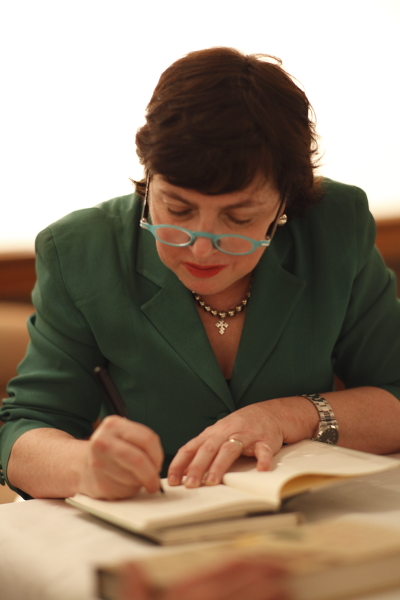
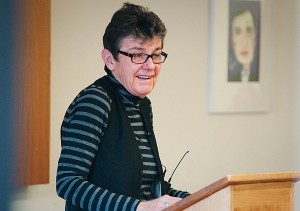
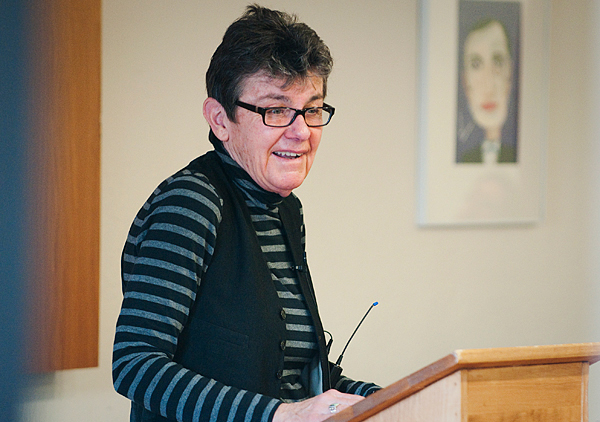
"Let there be lightness" (Photo: L.A. Cicero)

Who could be more deserving of a MacArthur “Genius” Award than Kay Ryan?  (We’ve written about her here and here and here – and my 2004 San Francisco Magazine essay on her, “Let There Be Lightness,” is here.)

Here’s what the New York Times had to say:

“Kay Ryan, 65, a former poet laureate of the United States who won the Pulitzer Prize for poetry this year, said the money provided a certain “mental ease,” as she continues to write and to advocate for community colleges, where she has taught remedial English skills for decades.” [For you Bay Area denizens out there, she taught at the College of Marin – ED.]

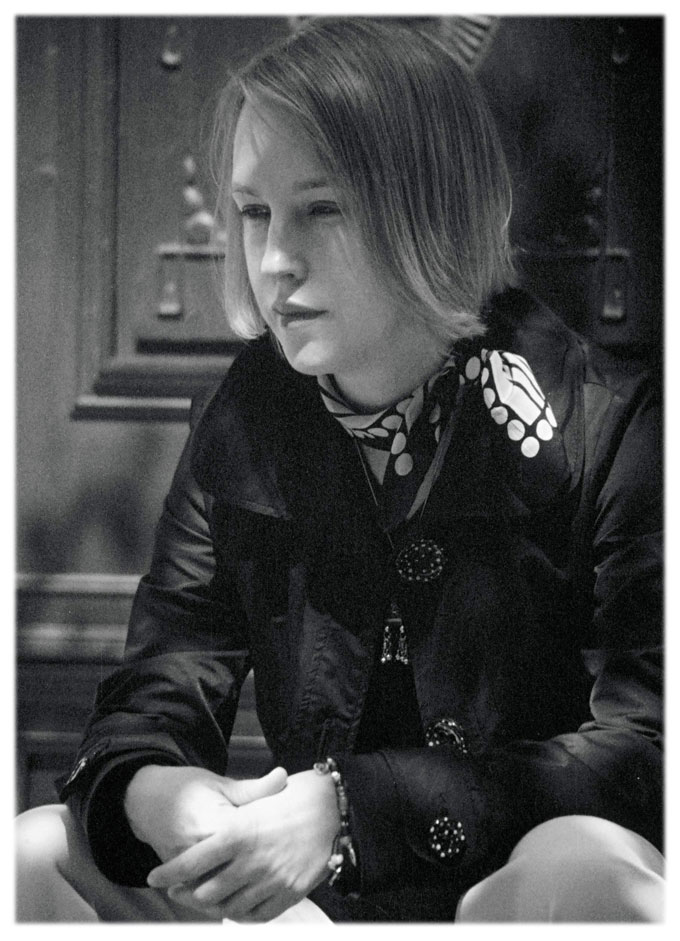
In Athens (Photo: John Psaropoulos)

“I was very, very surprised,” said Ms. Ryan, who lives in Fairfax, Calif. “I had certainly thought I was over the hill. Obviously these people think I’ve got five more good years in me.”

But here’s the other half of the news:  A.E. Stallings has also been awarded.  I sent my congratulations to both, Alicia via Facebook, Kay by “regular” email.  And also a note to Dana Gioia, who has promoted Kay’s work since way back when she was a relatively unknown Marin poet.  His reaction?  “Great news for two fabulous poets.”

Time to finally get a copy of Alicia’s 2007 verse translation of Lucretius‘s De Rerum Natura (The Nature of Things).  Yes, I’m that far behind.

 Postscript on 9/21:  And happy birthday too, Kay!

In the aftermath of the Google books decision: disappointment … and persistence

Share

No prophet

U.S. Circuit Judge Denny Chin‘s rejection of a deal between Google and book publishers happened while I was in New York City.  You can read about it here.  The federal judge in Manhattan said the deal, which would allow the search engine company share digitized copies,  “goes too far” and would give Google “a significant advantage over competitors, rewarding it for engaging in wholesale copying of copyrighted works without permission.”

It took a few weeks, but Andrew Herkovic at the Stanford University Libraries has issued his characteristically graceful comment on the Google brouhaha in his newsletter:

BooksIn the wake of last month’s judicial rejection of the proposed settlement of litigation between Google Books and various publishers and authors, there are only two firm facts that can be confidently stated about what’s next: first, nobody, with the possible exception of the litigants, knows anything; and second, the litigants aren’t talking. Thus we have the conditions for rampant public speculation, and many have risen to this temptation. I shall not.

Instead, I remind readers that the scanning of millions of books by the Google Books project has never abated, either at Stanford or among the many other participating libraries. Every weekday, a truckload of books goes to Google and a like number come back from them, in a smoothly choreographed process that assures both safekeeping and tracking of the books. The total to date is in the vicinity of two million volumes, and we anticipate continuing this process for years to come. We do not know how or even if any given book will be used by Google, but we are certain of the utility to Stanford in having our holdings preserved and being made searchable through digitization. We are hopeful of additional beneficial outcomes for Stanford.

The key word in Stanford’s public reaction to the demise of the proposed settlement was “disappointment.” That, almost five years after the class-action suits were initiated against the project, there is no resolution whatever is certainly disappointing; any decision might seem preferable to none. That a startling vision of public access to a vast amount of text as articulated in the proposed settlement has been occluded is another disappointment. That the “orphan works” and other copyright issues remain in limbo is a lesser disappointment, if only because efforts are underway to address them by legislative rather than judicial means. However, the key word I wish you to take away is “persistence.” We persist in scanning books through Google (as well as in our own labs). We persist in developing techniques to help scholars use digitized texts. We may be confident that the litigants will persist in seeking some eventual resolution to the court case. We persist in hoping that the discordance between copyright law and the realities of the digital age will be harmonized, at least with regard to printed literatures, before the century is much further along. We persist in fulfilling a vision and mission that depend on both digital and artefactual means of providing and preserving information.

Looking forward, but unprophetically,

Andrew Herkovic

Clare in NYC

A couple of postscripts:  Speaking of New York, I’ve added a photograph of Clare Cavanagh at last month’s Czesław Miłosz centennary event at the 92nd Street Y – thanks to David A. Goldfarb and his camera.

And, after reading my piece on Kay Ryan‘s Pulitzer, Dave Lull kindly sent me yesterday a Wall Street Journal “Speakeasy” Q&A with Kay Ryan, in which she says:

I never, ever worry about poetry or its survival because it’s the very nature of a poem to be that language that does survive. Poems are even better than tweets – they don’t require any electronic equipment. They can lodge right in your brain. They are by nature short. You don’t even have to remember all of them — you can remember just a phrase. That can be something you can turn to in any emergency, good or bad. You’ll pluck out a little group of words, just maybe a phrase, and that’s exactly what poetry is for. It’s for the things that really last. Because it lasts.

Kay Ryan wins the Pulitzer Prize: “I would like my work to be weightless.”

Share

In praise of lightness: Marin's self-sytled "Sheriff of Emptiness" (Photo: L.A. Cicero)

Kay Ryan has won this year’s Pulitzer Prize for The Best of It: New and Selected Poems.  I wrote about the Marin poet here during a recent visit to Stanford.  I blogged some outtakes from my interview with her eight years ago here. And I’ve written about her elsewhere, too – oh, for San Francisco Magazine, in an October 2004 article, “Let There Be Lightness,” which isn’t, alas, online.  (Postscript on 4/19:  It is online now – here.)

An excerpt from that piece, in honor of the occasion:

A bubble. The foam on a stein of beer. A tulip quivering on a slender stem. A feather, to counterpoise the world’s density, inertia, heaviness.

Lightness is a much underrated virtue, and a much misunderstood one. “Lightness” does not mean being vapid or intellectually shallow. It means looking at the world from a different perspective, with a different system of weights and measures. Marin County poet Kay Ryan—a very quiet writer who is suddenly creating a lot of noise—does exactly that in her poems.

It’s a pickle, this life.
Even shut down to a trickle
it carries every kind of particle
that causes strife on a grander scale….

The lightness of atoms inhabits Ryan’s fey, easy-on-the-ear poetry, which wins her instant fans at her occasional, low-key readings. She explains what she’s after this way: “It’s the object of my life to get things to float. Because I like it. Because it’s a relief. It is relief. It’s freedom. So I would like my work to be weightless.”

But in today’s grim and weighty world, she’s been rebuked with charges of insubstantiality, even frivolity. Library Journal gave Ryan’s 1994 book of poems, Flamingo Watching, a stern “not recommended,” commenting, “Ryan’s cramped syllabics have a monotonous density that too often mistakes sound for sense… these poems are derivative and lacking in substance.”
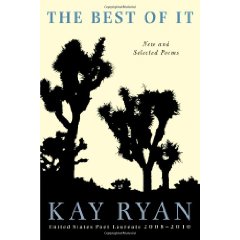
The winning book

There’s nothing frivolous, however, about the attention Ryan has been getting lately, finally, after decades of writing and six books of poetry, including 2000’s Say Uncle. Within a few months last spring, she won both a $40,000 Guggenheim Foundation fellowship and the $100,000 Ruth Lilly prize from Chicago’s esteemed Poetry magazine.  The award, praising a “singularity and sustained integrity that are very, very rare,” establishes her in an enviably successful firmament that includes Adrienne Rich, Philip Levine, Anthony Hecht, John Ashbery, and W.S. Merwin—heavyweights all.

One thinks of Ashbery’s avant-garde experimentalism. One thinks of the erudite Hecht’s dark and troubled formal verses. One thinks of Rich’s heavy-duty poems on poverty, racism, lesbianism, violence. Or of Levine’s obsessions with working-class life in Detroit, or Merwin’s dreamy, densely imagistic poems, with their long lines. One thinks of millions of poems everywhere, trying to impress you with their suffering and how very seriously they take themselves. Clearly, Ryan is hacking out a path of her own, but with a scalpel, not a machete.

She’s not so much treating serious things lightly as she is turning the world upside down—not being drawn into its heaviness, not letting its heaviness inhabit her. In a sense, she’s been keeping the darkness of the world from extending its territory, which is a signal act of defiance, perhaps more so than that of many “protest” poems. (Witness the leaden dullness of so much of the work in the Poets Against the War movement.) Ryan’s poems may shimmer on the surface— and how is that a bad thing?—but they are compelling in the quiet knowledge they bear.

You can read the rest here.

***

Congratulations to Bruce Norris, whose Clybourne Park, won the Pulitzer for drama.  We had the pleasure – and it was indeed a pleasure – of seeing the smart, politically incorrect play a few months ago at San Francisco’s American Conservatory Theater.  The San Francisco Chronicle‘s little man was out of his seat clapping, and Robert Hurwitt had this to say:

The jokes, lobbed like grenades, are more offensive than funny. The reactions to them are hilarious. And revealing. For us, as for the characters in Bruce Norris’ scathingly observed “Clybourne Park,” the only thing more cringe-inducing than a tiptoe around the taboo topic of race is confronting it.

As seen Thursday, “Clybourne” is the kind of trouble-making comedy of manners that tears the lid off good intentions and hypocrisies to amusing and salutary effect. And it’s being performed to discomforting perfection by the ACT cast in the pinpoint-precision stagings of California Shakespeare Theater Artistic Director Jonathan Moscone in his company debut.

Attitudes toward gender, patriotism, marriage, the touchy topic of real estate and various ethnicities come under fire, but race is the elephant in the room. That would be the spacious living room of the house in Chicago’s (fictional) Clybourne Park, which undergoes its own remarkable transformation …

A Swedish award for a Swede? Ladbrokes has spoken…

Share

79-year-old perennial Nordic bridesmaid

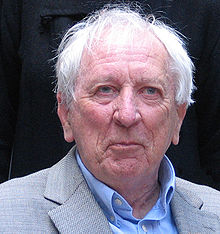
Tomas Tranströmer is the odds-on favorite to win this year’s Nobel Prize for literature. Ladbrokes has spoken, putting his chances at 5 to 1.  However, Bill Coyle at the Contemporary Poetry Review states the problem this way:

Every year, as the announcement of the Nobel Prize in Literature approaches, partisans of the Swedish poet Tomas Tranströmer hold a collective breath, hoping against hope. A win for their man is unlikely for a number of reasons. One is the residual fallout from 1974 when the Swedish Academy gave the prize to two of its own members, Harry Martinson and Eyvind Johnson. Both were fine writers, but the appearance of nepotism was impossible to avoid. No Swede—no Scandinavian—has won the prize since.

Reuters observes that “Poetry dominates the bookmakers’ list” and that “American writers set to be overlooked again” — unless, of course, you consider perennial American Nobel bridesmaid Joyce Carol Oates, ranked #12, or perennial groomsman Philip Roth, at #15.  Thomas Pynchon is #16.  Note that none of the Americans are poets.  At least not primarily.

Does Bjørg-the-Cyborg pick the winners?

“Tomas Transtromer must surely be in pole position,” said David Williams of Ladbrokes. “He’s long been mentioned for the prize and we feel his work finally deserves this recognition.”  Probably an indication he won’t get it.  (You can read a few of his poems at The Owls website here.)

There’s an obscure Paraguayan playright — Nestor Amarilla — rumored to be shortlisted.  No one’s ever heard of her, which would be in keeping with recent prizewinners.  Do I sense another wicked Ted Gioia parody coming?  Read his “Shocking Revelation: Nobel Lit Prize Has Been Picked by a Robot since 1994!”  (His slightly more sober “Nobel Prize in Literature from an Alternative Universe” here.

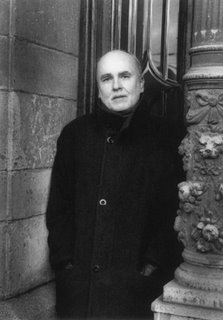
The man in the #2 favorite spot leaves me with divided feelings — it would be nice to see Polish poet Adam Zagajewski bag the prize — but the award has a way of turning lives upside down. (Read An Invisible Rope for some firsthand stories about what it did to Czesław Miłosz in 1980.)  I remember Zagajewski kindly serving as my sherpa in literary Kraków — and, well, I’m selfish.  Which is to say, I would miss his friendship.

I reviewed his book for the San Francisco Chronicle (and no, I didn’t write the headline) — I’m chuffed that it inspired Kay Ryan to write to the newspaper:  “It was a thrill to read Cynthia Haven’s brilliant review the poet Adam Zagajewski’s book of essays, A Defense of Ardor, in this past Sunday’s Book Review. Almost never do I come across something about poetry that has the sting and bite of poetry in it.  Zagajewski comes straight through Haven’s elegant and deeply informed prose.  More of these brainy reviews please; more Cynthia Haven, please.”  I hope they published it.  I honestly can’t recall.  Oscar Villalon sent it to me.  God knows one gets enough slaps and punches.

I also profiled Adam for the Poetry Foundation magazine here — an article that still gets a lot of hits.

I remember meeting Adam for tea in Krakow’s main square, and being thrilled by the squadrons of pigeons.  Adam assured me loftily that they were very stupid creatures.  And, as a newcomer to his town, he showed me the Jagiellonian University,  as the light was fading…

"Only others save us..."

When I asked him about the future of poetry and poetry-lovers in the world of tweets and sound bites he said this (which didn’t make it into the final cut of the Poetry Foundation article):  “We’ll be living in small ghettos, far from where celebrities dwell, and yet in every generation there will be a new delivery of minds that will love long and slow thoughts and books and poetry and music, so that these rather pleasant ghettos will never perish — and one day may even stir more excitement than we’re used to now.”

I keep this on my desk:

Only others save us,
even though solitude tastes like
opium. The others are not hell,
if you see them early, with their
foreheads pure, cleansed by dreams.

— Adam Zagajewski, “In the Beauty Created by Others”

The “Sheriff of Emptiness”

Share
ryan_news

Kay Ryan (Photo: L.A. Cicero)

Kay Ryan, our current U.S. poet laureate, calls herself the “Sheriff of Emptiness.” I wrote about her today here.

I met Kay years ago, through Dana Gioia, another North Bay poet.  We had an interview at Kay’s Fairfax home in July 2004.  I had described the meeting in my notes this way:

“Ryan is waiting for me, but not idly.  She is re-grouting the colorful Puebla-style tiles, on the risers of her entryway.  She is short and solidly built.   In khaki shorts and a black t-shirt, however, she appears scrappier, more muscular than she might appear more fully dressed at her readings.  Her longtime companion, Carol, is in Mexico, and Kay is alone in her brisk, clean house.  She is alone, except for Wally, a pale-colored, ancient cat who is mostly bones and fur  – so old he has lost most of his senses, but not his sense of friendliness, and is nevertheless currently in disfavor.”  [He had urinated on something, as I recall — ED.]

Wally, alas, died soon after my visit.  But my connection with Kay lasted longer.  I remember her recalling her family’s move to the Mojave: “It was hot, it was empty.  I didn’t have any friends.  And it took me awhile to come to like it.  But now I really do feel I have the desert in my blood.”  Much like her poem “Blandeur,” she said,  “ I like the emptiness, I like the lack of features.  I like its featurelessness.  I like how any event is a big event.”

And I remember this comment about her 30-year teaching stint at the College of Marin:

Back to Marin .. you teaching remedial writing?

I teach very basic English skills.

I think the way you described it when I first met you was, “My Friend, the Comma.”

I introduce them to the concept of indenting.  We learn to capitalize certain words, and not capitalize others.  I go up through the paragraph – writing a paragraph with a topic sentence and primary supports.

Who are your students?51VW9lkcaxL._SL500_AA240_

They range from high school students to people in their fifties.  Many second-language students.  Lots of people who got off-course one way or another, through drugs, or through just a variety of difficulties in their life, so they didn’t get basic skills.  I like the people I work with.  I’ve never wanted to teach any advanced courses.  I like the sort of life-and-death teaching.  These are survival courses.  And I don’t like spoiled people.  I don’t like to do for people what they could do for themselves.  These people aren’t spoiled.  They’re not saying, “Entertain me.” They’re here to get what they need to have their gardening business.  Some are going ahead in school.  But for some…to get a job at Long’s.  To be able to write a note at the bank where they work.

I still admire Kay’s respectful and thoroughly practical outlook towards teaching the students who need it most.

Speaking of the desert — here’s the cover of Kay’s new book, out this month:  The Best of It: New and Selected Poems.