
When literary tête-à-têtes ends in fisticuffs…

Share

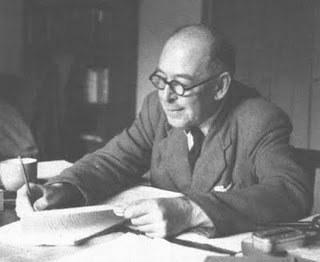
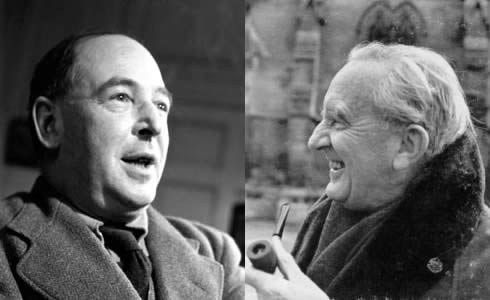
The subject of the fistfight: Lewis and Tolkien

It’s not often that two guys having a literary discussion end up by hauling off and whacking each other. And yet  it happened in the city of my alma mater, after several hours of serious drinking:

A 34-year-old Ann Arbor man was sent to the hospital with a head injury after another man punched him on Saturday during a literary argument, according to police. … the man was sitting on the porch with some people he had just met, talking about books and authors.

The 34-year-old man was then approached by another party guest, who started speaking to him in a condescending manner. An argument ensued and the man was suddenly struck in the side of the head, suffering a cut to his left ear …

The injured man – who was smacked so hard his glasses flew off and a lens popped out – was treated at a local hospital.

The story jumped from Ann Arbor to The Guardian, whose blogger, Sam Jordison, telephoned Michigan to get the scoop:  “The details remain sketchy, but the prominent rumour around town is that the men were disputing the relative merits of J.R.R. Tolkien and C.S. Lewis.”
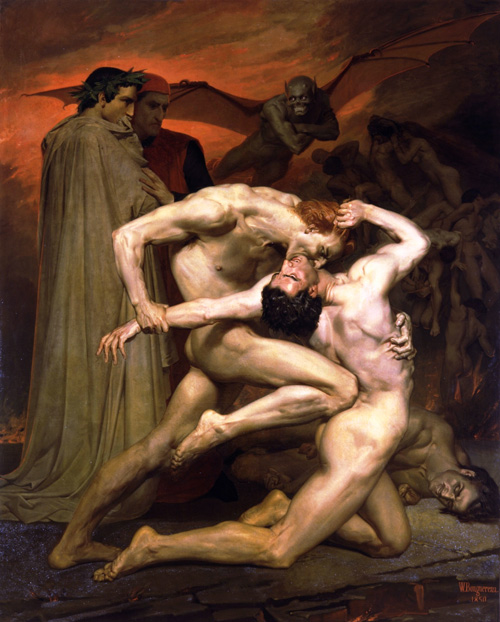
Virgil says: Don't watch. Don't listen.

Then Jordison shares his own self-satisfaction and his derision of his betters (Henry James, for example, is “the old windbag”) – apparently, he never loses a fight and is always right, just like the rest of us.  (It is the one thing we all have in common.) Then he asks a question:

But all this does make me wonder whether anyone else has experienced book-based violence. Have you had a literary argument so heated that you’ve only been able to resolve it with blows? Or could you imagine doing so – or at least losing your cool? And what’s your tipping point? If, for example, I were to inform you that J.M. Coetzee‘s Disgrace is a clever book for people who don’t like to think, would you hold it against me? And how do you like to annoy other book-lovers?

Here’s a few.
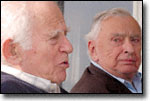
Mailer, Gore

Mad men: Mailer, Gore

There’s the time Norman Mailer punched Gore Vidal. “As usual, words failed him,” quipped Vidal.

And two Nobel laureates ended a friendship when Mario Vargas Llosa socked Gabriel García Márquez – story recounted here and here.

Then there’s the fistfight between Ernest Hemingway and Wallace Stevens, confirmed by others but recounted by Hemingway in a February 1936 letter:

"Nice Mr. Stevens" and Hemingway

Nice Mr. Stevens. This year he came again pleasant like the cholera and first I knew of it my nice sister Ura was coming into the house crying because she had been at a cocktail party at which Mr. Stevens had made her cry by telling her forcefully what a sap I was, no man, etc. So I said, this was a week ago, ‘All right, that’s the third time we’ve had enough of Mr. Stevens.’ So headed out into the rainy past twilight and met Mr. Stevens who was just issuing from the door having just said, I learned later, ‘By God I wish I had that Hemingway here now I’d knock him out with a single punch.’

So who should show up but poor old Papa and Mr. Stevens swung that same fabled punch but fertunatly missed and I knocked all of him down several times and gave him a good beating. Only trouble was that first three times put him down I still had my glasses on. Then took them off at the insistence of the judge who wanted to see a good clean fight without glasses in it and after I took them off Mr. Stevens hit me flush on the jaw with his Sunday punch bam like that. And this is very funny. Broke his hand in two places. Didn’t harm my jaw at all and so put him down again and then fixed him good so he was in his room for five days with a nurse and Dr. working on him. But you mustn’t tell this to anybody.
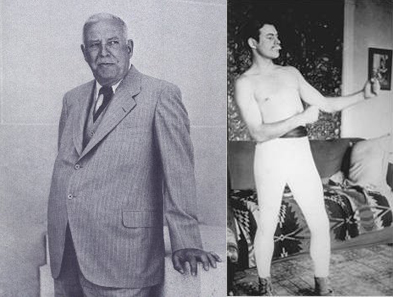
The winners

Then there’s the time that Desmond Leslie punched journalist and theater critic Bernard Levin in front of 11 million viewers over an article Levin had written about his wife, the actress Agnes Bernelle. The incident occurred the TV show That Was The Week That Was in 1962.

I am forced to come to the conclusion that book-lovers are a quarrelsome lot, not so much from these incidents as from some of the unsupported character assassination in the reader replies (though they did tip me off about where to find the best fights). Basta! What is it in us that likes to watch a fight?  As Virgil says to Dante in the Inferno: “To hear such wrangling is a joy for vulgar minds.” It’s one reason the Inferno has always been more popular than the Purgatorio or the Paradiso. Something to remember when one indulges in the “Comments” sections.

The two who come out best from the whole mess are … those two tweedy Oxford dons, J.R.R. Tolkien and C.S. Lewis.  Lewis, in particular, was generous and self-sacrificing to an extreme, and though the two men disagreed, they remained gentlemen and friends.
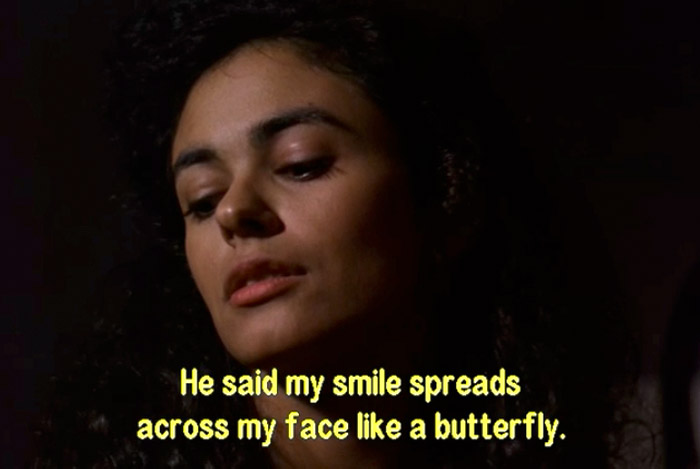
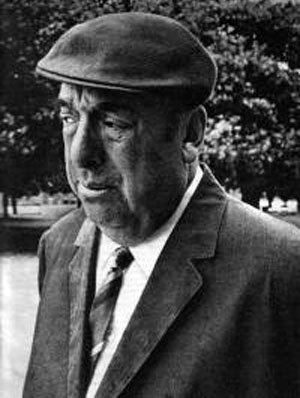
Pablo Neruda: Greatest pick-up artist evah?

Share

The conversation erupted on my Facebook page, debating the eternally recurring subject of unjust Nobel awards. It’s recently been revealed that J.R.R. Tolkien had been snubbed by the Nobel committee because his writing wasn’t up to snuff.

Other poor Nobel choices came to mind among my FB friends – the 1971 Nobel to Pablo Neruda over Tolkien?  Or over W.H. Auden, for that matter?  Or Jorge Luis Borges?  Or Vladimir Nabokov?

Another Nobel laureate, Octavio Paz called Neruda “the greatest bad poet of the century,” a much-repeated soundbite that sticks.  Yet Nobelist Gabriel García Márquez called him “the greatest poet of the twentieth century – in any language.” To which one can only reply Osip Mandelstam, W.H. Auden, Marina Tsvetaeva, T.S. Eliot, Czeslaw Milosz.

Our view of Neruda is now inevitably colored by his Stalinist politics.

Apologists say the Stalinists couldn’t possibly have known about the murderous excesses of the U.S.S.R.  Couldn’t possibly have known?  Despite a generation of slaughtered, imprisoned and exiled writers from Russia?  Despite a man-made famine that starved millions?  Despite the writings of Robert Conquest?  If Neruda had any questions, all he had to do was ask Czeslaw Milosz, who defected in 1950.  Instead, he infamously penned a denunciation of Milosz as “The Man Who Ran Away.”

There is nothing so dangerous to us as the thing we do not want to be true, the thing we turn our backs to.

Not bad for a dumpy-looking guy

In time for the 2004 Neruda centenary, Stephen Schwartz (not a literary critic, but a conservative political commentator), wrote in a seminal article that has been cited all over the internet:

There is probably no more chance of halting this current binge of Neruda worship than there is of banishing the cicadas, but, still, the truth does need to be said: Pablo Neruda was a bad writer and a bad man. His main public is located not in the Spanish-speaking nations but in the Anglo-European countries, and his reputation derives almost entirely from the iconic place he once occupied in politics – which is to say, he’s “the greatest poet of the twentieth century” because he was a Stalinist at exactly the right moment, and not because of his poetry, which is doggerel.

So does Neruda’s poetry have a future?

Eternally.  On Facebook, my friend Kevin assured me that Pablo Neruda has enduring market value in the Spanish-speaking world for his … pick-up lines. Not bad for a dumpy-looking guy (see right).

Hard to argue that point – an award-winning film was made on precisely that subject, Il Postino/The Postman.  The plot: nerdy Italian postman wants to pick up pretty girl.  He befriends the exiled Neruda and voilà!  Plagiarism is born in a small Italian village.

As Schwartz himself admitted:

Yes, his work is still plagiarized by teenage boys in Latin America, who see his Twenty Love Poems and a Desperate Song and figure there is nothing wrong with borrowing from it–just as one poem in the book is itself stolen from Rabindranath Tagore – and presenting its overwrought lines to their girlfriends. But if those boys grow up to be serious writers, they leave Neruda behind.

No luck with the line

But Kevin had a story of his own.  During a summer studying at the London School of Economics, an attractive young Spanish woman caught his eye.  How to attract her attention? His friend Pedro (there were a lot of Spaniards around that summer)  said it was very important to open with a sure-fire line.  Neruda was the ticket.

A dormitory lunchroom discussion of Neruda and the art of line-by-line seduction followed.  The young woman demanded an example of a florid Iberian pick-up line: “Let me hear it.”

Kevin recalled the line Pedro had taught him:  “The sentence would be something like “Oh, cielito mío, que Dios me dió” [Oh, my little heaven, given to me by God].

“It’s the cheesiest thing in the world.  And she said, ‘Wow, that’s really good.’”

Did he get the date?  No.  But he learned his lesson: “That’s how it’s done in España.”


Out of the shadows: C.S. Lewis in Oxford

Share

More cramped than it looks (Photo: C.L. Haven)

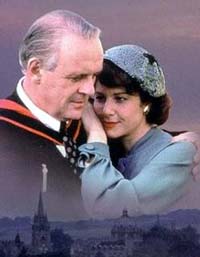
In the summer of 2009, I visited C.S. Lewis‘s digs about two miles outside Oxford.  Having seen Shadowlands, the movie based on his life (it must have been filmed somewhere else), I must say I was expecting something a little grander.  Not grand, just grander.

I knew the author had never been rich, but I wasn’t expecting a place quite so cramped and makeshift, quite so… well … “adequate.” But what struck me most on the personal tour is how William Nicholson‘s play and subsequent film misrepresented a life that was not a passionless, solitary bachelorhood, but crowded with people and noise and human obligations, whether to the bad-tempered mother of a dead friend who lived at Kilns with him and his alcoholic brother, Warren, or the rotating tribe of teenage wards who came to crowd the quarters.

A fateful night on Addison's Walk (Photo: C.L. Haven)

Some of the obligations were self-imposed. As Tom O’Boyle wrote recently in the Pittsburg Post-Gazette:

One discipline he kept as a result was replying to the 20-30 letters he received each day from fans on the day of receipt. It’s estimated he wrote as many as 20,000 letters during his lifetime. Maintaining this practice consumed hours every day and was especially taxing as his health began to fail.

I reviewed the 1,800+ page third volume for the Washington Post here, and mentioned the same. Lewis wrote everyone, including T.S. Eliot, the sci-fi maestro Arthur C. Clarke, and the American writer Robert Penn Warren.  “Other letters were from cranks, whiners and down-and-out charity cases; he answered them all,” I wrote.

“’The pen has become to me what the oar is to a galley slave,’” he wrote of the disciplined torture of writing letters for hours every day. He complained about the deterioration of his handwriting, the rheumatism in his right hand and the winter cold numbing his fingers. In the era of the ballpoint, he used a nib pen dipped in ink every four or five words.”

For me, Jack Lewis is the patron saint of labor.  And the turning point was a warm September night in 1931, when he took an after-dinner walk with Oxford chums Hugo Dyson and J.R.R. Tolkien. The three strolled on Addison’s Walk, a beautiful tree-shaded path along the River Cherwell (I’ve walked it often on my Oxford visits), and got into an argument that lasted until 3 a.m.  It resulted in his conversion.

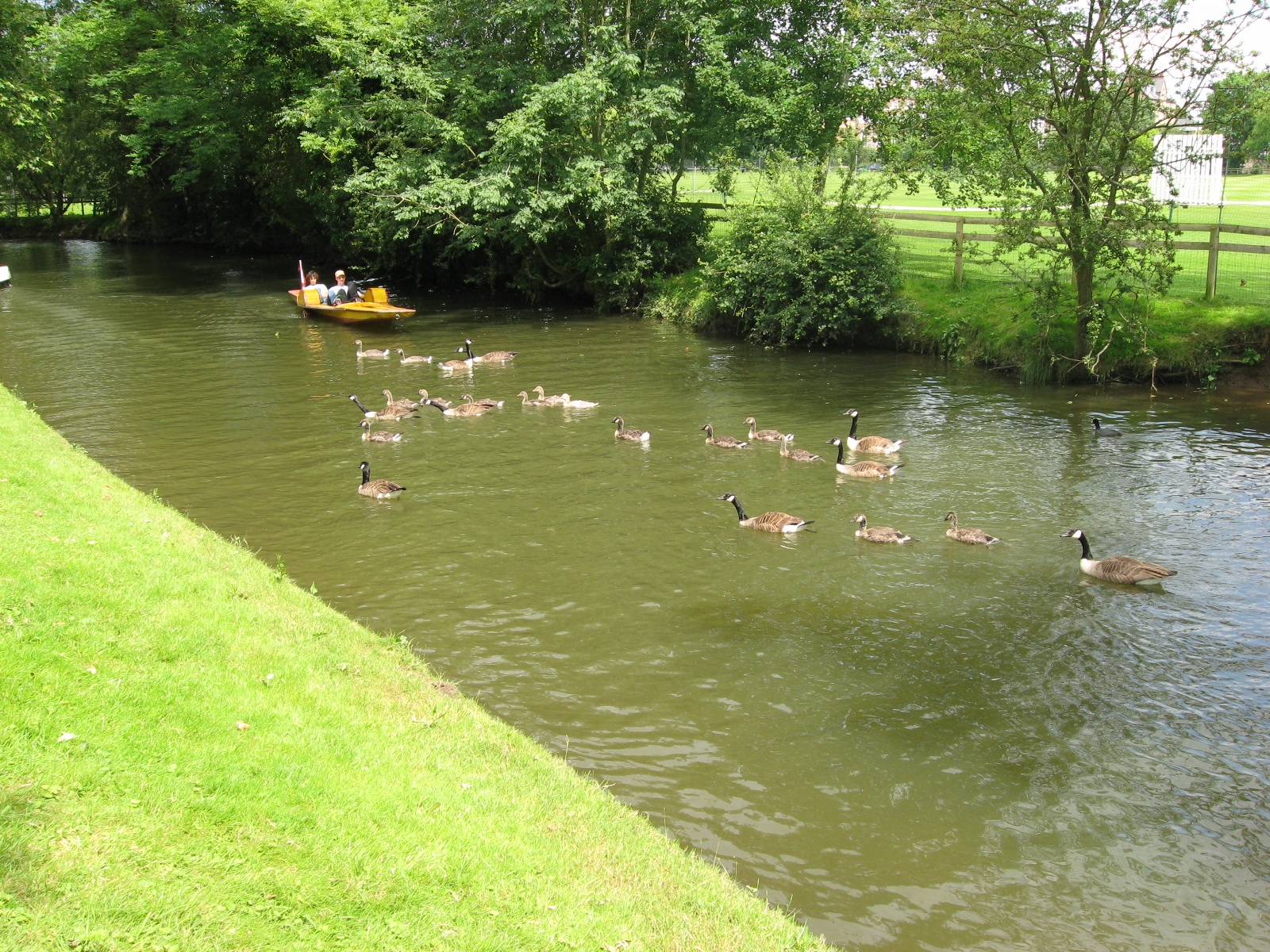
The charms of Cherwell (Photo: C.L. Haven)

As O’Boyle put it:

The effect of this conversion was explosive. Before it, Lewis’ ambition to be a great writer had been hampered by the fact that he hadn’t found anything worthwhile to say. The ledger of pre- vs. post-conversion literary output is hard to fathom. Pre: two slim volumes of verse; post: a torrent of books, essays, novels and radio talks – more than 30 published titles – all works with obvious Christian themes.

After conversion, he also prodded Tolkien to pull together and complete his tales about the private universe that had preoccupied him … Middle-earth.

Not a quiet life, nor a lazy one

Two slim volumes of verse.  A couple decades ago, at least, I remembering sitting on a sunny afternoon on a balcony outside a small library, idly thumbing through a volume of C.S. Lewis‘s poetry.  The magical lightness, the imaginative leaps, the quicksilver sense of the miraculous everywhere which colors Till We Have Faces, The Space Trilogy, The Great Divorce, and the Narnia books was nowhere to be found.

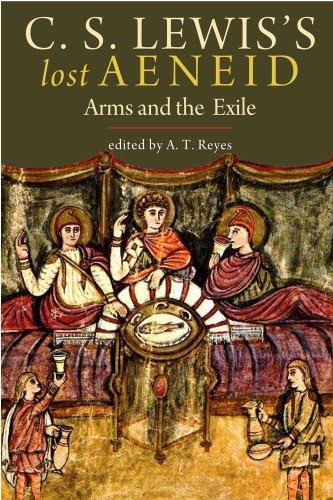
As I recall it, the poems had the solid, leaden consistency of a bowl of porridge.  So I was eager to alter my opinion with his recently published fragments of Virgil‘s Aeneid, a translation project that was interrupted by his death, the same day that John F. Kennedy was shot, Nov. 22, 1963. I haven’t had time to give it a fair shake, but I haven’t seen much to change my mind.

Not the whole story

In Books and Culture, Sarah Ruden agrees.  She wrote that, in his preference for archaic language and stilted locutions in his poetry showcase “Lewis at his narrowest.”

I know the narrowest (he disliked not only Eliot’s verse, but Evelyn Waugh‘s prose), but find virtues that more than offset them in the man as well as in the prose. (Besides, people say the same about Jane Austen – and really, isn’t that’s one of the reasons she’s delightful?)

Steve King, in a Barnes & Noble review, “Remembering C.S. Lewis,” on Lewis’s Nov. 29 birthday last week, recalled his prodigious memory:  “Meetings often lost focus as Lewis galloped through whatever books, ideas, allusions, and quotations sprang to mind. Few could keep up on the scholarly ride,” though others found it great fun.  According to his student Alastair Fowler:

Lewis has been called “bookish” — a dumbed-down response. Of course he was bookish; hang it, he tutored in literature. Even standing on the high end of a punt in a one-piece swimming costume with a single shoulder strap, about to dive, he had time for a quotation….”

And maybe there is even something to be said for “Lewis at his narrowest.”  From Fowler again:

He had been laughed at for offering himself as a specimen of Old Western culture. But he proved in actuality to be one of the last of a threatened species. Before he died, he wrote, optimistically, of the tide turning back to literature. In the event…[u]niversities submitted to bureaucratic management, dons morphed into accountants, training replaced education, and Theory displaced literature. Reading simplistic codes, supplying false contexts, pursuing irrelevant indeterminacies or tell-tale “gaps”: these have proved no substitute for the memorial grasp of literature.

A belated happy birthday, Jack.

Bodleian’s treasures on display: paradise as a library

Share

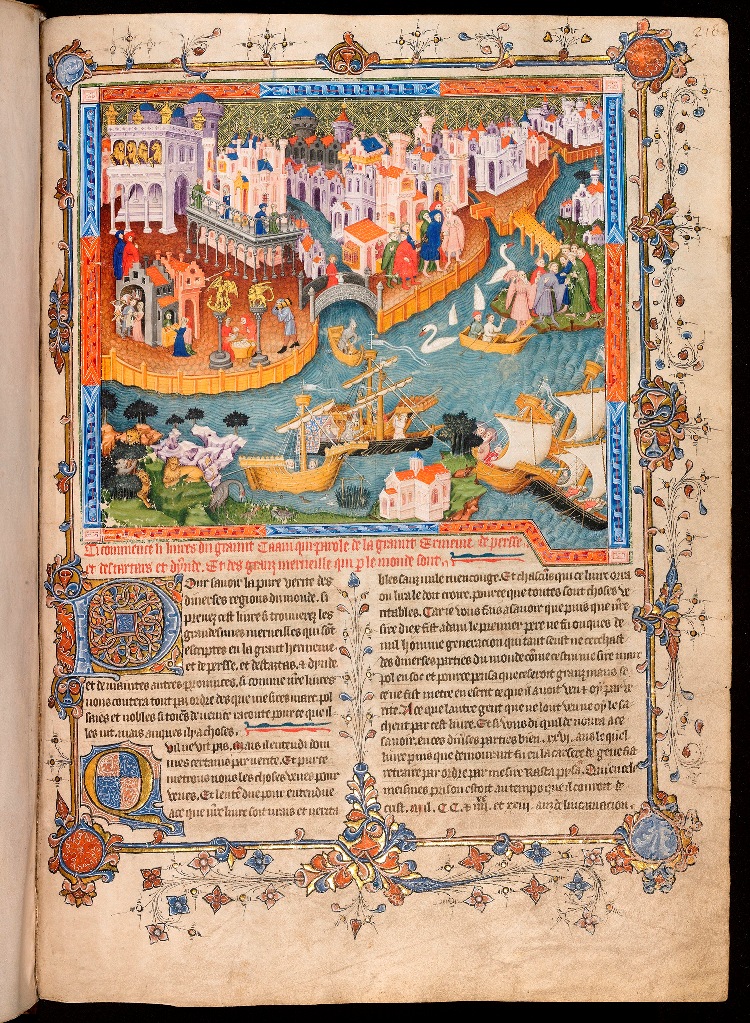
"Marco Polo's Travels," 14th century. Copyright Bodleian Libraries,University of Oxford

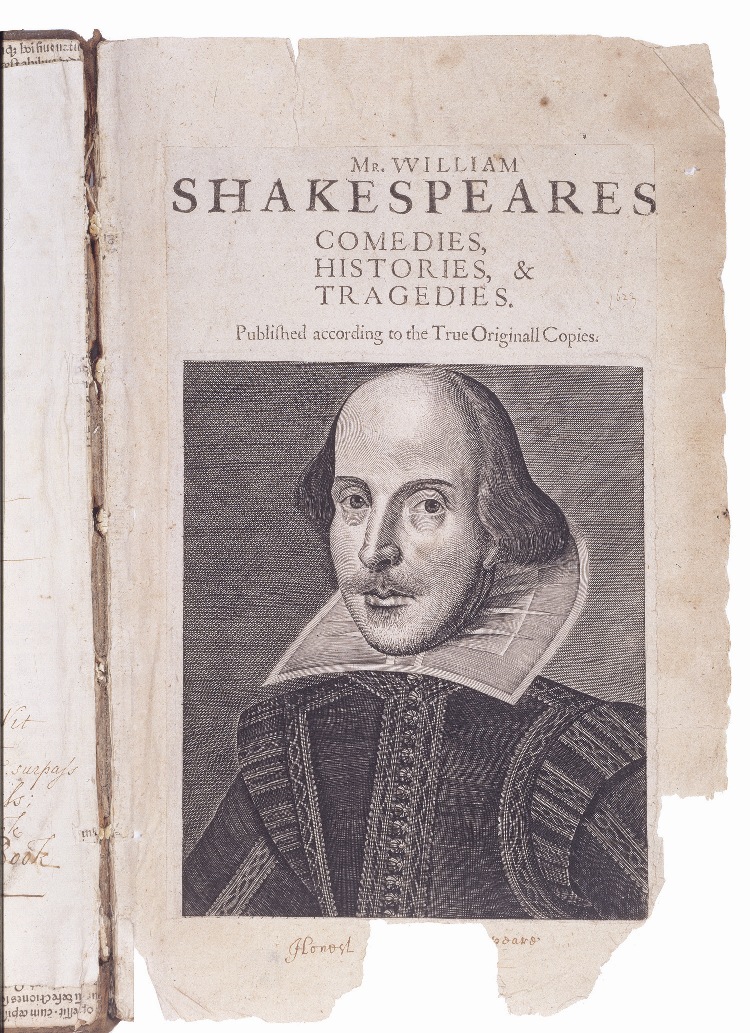
As you enter the darkened room,  a 1623 Shakespeare First Folio is to your right.  Enigmatic scraps of a poem by Sappho, circa 2nd century A.D., are to your left.  And all around you the wonders of the world: weighted with heavy seals, a 1217 “engrossment” of the Magna Carta is nearby (it was reissued under Henry III); so is a 1455 Gutenberg Bible.  In the corner of one glass case –  an exquisite 18th-century miniature scroll of the Bhagavad Gita, which shines like a cache of jewels, somehow pressed and rolled into paper.

William Shakespeare, First Folio,1632. Copyright Bodleian Libraries,University of Oxford

“I have always imagined that Paradise will be a kind of library,” Jorge Luis Borges famously said. And here, in the Bodleian Library’s current exhibition, “Treasures of the Bodleian,” 30 Sept. – 23 Dec. 2011, everyone could see that, well, he had a point.  The exhibition anticipates a permanent gallery in the Weston Library in 2015.  The exhibition shows some of the Bodleian’s rarest, most important, and most evocative rarities.

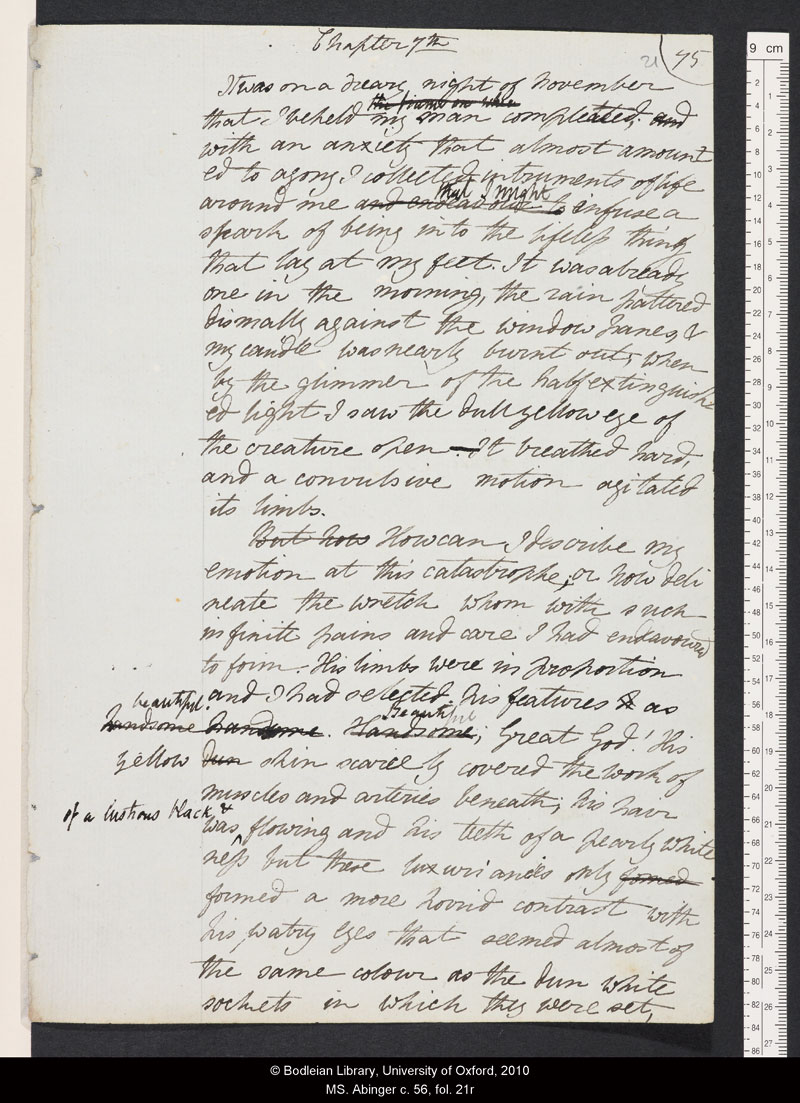
To wit:  In a corner, a single page of Mary Wollstonecraft Shelley‘s Frankenstein describes the ominous night of the creature’s creation. Her scrawled text is corrected and amended by her husband, the poet Percy Bysshe Shelley.  Other handwritten manuscripts are the work of Jane Austen, John Donne, and Gerard Manley Hopkins.  Others are the work of a brush rather than a nib: an exquisite 17th-century picture scroll of the sad Tale of Urashima, a classic Japanese fairy tale which I had read as a child.

For Sir Thomas Bodley, who basically created the museum that opened its doors in 1602, the Shakespeare first folio did not seem like the greatest find. According to the exhibition guide, he “would likely have dismissed this as one of the ‘idle books, and rife raffes’ that had not place among the Library’s predominantly theological collections.”

The volume left the library under mysterious conditions in 1674, and resurfaced only in 1905.  By that time, “the Bodleian was prepared to pay the unheard-of sum of £3,000 to buy back ‘its original long-lost copy of the First Folio of Shakespeare.'”

William Shakespeare,First Folio,1632. Copyright Bodleian Libraries,University of Oxford

I visited the exhibition in the company of my friend, Oxford’s Eliza Tudor, and we gravitated towards our favorites.  Hers seemed to be J.R.R. Tolkien‘s brilliant golden watercolor of Bilbo Baggins, rendered invisible by a magic ring, as he converses with a dragon.  She also took a liking to the Selden map of China, from the Ming era – the earliest Chinese map to show not only shipping routes, but also to depict China as part of a greater East and Southeast Asia. And for me … well, what a choice!  Perhaps I’ll plump for one of the earliest editions of Dante‘s Divine Comedy, fully illustrated, made within decades of his death (see video below).

But there are littler treasures, too – Mohandas Gandhi wrote to his friend, the Anglican missionary Charles Andrews, in a 1932 prison letter exhibited in the collection: “I can therefore never say beforehand what will occupy my attention exclusively or for the most part at a given moment and since a civil resister bargains for the punishment he receives for his resistance, he must not fret over it. Therefore and to that extent I am content with my lot.”

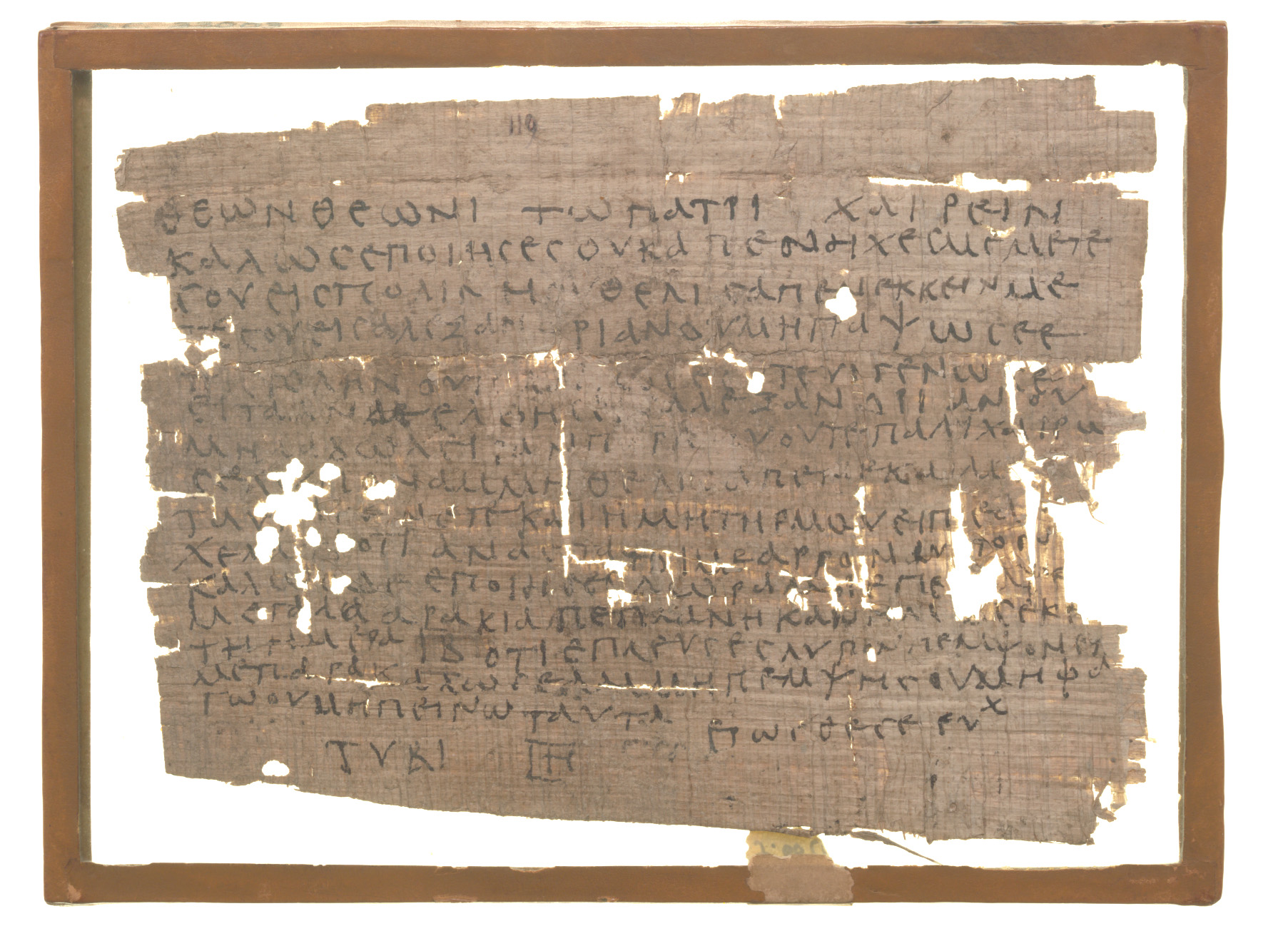
Letter from an Egyptian boy to his father, 2nd or 3rd century A.D. Copyright Bodleian Libraries, University of Oxford

Eliza arrived with her young son Fabian, who was mildly ill and did not attend school that day. His own choice was no surprise.  The exhibit that intrigued him the most was one of the earliest – about the same era, perhaps a little later, as the Sappho fragments: on a sheet of papyrus, an Egyptian schoolboy Theon complains to his father:

Theon to his father Theon, greetings. A nice thing to do, not taking me with you to the city. If you refuse to take me with you to Alexandria, I shall not write you a letter or speak to you or wish you good health. So: if you go to Alexandria I shall not take your hand or greet you ever again. If you refuse to take me, this is what happens. And my mother said to Archelaos, “He’s upsetting me, take him away!” A nice thing to do, sending me these grand presents, a hill of beans. They put us off the track that day, the 12th, when you sailed. Well then, send for me, I beg you. If you don’t send for me, I shan’t eat, I shan’t drink. There! I pray for your health.