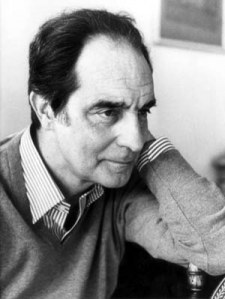
The Italian writer Italo Calvino would have been ninety today. Happy birthday, wherever you are…
“In an age when other fantastically speedy, widespread media are triumphing and running the risk of flattening all communication onto a single, homogeneous surface, the function of literature is communication between things that are different simply because they are different, not blunting but even sharpening the differences between them, following the true bent of the written language.”
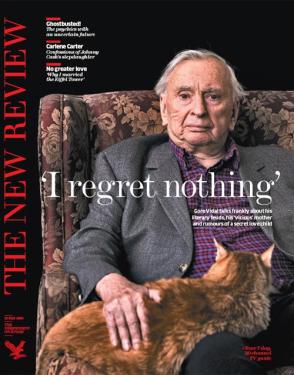
No, no, not that Gore. Gore Vidal. I know, it’s sudden… I was watching the interview I posted a few days ago. It uncovered a Vidal I didn’t know existed. He is moved almost to tears recalling Italo Calvino‘s death. He, the disdainful mandarin, notorious for his literary fights and insults, humbly drops to one knee before someone he considers his better. Didn’t know he had it in him:
“I have studied the landscape of literature all my life, and he was the only great writer of my time.”
“Let’s use a word that is often misused – universal. Where Calvino was, there was literature. Like it or not.” “He was it. He was the real thing.”
We don’t live in a great time for writers or writing, he said, “but Calvino was a one-man great society.”
“Calvino was there, everyone who knew about him admired him, read him, wrote about him.”
The interviewer, Riz Khan, asks Vidal what passed through his mind at Calvino’s funeral. The author’s eyes seemed to mist up, as he answered: “When will there be another? With Italo, I thought literature had died.”
“It was as if a great prince had died. The whole nation went into mourning,” he said in slow, emphatic syllables. “What American or Brit or Frenchman would have that audience in his own country today?”
Vidal was not, apparently, a great fan of the literature of Eastern Europe. Otherwise, he would have recalled one funeral in 2004 where thousands lined the streets of Kraków.
Czesław Miłosz came to my mind for another reason. I remembered speaking to the Polish poet about his friend and fellow laureate, Joseph Brodsky, and his description of what Miłosz called the Russian poet’s “piety.” From my Georgia Review interview a dozen years ago:
There was at a given moment a stable world where we could see, hold on to values that were a reflection of the eternal order of things. Now we are in a flux. This is a very peculiar way of life. … When everything is in flux, revision, it is healthy to have some poets who preserve the feeling of respect.
For me, the value of Brodsky was his sobering effect, and his enormous feeling of hierarchy. He had a great feeling of hierarchy of value in works of art and works of literature.
Brodsky was very sensitive to the sacredness of being. Yes. That’s why I call him pious. I didn’t ask him if he believes in God – you felt in him that openness to the sacred.
“Piety.” It’s an impressive quality. And I thought of that as I listened to Vidal speak. The sense of “hierarchy of value in works of art and works of literature.”
Khan asked Vidal what impressed him most about Calvino’s character. Vidal, one short year before his demise, gazed straight ahead as if staring down death: “Truth.”
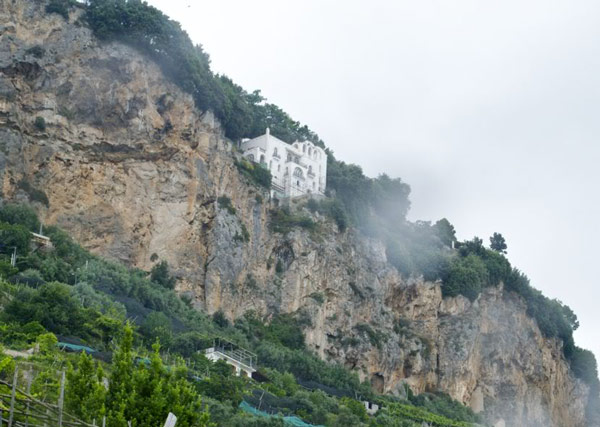
Gore Vidal's magnificent Mediterranean digs – Calvino was a neighbor.
A few days ago I wrote about Italo Calvino. I’ve so far neglected the death of Gore Vidal – so many have written so much already I didn’t feel I had anything substantive to add.
Since both writers have been on my mind, it was curious to see their names intertwined in a link (can’t even remember where) that revisited a New York Review of Books article, featuring Vidal’s 1985 recollection of Calvino’s burial in Italy – the two were, in fact, neighbors.
Europe regarded Calvino’s death as a calamity for culture. A literary critic, as opposed to theorist, wrote at length in Le Monde, while in Italy itself, each day for two weeks, bulletins from the hospital at Siena were published, and the whole country was suddenly united in its esteem not only for a great writer but for someone who reached not only primary school children through his collections of folk and fairy tales but, at one time or another, everyone else who reads.
He had first written about Calvino eleven years earlier, in an essay that included the passage: “Reading Calvino, I had the unnerving sense that I was also writing what he had written; thus does his art prove his case as writer and reader become one, or One.” The article caught Calvino’s attention, the two exchanged letters, and finally met.
En route to the burial sans ceremony at Castiglion della Pescáia, Vidal recalled:
As we drove north through the rain, I read Calvino’s last novel, Palomar. He had given it to me on November 28, 1983. I was chilled—and guilty—to read for the first time the inscription: “For Gore, these last meditations about Nature, Italo.” “Last” is a word artists should not easily use. What did this “last” mean? Latest? Or his last attempt to write about the phenomenal world? Or did he know, somehow, that he was in the process of “Learning to be dead,” the title of the book’s last chapter?
What greatness looks like.
What’s surprisingly moving in Vidal’s account is his obvious reverence for the Italian maestro, which assumes the usual form of embroidering a connection to make it more important, more real (“I hold Chichita’s hand a long moment,” he makes sure he tells us as he stands at the graveside with Calvino’s widow). One would not have expected Vidal to expose himself that way, even inadvertently. But humility is the sincerest and most difficult form of greatness.
That’s why it’s so dispiriting that Vidal’s fatal flaw persistently surfaces, the one that kept his own work from greatness: Vidal can’t resist the impulse to take an unnecessary and irrelevant swipe at those he holds in contempt, which is almost all of us. For example, an almost random mention of meeting “the dread physical therapist Ms. Fonda Hayden,” which undermines the piece and should have met a sterner editorial pen.
He also laces his piece with taxonomies of middlebrow, highbrow, lowbrow, along with disdainful (and often unjust) comparisons of, for example, American ways with Continental ways – with the former always risible, provincial, gaffe-prone. The inclusion of such remarks is predicated on the idea that we give a damn, and gives the impression that we earnestly seek his approval or want to be one of the toffs. We don’t. Where was the friend who could have told him these asides immeasurably weaken his writing?
A more or less random example of passing insult: “He wants us to see not only what he sees but what we may have missed by not looking with sufficient attention. It is no wonder that Galileo crops up in his writing. The received opinion of mankind over the centuries (which is what middlebrow is all about) was certain that the sun moved around the earth but to a divergent highbrow’s mind, Galileo’s or Calvino’s, it is plainly the other way around. Galileo applied the scientific methods of his day; Calvino used his imagination. Each either got it right; or assembled the data so that others could understand the phenomenon.
But I have seen “highbrows” hold remarkably conventional and conformist views, and I have encountered truly original and iconoclastic lowbrows. So this isn’t a measure of anything except Vidal’s rather commonplace worship of “science.”
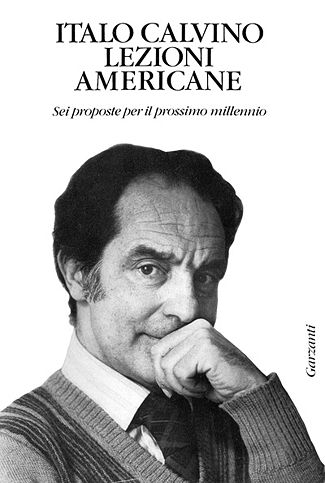
Here’s what Calvino does with related material, in the Charles Eliot Norton lectures that preoccupied him in his final months, and eventually became Six Memos for the Next Millenium:
Overambitious projects may be objectionable in many fields, but not in literature. Literature remains alive only if we set ourselves immeasurable goals, far beyond all hope of achievement. Only if poets and writers set themselves tasks that no one else dares imagine will literature continue to have a function. Since science has begun to distrust general explanations and solutions that are not sectorial and specialized, the grand challenge for literature is to be capable of weaving together the various branches of knowledge, the various “codes,” into a manifold and multifaceted vision of the world.
On the video below, Vidal says: “He was the only great writer of my time.” This is a great video, thoroughly addictive.
My introduction to Italo Calvino occurred some years ago via the poet Kay Ryan, who recommended Six Memos for the Next Millenium, which she seemed to view as a personal enchiridion. The essays were written in 1985, the year Calvino died.
Here’s one passage I marked with pencil from the essay called “Lightness,” as he recalled his beginnings as a writer:
“Maybe was I only then becoming aware of the weight, the inertia, the opacity of the world – qualities that stick to writing from the start, unless one finds some way of evading them.
“At certain moments I felt that the entire world was turning into stone: a slow petrification, more or less advanced depending on people and places but one that spared no aspect of life. It was as if no one could escape the inexorable stare of Medusa. The only hero able to cut off Medusa’s head is Perseus, who flies on winged sandals…”
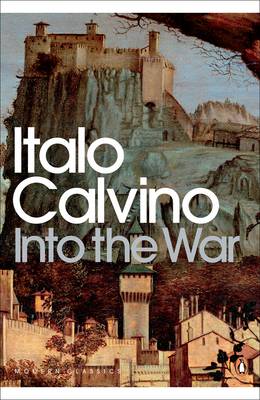
Joseph Luzzi calls the Italian author a “self-styled moralist” in a recent Times Literary Supplement article here – how does that lightness weigh against fascist Italy, then? Calvino’s newly translated Into the War, a trilogy of autobiographical works, takes a very heavy subject – war – and views it through the ambiguous and non-commital gaze of an adolescent, watching from the sidelines.
The beginning of the first story, “Into the War”, evokes Clausewitz’s famous depiction of the “fog of war”, a realm permeated by uncertainty and requiring – yet rarely finding – unusual powers of discernment: “The 10th June 1940 was a cloudy day. It was a time in our lives when we weren’t interested in anything . … We knew that Mussolini was to speak in the afternoon, but it was not clear whether we would be going to war or not”. … Mussolini makes only a brief cameo in “Into the War”, when he speeds past the narrator in an open-top car, on his way to inspect the troops. The only person who seems to be enjoying himself, Mussolini appears as a child playing a very dangerous game; less sanguine, the distracted Calvino can only comment, “the car was going fast; [Mussolini] had disappeared. I had barely seen him”.
Calvino described lyrical autobiography as enemy terrain. He had reservations about memoir and autobiography, once confessing to a reviewer, “Once you start on the road to autobiography, where do you stop?”
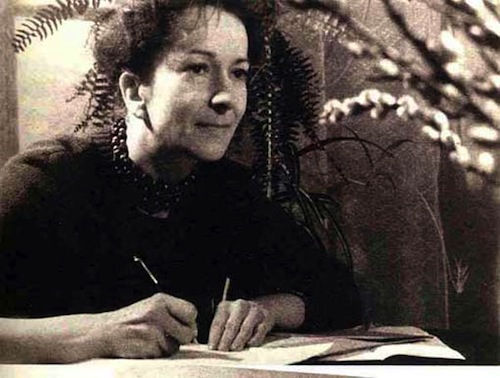
Wisława Szymborskais dead at 88. It’s after 1 a.m., but it wouldn’t seem right to let the night pass without a comment.
In 2008, I had tried persistently to meet the reclusive Nobel poet in Kraków – another story, for another time. During my return for the Year of Czesław Miłosz last spring, my time had run out too quickly, and now apparently hers has also.
But I did see her briefly last spring, at a rare public appearance at St. Catherine’s Church, a reading where she shared the stage with her friend Julia Hartwig, the Chinese poetBei Dao, and others. The formidable figure seemed friendly, frail, exuding warmth and authenticity. Afterward, she was whisked away through the back, like a rare and delicate doll that must be exhibited, but not touched by the fans who had flooded the medieval church.
Perhaps the reason for the paucity is because it took a long while to edit the “I” out of her poems, which slip in and out of personal identity. The heart-breaking title poem assumes the voice of a dictator’s dog; “Among the Multitudes” considers the wonder of being born human rather than with fins or feathers; another poem ponders her one-sided relationship with plants; “Plato, or Why” asks about the Ideal Being — “Why on earth did it start seeking thrills/ in the bad company of matter? … Wisdom limping/ with a thorn stuck in its heel?”
Or perhaps it’s because, as she has written elsewhere, she has tried to borrow weighty words, and then labored to lighten them. As always with Szymborska, a poet who survived the Nazi and Soviet regimes in Poland, poems of war and dislocation are told with a feather touch that nonetheless, for all its lightness, lingers. “Some People” describes the plight of refugees: “Always another wrong road ahead of them,/ always another wrong bridge/ across an oddly reddish river.”
Szymborska’s lightness is never denial or indifference; it is a subtle means of defiance. Italo Calvino, who praised the literary virtue of leggerezza, which he called the “subtraction of weight,” elaborated: “Whenever humanity seems condemned to heaviness, I think I should fly like Perseus into a different space. … I have to change my approach, look at the world from a different perspective, with a different logic and with fresh methods of cognition and verification.”
When I pronounce the word Future,
the first syllable already belongs to the past.
When I pronounce the word Silence,
I destroy it.
When I pronounce the word Nothing,
I make something no non-being can hold.

 The Italian writer Italo Calvino would have been ninety today. Happy birthday, wherever you are…