
A novelist? “He knows no obligations of honor.”

Share

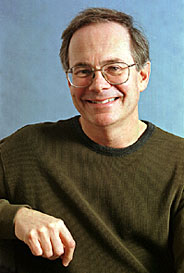
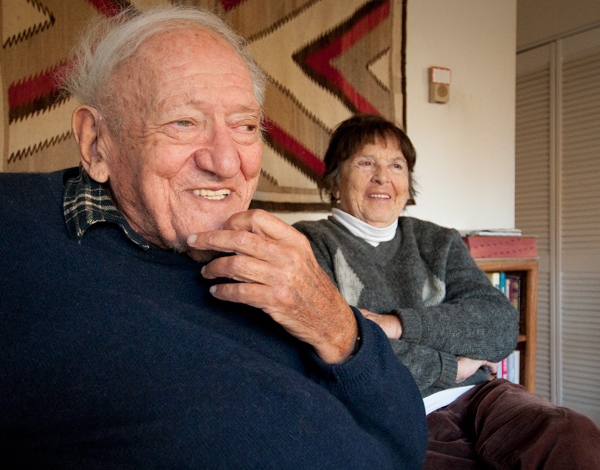
Joseph and Marguerite Frank, chuckling in their apartment. (Photo: L.A. Cicero)

Another sunny autumn day in Palo Alto.  And yes, California’s reputation for non-seasons notwithstanding, there were buckets of crisp red and orange and yellow leaves everywhere.

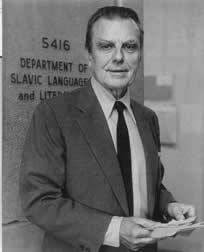
I spent the late afternoon chatting at a Stanford cafe with Marguerite and Joe Frank, the preeminent Dostoevsky scholar of our era, and the author of a big, thick, multi-volume biography.

Joe was in a wheelchair, wearing a black baseball cap that had “Crime and Punishment” embroidered in white Roman type across the front – a souvenir from a film crew. The longtime Paris denizen told me the cap was a good way to ferret out the Americans in France; they react to the title. Meanwhile, Marguerite advised me where to find Romanesque architecture in southern France next month.

Conversation inevitably turned Slavic.  Joe recalled Czesław Miłosz‘s visit to campus, some years ago.  The Polish poet thought highly of the Dostoevsky scholar – and said so in his address.  Miłosz taught Dostoevsky at Berkeley for years, but why is a little of a mystery.  Robert Hass told me a decade ago:  “Some of us asked him if he’d read Flannery O’Connor, and he said no. Had he read so-and-so? ‘No.’ And finally he said, ‘You know, I don’t agree with the novel.’ That’s a different way of thinking.”

It wasn’t the only different way of thinking on the subject of Dostoevsky.  I was reminded me of something I found this morning, while doing some reading for my upcoming talk on Miłosz at the British Academy.  From the Paris Review interview with the poet and Robert Faggen:
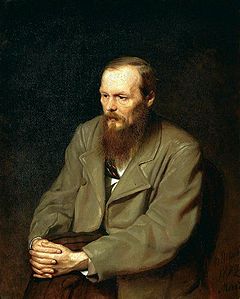
 

Without honor?

INTERVIEWER

Since then you have been uninterested in writing novels. You seem to have a quarrel with the genre. Why?

MILOSZ

It’s an impure form. I taught Dostoyevsky at Berkeley for twenty years. A born novelist, he would sacrifice everything; he knows no obligations of honor. He would put anything in a novel. Dostoyevsky created a character in The Idiot, General Ivolgin, who is a liar and tells stories—how he lost his leg in a war, how he buried his leg, and then what he inscribed on the tombstone. The inscription is taken from the tomb of Dostoyevsky’s mother. There you have a true novelist. I couldn’t do that.


Happy Halloween – here’s the best pumpkin evah.

Share

Happy Halloween, everybody!

Enjoy the day with the best pumpkin of the year – perhaps the best pumpkin evah.  This beauty was commissioned for New York City’s Museum of Modern Art, and carved by Marc Evan and Chris Soria.  I wonder how long it took to make.

Meanwhile, in the spirit of the day, you might want to revisit Dana Gioia’s ghost story, or more recently the Jeff Sypeck’s take on the spooks from the rooftops of Washington’s National Cathedral.  Or how about George Orwell on love, sex, religion, and ghosts. Or… or… or… Dostoevsky, Coetzee, Vargas Llosa, and Paul West on evil — just in time for Halloween.

Enjoy the day, and take it easy on the candy.  Read a book instead.

Postscript:  From high art to pop art in a few quick hours.  Here’s another pumpkin to celebrate the day.  Sculptor Andy Bergholtz created the jack-o-lantern Joker in one manic 8-hour stretch:

“Surprisingly, Bergholtz has only been carving pumpkins for a year. He said that another sculptor he knows, Ray Villafane, had been encouraging him for years to sculpt squash, but he resisted.  Then last year Villafane recruited him to help carve pumpkins for Heidi Klum’s Vegas Halloween party. Bergholtz said, ‘I instantly fell in love with the art form and haven’t looked back since.'”

Want to know how the artist did it?  See video below.

“His sobering effect”: Czesław Miłosz’s “Notes on Joseph Brodsky”

Share

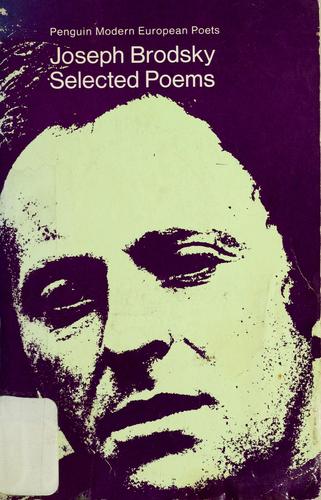
Last weekend I was chatting with Joseph Brodsky‘s first translator, George Kline.  The Bryn Mawr professor befriended the young Russian poet in St. Petersburg, and went on to be the translator of the Harper & Row 1973 Selected Poems, with a foreword by W.H. Auden.  It was later reissued as a Penguin paperback – I carried that dog-eared volume with me from 1976, when I bought it in an Ann Arbor bookstore, until it was lost it in a foreign city … somewhere in Vilnius, as I recall, sometime in the late 1990s.

George thanked me for sending him Czesław Miłosz‘s “Notes on Brodsky.” I couldn’t recall having done so, but looked up a copy for myself in Stanford’s Green Library, in a 1996 Partisan Review, to make sure I hadn’t.

The piece is well worth excerpting.  “The presence of Brodsky for many among his poet-colleagues was a mainstay and as if a point of reference,” the Polish poet wrote.  Later, “whatever survived from the past has been due to the principle of hierarchical distinction.”

“Here was a man who by his oeuvre and by his life reminded us, against what today is so often proclaimed and written, that hierarchy exists.  That hierarchy cannot be contrived by syllogisms and established in a discourse.  Rather, by living and writing, we affirm it every day anew. It has something to do with the elementary division into beauty and ugliness, truth and falsity, goodness and cruelty, liberty and tyranny. But, first of all, hierarchy means respect for that which is elevated and unconcern, rather than scorn, for that which is base. …

“To go straight to the goal, not letting oneself be swayed by any voices calling for one’s attention. That is, knowing how to recognize what is important and clinging only to it. That was precisely the the strong side of the great Russian writers of the past.

“Brodsky’s life and writing tended toward accomplishment, as an arrow tends towards the aim. Yet, evidently, that was an illusion, just as in the case of Pushkin or Dostoevsky. We must therefore formulate it differently – that fate tends straight to the aim, while the one who is ruled by fate knows how to read its main lines and to comprehend, be it dimly, that to which one is called.”

His words brought back what the Miłosz had said to me on the same subject, about “maintaining one’s own vision, one’s own taste, let us say, against the current fashion of the day.”

Esse.

From my Georgia Review interview a dozen years ago: “I have lived a long time in the West and tried to remain faithful to a line of Polish poetry. The same applies to Brodsky and Russia. The history of poetry is the history of language. That’s why Joseph Brodsky wrote that we write to please our predecessors, not our contemporaries.”  I’ve quoted this part before, about Milosz’s crucial division between esse and devenir:

“There was at a given moment a stable world where we could see, hold on to values that were a reflection of the eternal order of things. Now we are in a flux. This is a very peculiar way of life. … When everything is in flux, revision, it is healthy to have some poets who preserve the feeling of respect.  In a way, Brodsky was a conservative voice in that sense – he had a lot of sense.”

“For me, the value of Brodsky was his sobering effect, and his enormous feeling of hierarchy. He had a great feeling of hierarchy of value in works of art and works of literature.”

Nihilism, rebellion, and the perfect casting for The Brothers Karamazov

Share

Malkovich ... the perfect Ivan Karamazov?

I’m not familiar with the writings of the Russian philosopher Nikolai Berdyaev, but my friend Artur Rosman posted this on his Facebook page, and I’ve been pondering it now for several days.

Remember the “Grand Inquisitor” segment of Fyodor Dostoevsky‘s The Brothers Karamazov?  Long story.  Jesus Christ comes to Seville at the time of the Inquisition and is arrested after performing several miracles.  But just before he does, Ivan Karamazov makes a speech to his brother Alyosha on the intolerable suffering of children:

“And if the suffering of children goes to make up the sum of suffering needed to buy truth, then I assert beforehand that the whole of truth is not worth such a price. … I’d rather remain with my unrequited suffering and my unquenched indignation, even if I am wrong. … And therefore I hasten to return my ticket. And it is my duty, if only as an honest man, to return it as far ahead of time as possible. Which is what I am doing. It’s not that I don’t accept God, Alyosha, I just most respectfully return him the ticket.”

Always seemed a bit of a put-up job to me.  Berdyaev finally explained why:

Law ... the perfect Alyosha?

“Ivan Karamazov is a thinker, a metaphysician and psychologist, and he provides a deep philosophic grounding to the troubled experiences of an innumerable number of Russian boys – the Russian nihilists and atheists, socialists and anarchists. At the core of the question of Ivan Karamazov lies a sort of false Russian sensitivity and sentimentality, a false sort of sympathy for mankind, leading to a hatred towards God and the Divine purpose of worldly life. Russians all too readily become nihilistic rebels out of a false moralism. The Russian takes God to task over history because of the tears of the child, returns back the ticket, denies all values and sanctities, he will not tolerate the sufferings, wants not the sacrifices. Yet he however does nothing really, in order to lessen the tears, he adds to the quantity of flowing tears, he makes a revolution, which is all grounded upon uncountable tears and sufferings.”

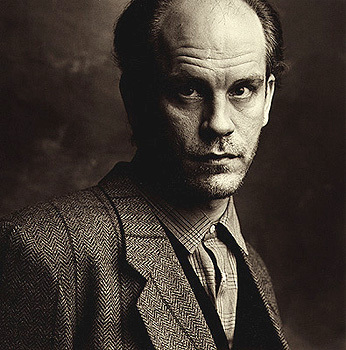
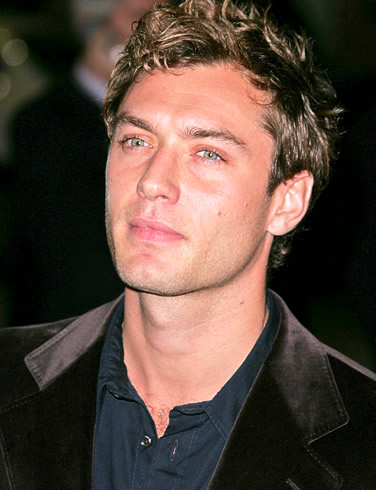
If you don’t have time for the 800-page book, you might try one of the films based on the book.  Like this one, with John Malkovich as Ivan Karamazov, and Jude Law as his brother Alyosha, and Sean Penn as Dmitri Karamazov, and Gerard Depardieu as their murdered father Fyodor Karamazov … whoops!  Movie was never made. I looked for it in vain.  Apparently, the Bernardo Bertolucci film is someone’s pipe dream of ideal casting.

While looking for a film clip telling me about this all-star film, I found this intriguing Russian miniseries by Pervyi Kanal seems to capture the spirit of the thing.

Ouch! A scientist’s sharp letter about the Albany massacre

Share

Science nerd on the attack

Dan Edelstein brought this letter to my attention — a rather scalding letter to George Philip,  the president of the SUNY Albany, who recently announced that the university was cutting its French, Italian, Classics, Russian and Theater Arts departments.

The author, Gregory Petsko, a professor of biochemistry and chemistry at Brandeis, started out as a classics major.  Yet he writes, “Of all the courses I took in college and graduate school, the ones that have benefited me the most in my career as a scientist are the courses in classics, art history, sociology, and English literature. These courses didn’t just give me a much better appreciation for my own culture; they taught me how to think, to analyze, and to write clearly. None of my sciences courses did any of that.”

An excerpt:

“I’m sure that relatively few students take classes in these subjects nowadays, just as you say. There wouldn’t have been many in my day, either, if universities hadn’t required students to take a distribution of courses in many different parts of the academy … You see, the reason that humanities classes have low enrollment is not because students these days are clamoring for more relevant courses; it’s because administrators like you, and spineless faculty, have stopped setting distribution requirements and started allowing students to choose their own academic programs – something I feel is a complete abrogation of the duty of university faculty as teachers and mentors. You could fix the enrollment problem tomorrow by instituting a mandatory core curriculum that included a wide range of courses.

University prez on the defense

“Young people haven’t, for the most part, yet attained the wisdom to have that kind of freedom without making poor decisions. In fact, without wisdom, it’s hard for most people. That idea is thrashed out better than anywhere else, I think, in Dostoyevsky‘s parable of the Grand Inquisitor, which is told in Chapter Five of his great novel, The Brothers Karamazov. In the parable, Christ comes back to earth in Seville at the time of the Spanish Inquisition. He performs several miracles but is arrested by Inquisition leaders and sentenced to be burned at the stake. The Grand Inquisitor visits Him in his cell to tell Him that the Church no longer needs Him. The main portion of the text is the Inquisitor explaining why. The Inquisitor says that Jesus rejected the three temptations of Satan in the desert in favor of freedom, but he believes that Jesus has misjudged human nature. The Inquisitor says that the vast majority of humanity cannot handle freedom. In giving humans the freedom to choose, Christ has doomed humanity to a life of suffering.

“That single chapter in a much longer book is one of the great works of modern literature. You would find a lot in it to think about. I’m sure your Russian faculty would love to talk with you about it – if only you had a Russian department, which now, of course, you don’t.

Bye bye, Fyodor

“Then there’s the question of whether the state legislature’s inaction gave you no other choice. I’m sure the budgetary problems you have to deal with are serious. They certainly are at Brandeis University, where I work. And we, too, faced critical strategic decisions because our income was no longer enough to meet our expenses. But we eschewed your draconian – and authoritarian – solution, and a team of faculty, with input from all parts of the university, came up with a plan to do more with fewer resources. I’m not saying that all the specifics of our solution would fit your institution, but the process sure would have. You did call a town meeting, but it was to discuss your plan, not let the university craft its own. And you called that meeting for Friday afternoon on October 1st, when few of your students or faculty would be around to attend. In your defense, you called the timing ‘unfortunate’, but pleaded that there was a ‘limited availability of appropriate large venue options.’ I find that rather surprising. If the President of Brandeis needed a lecture hall on short notice, he would get one. I guess you don’t have much clout at your university.

Ciao

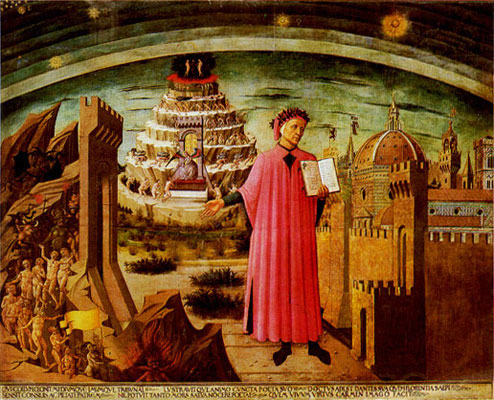
“It seems to me that the way you went about it couldn’t have been more likely to alienate just about everybody on campus. In your position, I would have done everything possible to avoid that. I wouldn’t want to end up in the 9th Bolgia (ditch of stone) of the 8th Circle of the Inferno, where the great 14th century Italian poet Dante Alighieri put the sowers of discord. There, as they struggle in that pit for all eternity, a demon continually hacks their limbs apart, just as in life they divided others.

“The Inferno is the first book of Dante’s Divine Comedy, one of the great works of the human imagination. There’s so much to learn from it about human weakness and folly. The faculty in your Italian department would be delighted to introduce you to its many wonders – if only you had an Italian department, which now, of course, you don’t.  …” read more here.

Dostoevsky, Coetzee, Vargas Llosa, and Paul West on evil — just in time for Halloween!

Share

In their book-crammed flat (Photo: L.A. Cicero)

Still thinking about evil after my post a few days ago, in keeping with Halloween.  Where better to turn than a Dostoevsky scholar?

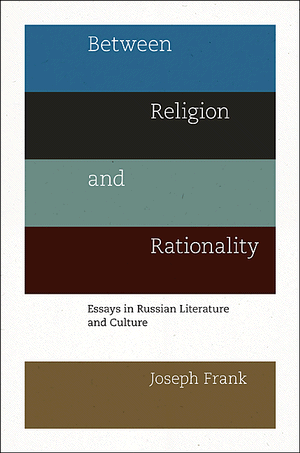
Joseph Frank sent me his book Between Religion and Rationality some time ago.  Morgan Meis over at The Owls would have found the cover sexy.  My tastes, alas, are a little more flashy and vulgar.  I found it too sedate.  Perhaps that’s why the book remained in a pile of books I meant to read.  But I picked it up at last for his chapter on “Dostoevsky and Evil.”

I was pleased to see Joe’s essay style is lucid and unaffected — and as digressive and roundabout as he can be in conversation.  So the effect is halfway between formal essay and a conversation in Joe and Marguerite’s book-crammed campus flat.

He opens with J.M. Coetzee‘s Elizabeth Costello, discussing the title character’s revulsion at Paul West’s The Very Rich Hours of Count von Stauffenberg, which describes degrading,  obscene details of the execution of Hitler’s would-be assassins.  But the details recounted are fictional.  No one was there to say what had actually happened.

Not sexy

“What troubles her above all is that, while appalled and repelled by the book, she had not been able to push it away entirely. It had resisted her feelings of revulsion and disgust, and she feared that some of the ‘absolute evil’ it depicted had, as it were, also infected her; ‘she felt, she could have sworn, the brush of Satan’s hot, leathery wing.”

(The protagonist also shares Coetzee’s passionate vegetarianism: “If Satan is not rampant in the abattoir, casting the shadow of its wings over the beast … where is he?”)

Mario Vargas Llosa, author of The Feast of the Goat, another book that portrays evil in graphic detail, has a different take.  (And here’s where Dostoevsky comes into play.)  Joe quotes the Peruvian author:

“Perhaps we would be able to read what Mr. West wrote and learn from it, and therefore come out stronger rather than weaker. … The manner in which a poem, a novel, a play works on the sensibility or on a character varies to infinity, and much more as a result of the reader than rather than of the work.  To read Dostoevsky may, in some cases, lead to traumatic and criminal consequences, while on the other hand it is not impossible that the spermatic iniquities of the Marquis de Sade have increased the percentage of virtuous readers, vaccinating them against carnal vice.”

Sorry.  I’m with fellow vegetarians Coetzee and Elizabeth Costello on this one. I know what it is like to feel polluted even by a brilliantly written book (perhaps more so then).  But the good Prof. Frank has a different p.o.v. altogether:  “The details chosen to evoke the scene are his [West’s] own creation, and her [Costello’s] horrified response cannot simply be fobbed off as a private reader reaction.”  Recalling Dostoevsky’s murders in Crime and Punishment, he writes:

Pity, terror, and dinner soon

“One would be hard put to match such grisly details in either the European or the Russian novel of the same period, but their effect is ultimately offset by the intensity of Raskolnikov’s inner suffering and his final inability to endure his total estrangement from the rest of humanity.  …  One can find example after example in Dostoevsky’s works of the same boldness in depicting evil at work and the same effort to overcome its effects.”

He returns to Costello, Coetzee, and Paul West:

“… as author he [West] is responsible for the manner in which he depicts this episode; and there is no evidence here of pity, only terror and even horror.  It is such horror that leads Costello to level against him the charge of ‘obscenity,’ and to arrive at her extreme conclusion. ‘To save our humanity, certain things that we may want to see (may want to see because we are human!) must for ever remain off-stage.  Paul West … has shown what ought not to be shown.'”

Costello longs to argue with West, “some confrontation leading to some final word” — however, concludes Frank, “one cannot help thinking that the person Costello really wishes to meet, rather than Paul West, is an incarnation of Dostoevsky.”

And perhaps Charles Dickens, as well.  And Victor Hugo.  Maybe Lev Tolstoy, too. May I come to that dinner?  Soon?