
What do Truman Capote, Ernest Hemingway, Philip K. Dick, and Jean-Paul Sartre have in common?

Share

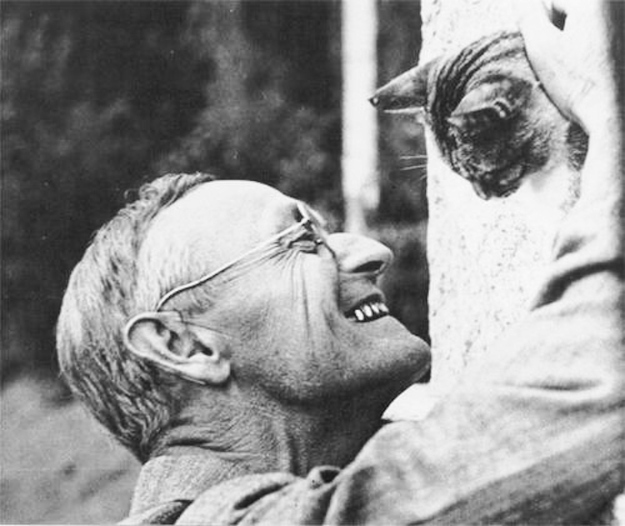
Hermann Hesse finds true love

I have a lot of writing to finish between now and Sunday night – I’ll be going at it 24/7.  Meanwhile, you might want to check out Buzzfeed’s “30 Renowned Authors Inspired by Cats.”  There’s also more at Writers and Kitties.

Mark Twain was an obvious choice.  But I combed through to see if they were going to remember some of the world’s most famous cat-lovers.  Colette, for example, who famously said, “Plus je connais les hommes, plus j’aime mes chats.”
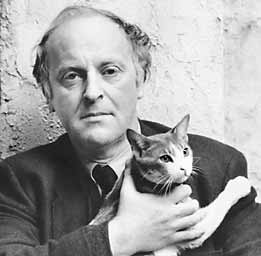
Mississippi and J.B. (Photo: Bengt Jangfeldt)

She’s there, along with Truman Capote, Ernest Hemingway, Edgar Allan Poe, Philip K. Dick, Hermann Hesse, Edward Gorey, George Plimpton, Jacques Derrida, W.H. Auden, and Jean-Paul Sartre make the cut.  But where’s T.S. Eliot, for goodness sake?

A few other notables were missed.  Where is Joseph Brodsky and his famous cat Mississippi?

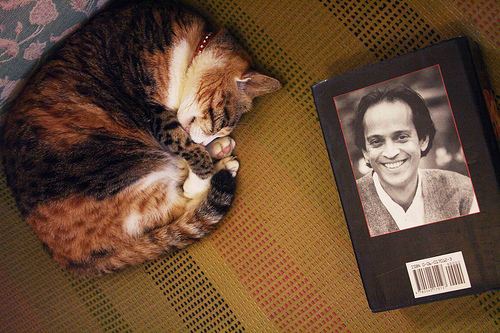
I’m not entirely sure Vikram Seth is a cat-lover, but I think he must be.  The gnarly old tomcat Charlemagne, in The Golden Gate, is one of the great literary cats. I could find no photo of him with cats – only this from Delhi Walla, which is as close as I’m going to get tonight.  And since my own copy of Golden Gate is loaned out to a good cause, I found this sole sonnet (the novel is composed of Pushkin tetrameter sonnets), in which the lawyer John is warned of his romantic competition for the heart of fellow attorney Liz.  I like the way these fleet, four-footed sonnets fit onto wordpress better, next to a photograph, without awful line breaks:

Vikram Seth and fan
Ah, John, don’t take it all for granted.
Perhaps you think Liz loves you best.
The snooker table has been slanted.
A cuckoo’s bomb lies in the nest.
Be warned. Be warned. Just as in poker
The wildness of that card, the joker
Disturbs the best-laid plans of men,
So too it happens, now and then,
That a furred beast with feral features
(Little imagined in the days
When, cute and twee, the kitten plays),
Of that familiar brood of creatures
The world denominates a cat,
Enters the game, and knocks it flat.

Charles Bukowski and friend

Speaking of Vikram Seth, let’s take a moment to give equal time to dogs.  I have in mind one that played prominently in Seth’s novel, An Equal Music. It’s St. Augustine’s small white Maltese dog in Vittore Carpaccio‘s Saint Augustine in His Study, in Venice’s Scuola di San Giorgio degli Schiavoni. It’s from Carpaccio’s mature period – he began it in 1502 and completed it in 1507. It’s one of seven panels he made, still in the Schola, depicting the guild’s patron saints.

On Vikram Seth’s authority, I shlepped to the Schola a decade or so ago. It’s tucked away on one of Venice’s sidestreets and not easy to find.  It was worth it. The schola is dark and mysterious and pure magic. The painting everything he said it would be.

Highly recommended.

.
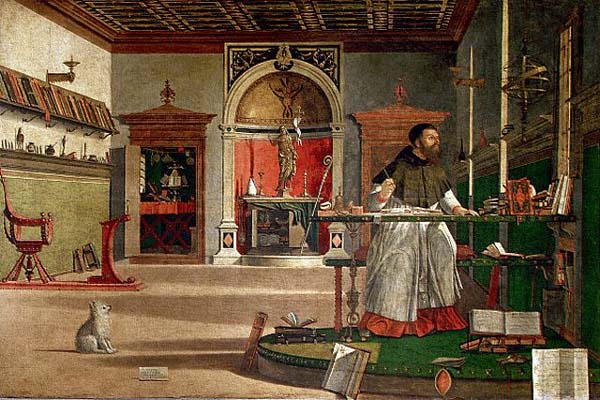
A saint's best friend...Carpaccio's Augustine in his study

.
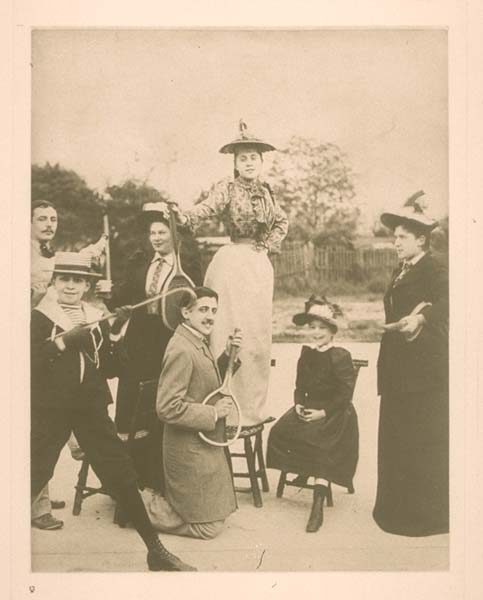
Marcel Proust playing air guitar

Share

OK, you’ve got to see thisSusan Sontag in a bear suit.  Flavorwire has Annie Leibovitz‘s photo of her partner thus outfitted – but go to the source, which is here, for a gallery of Leibovitz’s portraits, including some magnificent ones of Sontag.

Flavorwire’s “Extremely Silly Photos of Extremely Serious Writers” features Sontag as Exhibit #1, but some of them are more or less unsurprising. Mark Twain playing billiards, Ernest Hemingway kick a can, Hunter Thompson with an inflatable woman, Colette dressed as a cat – but this one takes the cake: Marcel Proust playing air guitar on Boulevard Bineau with his friends in 1892 (his mimetic beloved Jeanne Pouquet in center).  At this time of the photo, he was known as a snob, a dilettante, and a social climber.

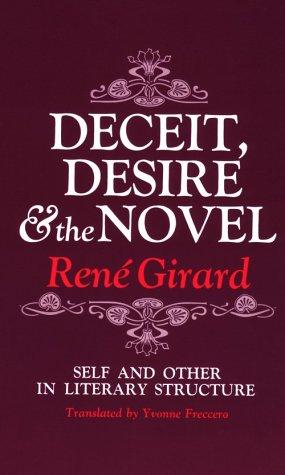
But the somehow sad image brought back the words of René Girard (recently the subject of a post here) from his landmark Deceit, Desire, and the Novel, which celebrated its 50th anniversary since publication a few months ago. His words:

“The sterile oscillation between pride and shame is also found in Proustian snobbism. We shall never despise the snob as much as he despises himself. The snob is not essentially despicable; he tries to escape his own subjective feeling of contemptibility by assuming the new being which he supposedly procures through snobbism. The snob thinks he is always on the point of securing this being and behaves as if he has already done so. Thus he acts with intolerable arrogance. Snobbism is an inextricable mixture of pride and meanness, and it is this very mixture which defines metaphysical desire. …

“The snob bows before a noble title which has lost all real value, before a social prestige so esoteric that it is really appreciated by only a few elderly ladies. … The snob seeks no concrete advantage; his pleasures and sufferings are purely metaphysical.”

The anonymous photo is from the Bibliothèque Nationale de France, which, incidentally, also has the René Girard archive.

When literary tête-à-têtes ends in fisticuffs…

Share

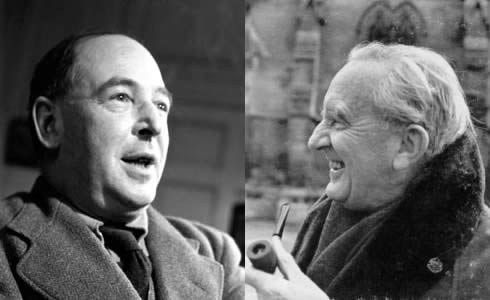
The subject of the fistfight: Lewis and Tolkien

It’s not often that two guys having a literary discussion end up by hauling off and whacking each other. And yet  it happened in the city of my alma mater, after several hours of serious drinking:

A 34-year-old Ann Arbor man was sent to the hospital with a head injury after another man punched him on Saturday during a literary argument, according to police. … the man was sitting on the porch with some people he had just met, talking about books and authors.

The 34-year-old man was then approached by another party guest, who started speaking to him in a condescending manner. An argument ensued and the man was suddenly struck in the side of the head, suffering a cut to his left ear …

The injured man – who was smacked so hard his glasses flew off and a lens popped out – was treated at a local hospital.

The story jumped from Ann Arbor to The Guardian, whose blogger, Sam Jordison, telephoned Michigan to get the scoop:  “The details remain sketchy, but the prominent rumour around town is that the men were disputing the relative merits of J.R.R. Tolkien and C.S. Lewis.”

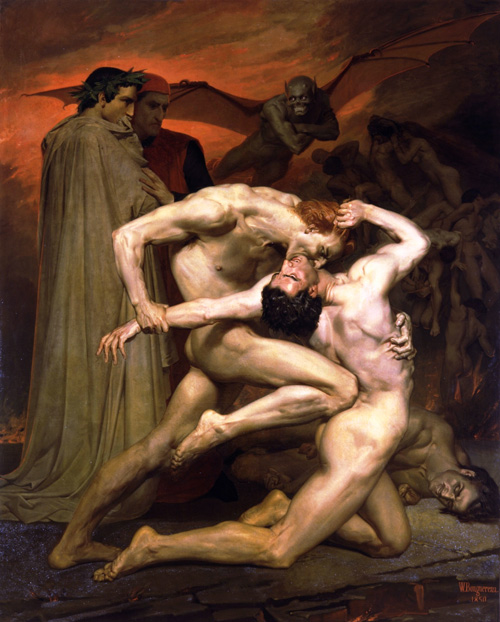
Virgil says: Don't watch. Don't listen.

Then Jordison shares his own self-satisfaction and his derision of his betters (Henry James, for example, is “the old windbag”) – apparently, he never loses a fight and is always right, just like the rest of us.  (It is the one thing we all have in common.) Then he asks a question:

But all this does make me wonder whether anyone else has experienced book-based violence. Have you had a literary argument so heated that you’ve only been able to resolve it with blows? Or could you imagine doing so – or at least losing your cool? And what’s your tipping point? If, for example, I were to inform you that J.M. Coetzee‘s Disgrace is a clever book for people who don’t like to think, would you hold it against me? And how do you like to annoy other book-lovers?

Here’s a few.

Mailer, Gore

Mad men: Mailer, Gore

There’s the time Norman Mailer punched Gore Vidal. “As usual, words failed him,” quipped Vidal.

And two Nobel laureates ended a friendship when Mario Vargas Llosa socked Gabriel García Márquez – story recounted here and here.

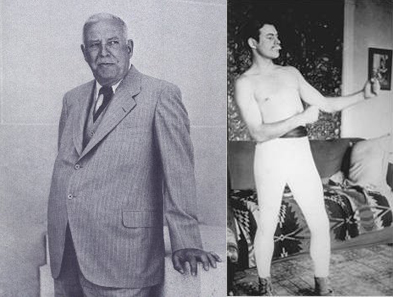
Then there’s the fistfight between Ernest Hemingway and Wallace Stevens, confirmed by others but recounted by Hemingway in a February 1936 letter:

"Nice Mr. Stevens" and Hemingway

Nice Mr. Stevens. This year he came again pleasant like the cholera and first I knew of it my nice sister Ura was coming into the house crying because she had been at a cocktail party at which Mr. Stevens had made her cry by telling her forcefully what a sap I was, no man, etc. So I said, this was a week ago, ‘All right, that’s the third time we’ve had enough of Mr. Stevens.’ So headed out into the rainy past twilight and met Mr. Stevens who was just issuing from the door having just said, I learned later, ‘By God I wish I had that Hemingway here now I’d knock him out with a single punch.’

So who should show up but poor old Papa and Mr. Stevens swung that same fabled punch but fertunatly missed and I knocked all of him down several times and gave him a good beating. Only trouble was that first three times put him down I still had my glasses on. Then took them off at the insistence of the judge who wanted to see a good clean fight without glasses in it and after I took them off Mr. Stevens hit me flush on the jaw with his Sunday punch bam like that. And this is very funny. Broke his hand in two places. Didn’t harm my jaw at all and so put him down again and then fixed him good so he was in his room for five days with a nurse and Dr. working on him. But you mustn’t tell this to anybody.

The winners

Then there’s the time that Desmond Leslie punched journalist and theater critic Bernard Levin in front of 11 million viewers over an article Levin had written about his wife, the actress Agnes Bernelle. The incident occurred the TV show That Was The Week That Was in 1962.

I am forced to come to the conclusion that book-lovers are a quarrelsome lot, not so much from these incidents as from some of the unsupported character assassination in the reader replies (though they did tip me off about where to find the best fights). Basta! What is it in us that likes to watch a fight?  As Virgil says to Dante in the Inferno: “To hear such wrangling is a joy for vulgar minds.” It’s one reason the Inferno has always been more popular than the Purgatorio or the Paradiso. Something to remember when one indulges in the “Comments” sections.

The two who come out best from the whole mess are … those two tweedy Oxford dons, J.R.R. Tolkien and C.S. Lewis.  Lewis, in particular, was generous and self-sacrificing to an extreme, and though the two men disagreed, they remained gentlemen and friends.