
Joseph Brodsky: “If we have all this here, why do we need Europe?”

Share

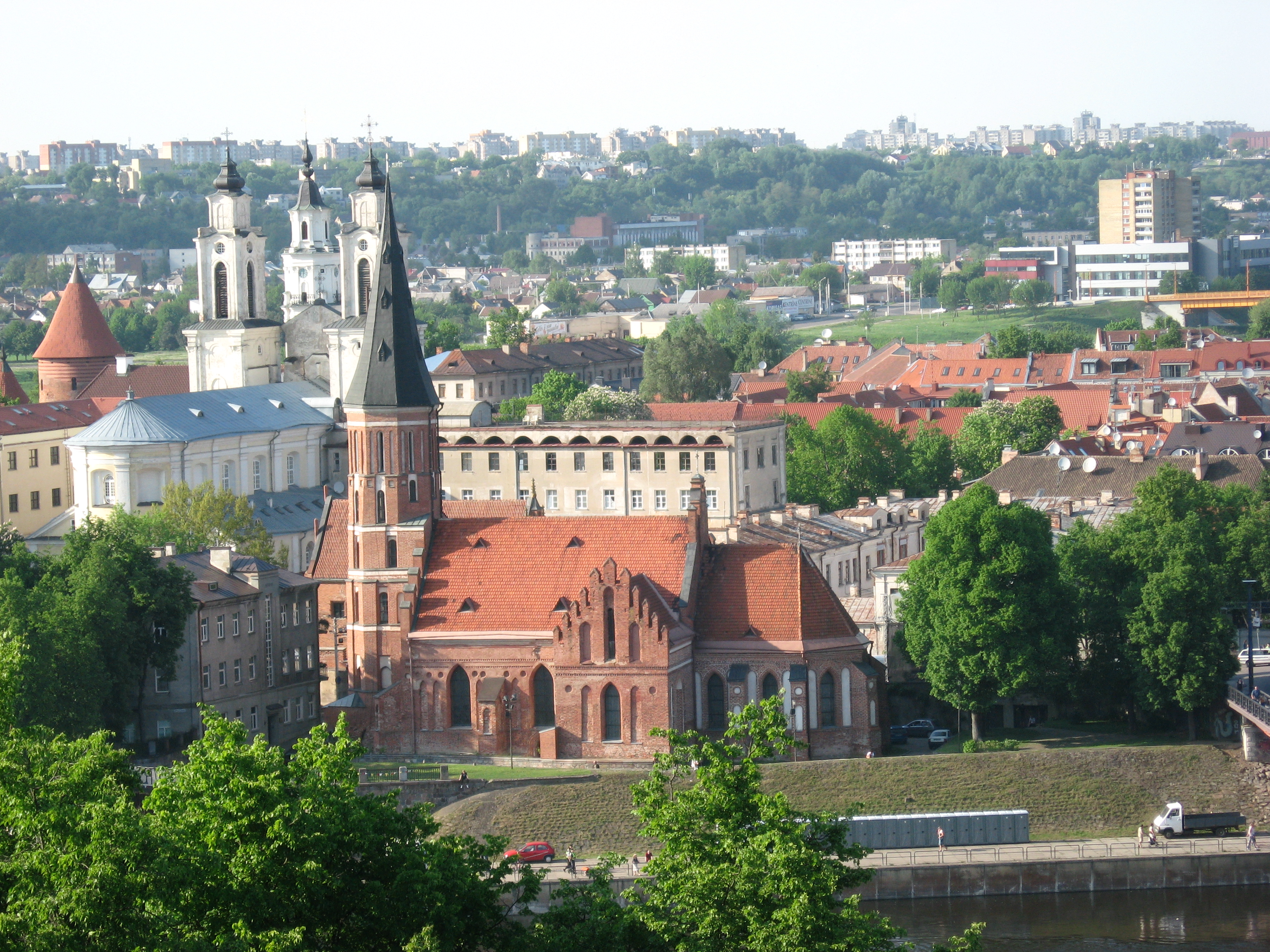
The city where Adam Mickiewicz taught secondary school. (Photo: C. Haven)

“If we have all this here, why do we need Europe?”  That’s what Joseph Brodsky reportedly said in 1966 when he surveyed not Rome, not Athens, but humble Kaunas, Lithuania’s second largest city.

The words come from Ramūnas Katilius, fils, quoting his father, Ramūnas Katilius, père, from this vantage point overlooking the city.  The elder Romas, a physicist, was one of the poet’s greatest chums, sometimes seeing the poet several times a day when they were in Leningrad.  Romas was in the photos of Joseph Brodsky departure from the Soviet Union forever in 1972.

Both Romas and Algirdas Avižienis, professor emeritus at director of the Czesław Miłosz Birthplace Foundation, hosted my visit to Miłosz’s Issa Valley.  I’ve just returned to Poland.

While much of my discussion with Romas was about his friend, Tomas Venclova, the physicist was interested when I told him that I had been a student of Joseph’s (he called me part of “the family”) – and hence our discussion returned to his memories of Leningrad, and J.B.’s time in Lithuania. There’s even a plaque in downtown Vilnius where the Russian Nobel poet stayed.

Admittedly, the quote I have cited above is secondhand, but it’s suggestive of how much the poet liked Lithuania. You could guess that, perhaps, from his poem “Lithuanian Divertissement.”
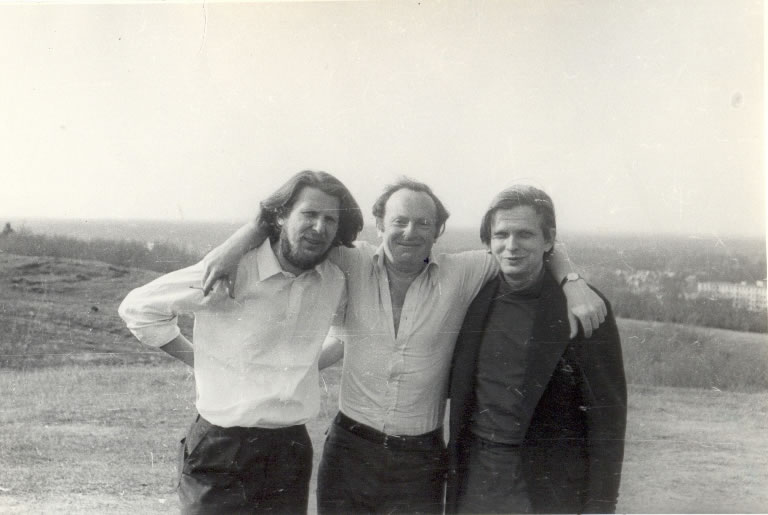
Ramūnas Katilius, Joseph Brodsky, Tomas Venclova in 1972 (Photo by Marija Etkind from the archive of Ramūnas Katilius and Elė Katilienė)

This remote and stunning little city was the temporary capital of Lithuania, when the Polish army occupied Vilnius in 1920.  The Nazis occupied it during the war, of course, and it was a Soviet Socialist Republic at the time Joseph Brodsky visited.

It’s also very early evidence, before he had seen Venice, Paris, or New York, of his early partiality of the cozy places on the outskirts of empire.  He was later to defend Russia’s historic hegemony in an acrimonious exchange with Miłosz, Derek Walcott and Susan Sontag, as described in Irena Grudzińska Gross‘s Czesław Miłosz and Joseph Brodsky: Fellowship of Poets.

I’m in Poland right now, and obviously don’t have access to Irena’s book or anything else in my library, but a Keith Gessen’s piece in today’s New Yorker (with a dynamite photo by Irving Penn) makes the same point:

Poetry was immortal, he argued: “That which is being created today in Russian or English, for example, secures the existence of these languages over the course of the next millennium.” But this wasn’t true, as Brodsky eventually acknowledged in a great and furious late poem, “On Ukrainian Independence,” in which he berated the independence-minded Ukrainians for casting aside the Russian tongue. “So go with God, you swift cossacks, you hetmans, you prison guards,” it says, and concludes:


Just remember, when it’s time for you, too, to die, you bravehearts,
as you scratch at your mattress and visibly suffer, you’ll forget
the flatus of Taras, and whisper the verses of Alexander.

Alexander Pushkin, that is. Despite itself, the poem is an anguished admission that a Russian state and Russian-speaking subjects are still vital to the project of Russian poetry.

Now.  Here’s an interesting bit about the photo above.  See the white double spires?  That’s the Jesuit church.  Now take a look at the rather nondescript yellowish building in front of it.  That’s where Adam Mickiewicz, the Polish language’s ur-poet (and, like Czesław Miłosz, he was born in Lithuania) taught at secondary school to pay off his university tuition  at the Jesuit’s Vilnius University.

Note to self:  Must read Mickiewicz when I get back to California.  Anyone know the best translations?
The Poles throw a party: postcard from Kraków

Share

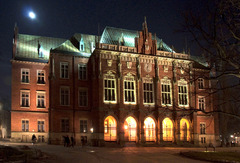
Jagiellonian University's Collegium Novum

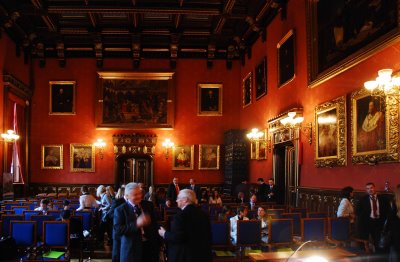
When the Poles throw a party – they don’t settle for half-measures.  And what better occasion than the Czesław Miłosz centenary?  This is easily the most lavish, labor-intensive, high-class shindig of its kind I’ve ever attended.

We’re not just talking about the obvious:  swag bags with books and DVDs; Miłosz pencils, pens, and t-shirts; Miłosz’s signature on the dinner napkins, and just about everywhere else.  It’s not only the stunning setting at Jagiellonian University, one of the oldest universities in Europe.

Collegium Novum's Assembly Room

Everyone is here:  Derek Walcott, Bei Dao, Thomas Venclova, Adonis, Natalia Gorbanevskaya, and Adam Michnik are among the luminaries – but only among. There are many more.

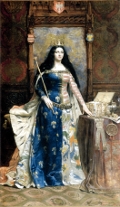
Queen Jadwiga's portrait watches over us

Though the Book Haven has been relatively silent lately, obviously I have not been idly eating bonbons.  Or at least, not only. This conference at the university’s Collegium Novum and the “Miłosz Pavilion” has pretty much been running me ragged – and the Milosz365 festival continues into the weekend and next week.

And organizers Jerzy Illg, publisher of Znak, and Aleksander Fiut, Miłosz scholar, have bags under their eyes …  Well, they’re not the only ones.

Consider this a down payment.  More later.

Postscript on 5/14:  Walcott’s a no-show, nobody knows why, though a pleasant, vague letter was read by Jerzy Illg at one of the events.  I understand this is not the first time Walcott has bailed.

“Marry your heart to your right hand”

Share

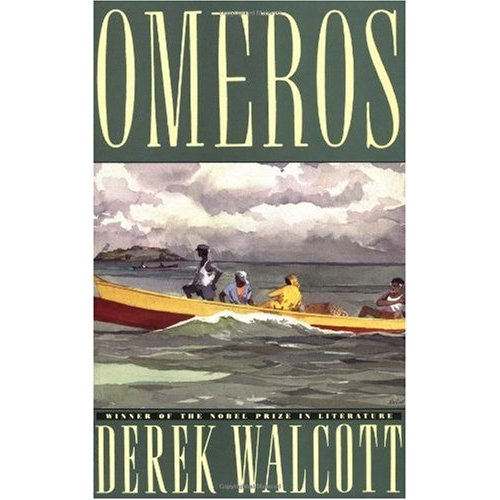
I attended last night’s reading of Omeros at Stanford Summer Theater. If this passage doesn’t describe the life of a writer, what does?

At the corner of Bridge
Street, we saw the liner as white as a mirage,
its hull bright as paper, preening with privilege.

“Measure the days you have left, do just that labour
that marries your heart to your right hand: simplify
your life to one emblem, a sail leaving harbour

and sail coming in. All corruption will cry
to be taken aboard. Fame is that white liner
at the end of your street, a city to itself.”

— Derek Walcott, Omeros

Walcott to Europe: “What is the meaning of your empires?”

Share

Rush Rehm‘s kind comment on yesterday’s post, “From Troy to the Caribbean: Homer onstage,” returned me to another passage from Irena Grudzińska Gross‘s Czesław Miłosz and Joseph Brodsky: Fellowship of Poets.  The passage occurs after an acrimonious confronation between Miłosz, Brodsky, and Susan Sontag on the nature of empire.  Walcott “rejects linear thinking, the straight line linking today to the past. Because the straight line, in the words of Peter Viereck, ‘is the longest distance between two points. And the bloodiest.'”  She continues:

Walcott "rejects linear thinking"

“During the conference in which Miłosz debated Brodsky on the matter of Central Europe, Walcott also spoke.  He had been hesitating, he began, before speaking: ‘I’ve a very great difficulty here between friendship and ideology. And I think that’s a penalty of ideology.’ This conflict causes in him ‘flashes of rage and an alternation between that and nausea. … The imperial voices dominates this conference and its range increases with every representation by European tribe, by European nation. This is not merely a historical posture of ancestry and tradition which goes under the general name of “civilization.” I am talking about tone … about a linear concept of progress and experiment in literature which I find no different from the presumptions of the priest and the conquistador. You writers of Europe continue that tone, that responsibility of carrying the banner and the cross or the book.  I have found no breadth, no expanse of imagination and, even at the risk of sounding corny, no evangelical vision.  What is the meaning of your empires? To hear all this from contemporary writers is only to deepen my conviction that for all its wars, its museums, its literatures, its revolutions, the provinciality of Europe and of Russia increases. Writers are not inheritors of history.'”


From Troy to the Caribbean: Homer onstage

Share

Callender and Donnie Hill (Photo: Stefanie Okuda)

Last year, during the Stanford Summer Theater’s Electra by Sophocles, one performance stood out remarkably in the mixed bag of university theater. L. Peter Callender played a role that might have been negligible for a less accomplished performer.  The faithful family retainer, in this case a tutor, is a staple in Greek tragedy, but Callender infused it with dignity and distinction.

I’m not the only one who noticed him last year: A San Francisco Chronicle review praised his performance in Athol Fugard’s My Children! My Africa!, a play that some consider too persistently didactic, although in this production “one dedicated teacher’s tragedy is a fierce reminder of the complexity of trying to right social wrongs.  L. Peter Callender embodies that complexity with every paternalistic utterance and sidelong glance he casts as the prematurely aging black teacher,” Robert Hurwitt wrote.

He’s back.  I sat in on some of the rehearsals for a few weeks ago for the Stanford Summer Theater’s Homeric cycle, which showcases The Wanderings of Odysseus, an adaptation of Homer’s Odyssey, opening Thursday night.  It was the second year of the Greeks, but not for Callender, who has performed Greek tragedy for years, everywhere from his alma mater (Julliard) to Berkeley Rep.

“It’s one of my favorite types of theater when it’s done well,” he told me later by phone, “because of the language, because of the history, the mythology, the depth of character and the depth of passion.”

But he admitted, “I’m finding a lot of this very difficult to memorize.”

With Courtney Walsh (Photo: Stefanie Okuda)

No surprise.  His work with Shakespeare (he’s logged in a couple dozen Shakespeare roles in the California Shakespeare Theater alone) has given him a feel for the iambic beat of the Bard’s blank verse — the beat that mimics the rhythms of the heart.  Oliver Taplin’s translation of The Odyssey, which Rehm directed for the Mark Taper Forum in 1992 at the Getty Museum, uses a loose Anglo-Saxon prosody – a quicker four-beat line that’s dependent on a lot of alliteration and a big caesura in the middle of the line (think of Seamus Heaney’s bestselling Beowulf.) It’s a bit of a rhythmic (and therefore psychological) shakeup.

During the rehearsals, Callender joined Rush Rehm in making suggestions for the fine detail work of the challenging production. ”This text is not a play but a poem, it’s a very difficult task. Everyone has to be on the same page at the same time,” he said.

His self-confidence in the director’s chair isn’t a surprise, either:  he’s the founding director of San Francisco’s African American Shakespeare Company, launched in 1994 to “create an opportunity and a venue for actors of color to hone their skills and talent in mastering some of the world’s greatest classical roles; and to unlock the realm of classic theatre to a diverse audience who have been alienated from discovering these time-favored works in a style that reaches, speaks, and embraces their cultural aesthetic and identity.”

The “L.” at the front of his name was a sort of augury for things to come:  It stands for “Lear.”  (In answer the inevitable follow-up question, he replies, “I don’t know what my parents were thinking.”)

Walcott

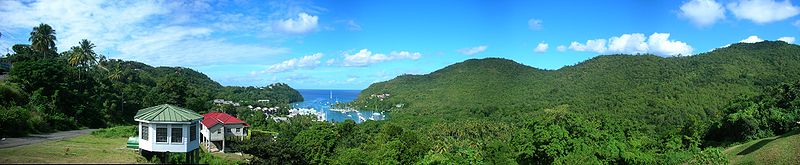
The Trinidad-born actor will probably excel also at the August 10 and 11 reading of Derek Walcott’s Omeros – which takes place in the poet’s native Saint Lucia.  It will return Callender to blank verse, as well as combining his love of the Greeks and his Caribbean heritage.  I was recently reading Irena Grudzińska Grosss comments on the Nobel poet:

Instead of history, which is degrading and calls for revenge, Walcott proposes a narrative, or a myth, which, because of its continuous present, opens time, making the new world equal to the old one.  His long poem Omeros show that the world of the Caribbean islands is as epic as Greece, because it contains a journey, a return to the native island, the fear of ancestors, gods.