Translation, Book Expo America, and le bruit du temps…

Share

The publisher...

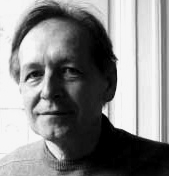
Some of you may recall my visit to the innovative Parisian publishing house of Le Bruit du Temps and it’s founder, Antoine Jaccottet, during my recent visit to Paris, during the cold, cold, cold snap of last February. I also spoke at the American University in Paris, and visited friend and colleague Daniel Medin.

Here’s a podcast that entwines them both:  Daniel interviews Antoine Jaccottet at “That Other Word,” a series of podcasts on literature and translation, the result of a collaboration between the Center for Writers and Translators at the American University of Paris and San Francisco’s Center for the Art of Translation.

...and his admirer

Said Daniel:  “It surprised me to learn that it was a small press in France doing the complete works of Zbigniew Herbert … that it was a small press in France doing the completeIsaac Babel, a volume even larger than the [Peter] Constantine one that appeared a decade ago in English , and that it was a small French press discovering books like the Julius Margolin‘s gulag memoir, and bringing them to life.  And I wanted to meet this editor, because of the interesting books he was selecting, because of the variety.”  Now you will have a chance to meet him, too.

But first, you’ll get Daniel’s quick overview of this month’s Book Expo America in New York City, where “Russia was the country of honor this year,” he said. He and Scott Esposito discuss a range of contemporary authors and books, including Mikhail Shishkin‘s Maidenhair, which will appear in English this October; Polish author Marek Bieńczyk’s Transparency;  Julius Margolin’s gulag memoir, Voyage au pays des Ze-Ka; and Dalkey Archive Press’ Contemporary Georgian Fiction.  

Their interests do not lie entirely east of the Vienna: they also discuss Éric Chevillard’s Prehistoric Times and his Demolishing Nisard.

Then, on to Antoine Jacottet.  On the perils of translation, the French publisher said:  “You do well what you know a little. I worked myself as a translator. I might mention my father [Philippe Jaccottet] was – is still – a well known translator.  For me, it has always been very important to be attentive to the quality of translations. When we began the press, my idea was: if you are a very small press and if you want to publish works that you think are masterpieces, one way of doing it is to order a new translation, and then you have to find a good translator for it. It’s not always easy, but  I think it’s the part of my job that fascinates me most.”

The podcast is here.

Józef Czapski: A Life in Translation – and a Cahiers Series giveaway

Share

Update on 3/26:  Still some editions of this treasure available for free for a retweet (or Facebook “share”) during the giveaway: Go to Facebook and Twitter pages here and here, beginning today.  I wouldn’t miss it. The New York Review of Books called this series “exquisitely produced, lavishly illustrated, and lovingly edited”

“…but knowing him at all was my good fortune.”

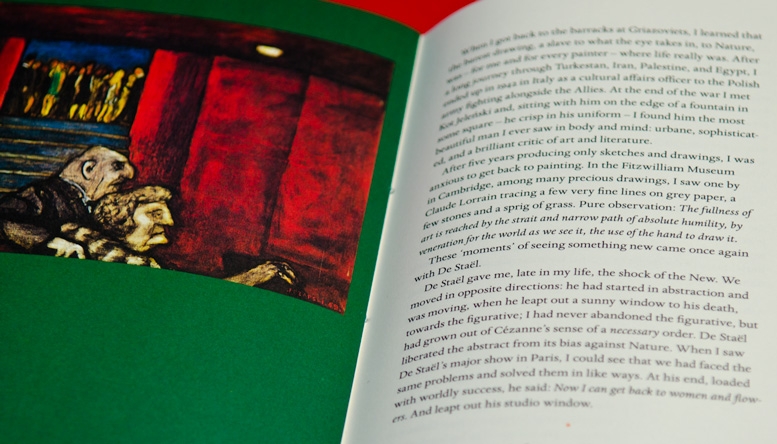
With those words – iambic pentameter with a stranded, falling syllable at the end – Keith Botsford begins his “autobiography” of artist, author, and critic Józef Czapski in the Cahiers Series’ Józef Czapski: A Life in Translation.

The Cahiers series/Sylph Editions will be hosting a giveaway on its Facebook and Twitter pages here and here, beginning today.  I wouldn’t miss it.

While visiting the Cahiers headquarters in Paris, Daniel Medin casually handed me Józef Czapski: A Life in Translation.  I didn’t realize until some time later, after my return to America, what a gift it would prove to be.

Botsford uses Czapski’s own words, interrupted with his commentary and illustrated with twelve of Czapski’s paintings. He calls this a “biography from within,” but he begins on the outside, with externals: Czapski was “not just tall, he was elongated…enormously wide awake behind his glasses.”

“There were two odors about him: the saddle-soap smell of the Uhlan officer and the more delicate perfume of the diffident man of delicate sensibilities, a whiff of the ascetic.”

Czapski seems to have cast a salutary spell on Botsford: “How could one fail to love such an Eye?” he asks. But it’s not just the artist’s vision that haunts him: “I am setting down a quality of his mind: the way he made connections. Not table-talk. He spoke ill of no one; even about Picasso he changed his mind.”
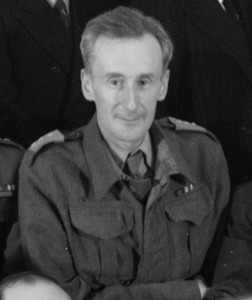
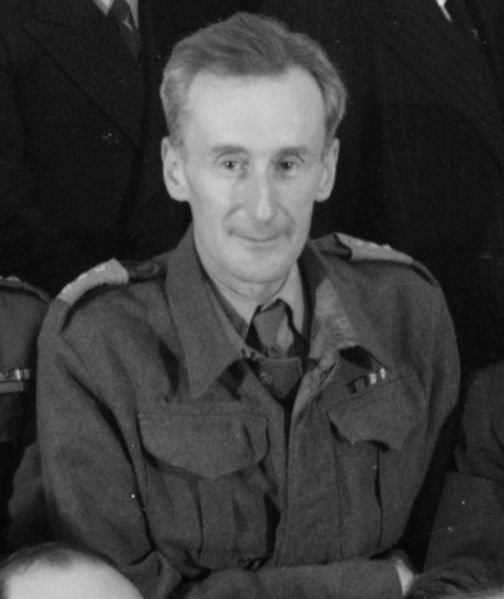
Polish officer in 1943

It’s hard to read much of 20th century Polish literature without running across the name Józef Czapski, one of the founders of the influential Polish emigré monthly Kultura.

My visit to the Kultura office in Maisons-Laffitte last month more insistently reminded of the remarkable man I had so far overlooked. A crucial chunk of Czapski’s  bio is necessary to understand him:  he was one of about 400 officers to survive the Katyń massacre, in which the Soviets slaughtered 20,000 Polish officers.  In 1941 and 1942, Czapski was sent as an envoy of the Polish government to look for the missing officers in Russia. After the war, Czapski remained in exile in Maisons-Laffitte. He was in a key position to offer help to dissidents and defectors. And he did.

During Czesław Miłosz’s time in Washington as a cultural attaché for the Soviet government, Czapski had told him that if he decided to jump ship, Kultura would protect him.

Miłosz had other reasons to be grateful to Czapski, the man who introduced him to the writings of Simone Weil through her first published book, Gravity and Grace. Czapski also showed him Arthur de Gobineau’s pages about ketman, which would become a key concept in the poet’s influential denunciation of communism, Captive Mind.

Botsford writes of Czapski: “In fact he was serene, and good order reigned in his mind. I take it as significant that from a man who had, like every Pole, suffered greatly from Poland’s German and Russian neighbors, I never heard a word against either nation, only a very pure love of his childhood and Poland.”

Yet, “Poland, and his exile, weighed on him.”
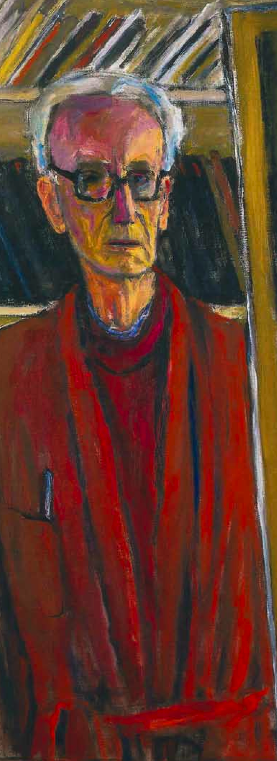
“not just tall, he was elongated” (Self-portrait, 1984)

“Striking is the fact that I can recall no whining. As he’d faced all he alterations of his long life, that Tolstoyan and Catholic streak in him was powerfully directed towards what was actively good, to what could still be celebrated about life.”

Czapski wrote:

Matisse was visited by Rouault. The two men had not spoken to each other in years. Matisse had survived two major operations. He told Rouault: How quickly life goes by! It’s terrible. Yet he was quite calm, blessed the blue sky he saw out the window, and wished his daily work was more like prayer.

How does one escape history? One doesn’t. There is something unbreakable about one’s being who one is, how formed, what seen and heard, where been when.

I think that Miłosz would have characterized him by the word he repeatedly emphasized in my own interview with him, “piety,” a term that embraced a respect for an aesthetic hierarchy. Joseph Brodsky would likely have called it “a plane of regard.”

The Nobel laureate said of Czapski: “He was deeply religious. So many of his major influences were men who thought of a divine order in the world. He read Rozanov, he debated with Simone Weil. All that was private and internal to the man. He had an idea of the Good in his head.”

This “idea of the Good in his head” permeated Czapski’s views of his art: The fullness of art is reached by the strait and narrow path of absolute humility, by veneration for the world as we see it, the use of the hand to draw it.  (Words that remind me an awful lot of the poet Julia Hartwig.)

Botsford, however, met Czapski when the artist was 70 – and  this short, 42-page study becomes truly remarkable when describing Czapski’s old age.  Czapski’s words again:

Akhmatova said: I kissed boots among the higher officials to get some news of my son, whether he was alive or dead, and got nothing. So many extraordinary people I’ve known. Why do I recall my fellow-officers in Griazovietz? Why did Herling-Grudziński listen to the stories of his fellow-prisoners, and tell them?  Because the stories they had to tell deserve to be remembered. They are gone, but who they were should not disappear. The Communion of Saints, the talk of the living and he dead, goes on.

Somewhere I read or heard of a woman who begged God to show her – even if just for a second – what paradise was like. An angel visited her and told her to shut her eyes and He would grant her wish. When she opened them again and looked about her, she said, But that is what I see every day.

Czapski’s old age lasted decades.  He soldiered on until 1993, and was more than ready for his death at 96.

But at eighty-three: I see death differently: as a form of salvation, a deliverance, as an ‘enough.’ What remains is what is poetry and what is goodness.

And elsewhere – “die and become. As a moth alters.”

Check out the giveaway.

(Photos at top and at right reproduced from the Cahiers Series with permission.)
Another souvenir from Paris…

Share

My charming host

I’ve received another souvenir from Paris, following last month’s talk at the American University on “Old Wine in New Bottles: Literary Journalism as Cultural Translation.” This time the ever-gracious Center for Writers and Translators has added a few sound clips from the workshop session.

They described them this way:

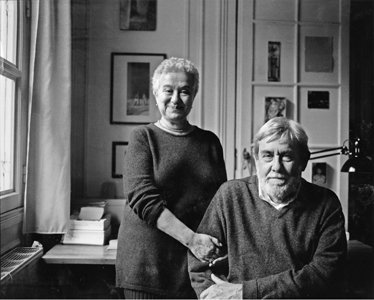
She joined us to discuss the changing face of cultural and literary journalism, touching on Twitter, Polish poets Czesław Miłosz and Adam Zagajewski, her memories of studying with Joseph Brodsky at the University of Michigan, the unexpected heroism of Marina Tsvetayeva‘s husband, and how to review books that don’t exist.

The sound clips are on the CWT website here. I share the new site with translators Richard Pevear and Larissa Volokhonsky discussing Nikolai Leskov. (I’ve written about the translating duo here.)

Dynamic duo

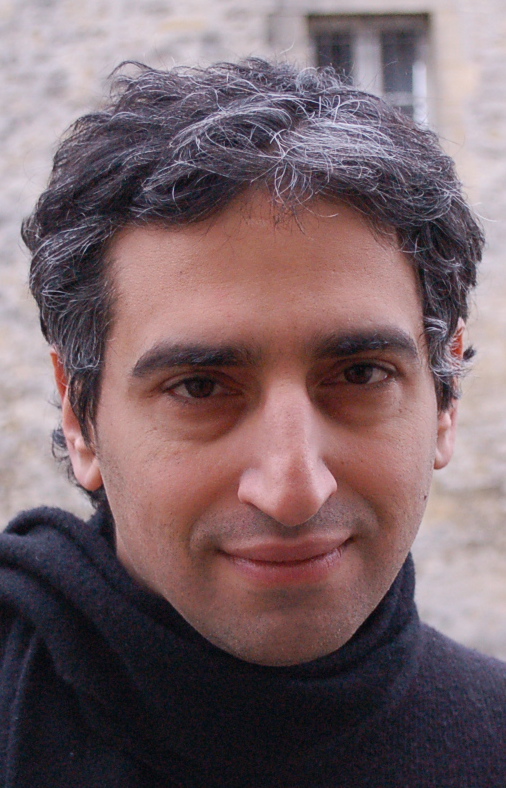
Meanwhile, my correspondence with my charming host for the visit, Daniel Medin, yielded this photo, more flattering (and more true-to-life) than the one I’ve used in earlier posts.

Daniel, by the way, is associate professor of comparative literature at the American University, associate editor of the Cahiers Series (we’ve written about that here), and the European editor of Quarterly Conversation (which I discussed here).

(Special thanks to Madeleine LaRue for coordinating the website effort!)

Roberto Bolaño on Neruda, Kafka, and the abyss

Share

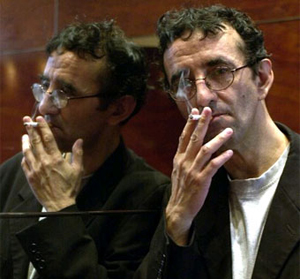
"A certain composure" (Photo: Creative Commons)

After reading my post on Pablo Neruda a few days ago, Daniel Medin sent me this insightful snippet from a Swiss journalist’s  interview of Chilean poet and novelist Roberto Bolaño, in the year before the writer’s death. Neruda is the least of it, really:

Which authors would you number among your precursors? Borges? Cortázar? Nicanor Parra? Neruda? Kafka? In Tres you write: “I dreamt that Earth was finished. And the only human being to contemplate the end was Franz Kafka. In heaven, the Titans were fighting to the death. From a wrought-iron seat in Central Park, Kafka was watching the world burn.”

I never liked Neruda. At any rate, I would never call him my one of precursors. Anyone who was capable of writing odes to Stalin while shutting his eyes to the Stalinist terror doesn’t deserve my respect. Borges, Cortázar, Sábato, Bioy Casares, Nicanor Parra: yes, I’m fond of them. Obviously I’ve read all of their books. I had some problems with Kafka, whom I consider the greatest writer of the twentieth century. It wasn’t that I hadn’t discovered his humor; there’s plenty of that in his books. Heaps. But his humor was so highly taut that I couldn’t bear it. That’s something that never happened to me with Musil or Döblin or Hesse. Not with Lichtenberg either, an author I read frequently who fortifies me without fail.

Musil, Döblin, Hesse wrote from the rim of the abyss. And that is commendable, since almost nobody wagers to write from there. But Kafka writes from out of the abyss itself. To be more precise: as he’s falling. When I finally understood that those had been the stakes, I began to read Kafka from a different perspective. Now I can read him with a certain composure and even laugh thereby. Though no one with a book by Kafka in his hands can remain composed for very long.

Postscript on 1/25:  Thanks to one of our readers, F.H., we have a link for the full interview.  It’s in German, here.

The Cahiers Series: “really, really beautiful” – and hand-stitched, even

Share

In a world where everything is becoming faster, cheesier, and more functional – when books are no longer tactile, sensual objects, but characters on Kindle – it’s cheering to see anything swimming upstream.  Bonus points if it extols that most underrated of literary trades, translation.

Applause keeps mounting for the Cahiers Series, published by the Center for Writers & Translators at the American University of Paris and Sylph Editions. It’s hard to stay on top of it.  But Daniel Medin, one of my more charming correspondents, has been sending me updates from the American University.

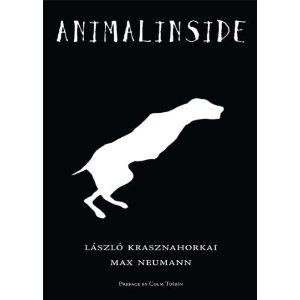
The latest plug is in Friday’s New York Review of Books blog, where Colm Tóibín introduces László Krasznahorkai‘s Animalinside (with illustrations by Max Neumann):

The prose of Hungarian novelist László Krasznahorkai is full of menace, but it would be a mistake to read the menace either as political or as coming from nowhere. In novels such as The Melancholy of Resistance and War & War, his imagination feeds on real fear and real violence; he has a way of making fear and violence seem all the more real and present, however, by removing them from a familiar context.

Daniel, now an associate professor at the American University (after teaching at Stanford a year or two back), said this:

The allegorical tissue in that text [i.e., Animalinside] is very thick, the “animal inside” a literal and metaphorical thing at the same time – think Herbert‘s Report from the Besieged City, where “a rat became the unit of currency.” We’re in the realm of Kafka and Beckett here, and not just in approach: I believe that Krasznahorkai is a writer of nearly the same magnitude who has the mixed fortune of having been born Hungarian – mixed because of that country’s embarrassment of (literary, cultural) riches on one hand and its linguistic isolation on the other.

Quite a coup for a small series that lives more or less hand to mouth, on uncertain funding. Part of the problem is shipping, which makes U.S. distribution difficult, even for a downright modest price of, say, $15.  Distribution in France is a little problematic, too, since the language is English.  “Every penny goes toward quality of production and keeping down the price,” Daniel writes.

Via the Cahiers Series subscription page you can buy a boxed set of volumes 1-6 (or a boxed set of volumes 7-12) for £51 – “which is approximately $4,000, but like I said, these are really, really beautiful. (Kidding—£51 is only $75 and these are worth every dime),” according to the Three Percent blog.  (Sorry, the blogger got me going for a moment – so I had to try it on you.)

[New updated deal: In addition to having the option of ordering cahiers individually, readers can now select any 6 cahiers for £55 in Europe/£59.50 everywhere else. Check it out here.]

Last year Daniel  told the Three Percent blog: “There are two main justifications for the Cahiers Series. The first is that we publish material that cannot easily be published anywhere else; we can play with form in a way that commercial publishers cannot. The second justification is to make something where the parts, through their relation to each other, add up to more than just that.”

Much more.  Clearly, the project is gaining momentum and some very high-profile attention – for example, from James Wood in the New Yorker here.

Daniel – handsomer than this, really

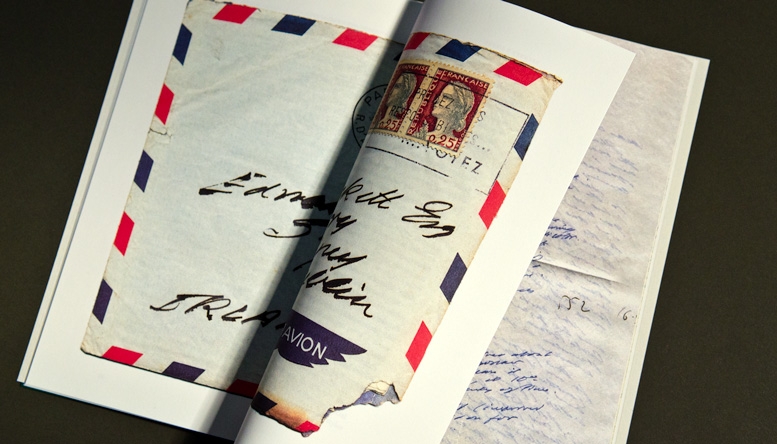
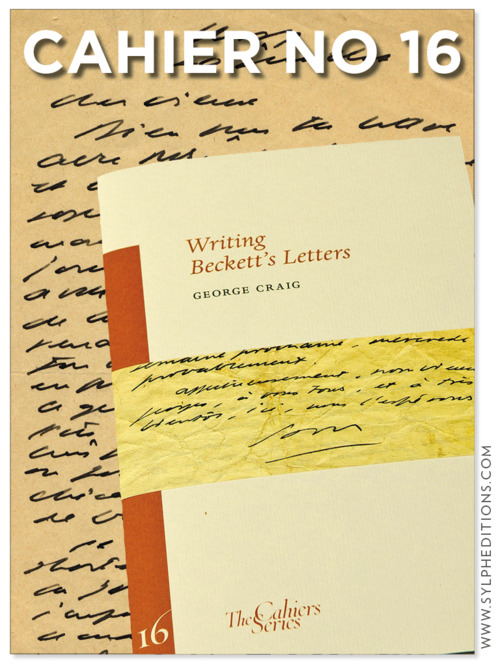
Daniel also sent me a copy of George Craig‘s Writing Beckett’s Letters. Craig spent 15 years translating the thousands of letters Beckett wrote in French.  It’s chock full of impressive insights, and handsomely produced – hand-stitched, even. I haven’t had a chance to read it yet, but Rhys Tranter did, and said this in the Spectator Book Blog (it’s here and here):

Whilst George Craig’s book is neatly timed to anticipate the next volume of Beckett’s Letters, it is more than just a preview of things to come. To Beckett scholars and enthusiasts, the appeal of this book is obvious, tightly-woven with rare insight and beautiful reproductions. But it is also thoughtful and engaging introduction to the problems of translation, and a testament to the status of correspondence as a kind of art-form. To paraphrase Craig’s description of Beckett and Duthuit’s correspondence, this is a work that abounds in strange, unexpected things.

Prescient words. Daniel has been promoting literary translations in other ways: He’s proud that the first invitation he issued at the American University was to Adam Zagajewski, who read from his latest collection and chatted with his students about his first encounter with Kafka. “An incredibly lucky bunch, they were: Tomas Venclova dropped by the next week and shared his own stories about discovering The Metamorphosis – in Polish!”

We’ll be writing more on the exceptional Cahiers series in posts-to-come.