
Hitchens on cancer etiquette … and Randy Pausch

Share

The Miss Manners of cancer etiquette?

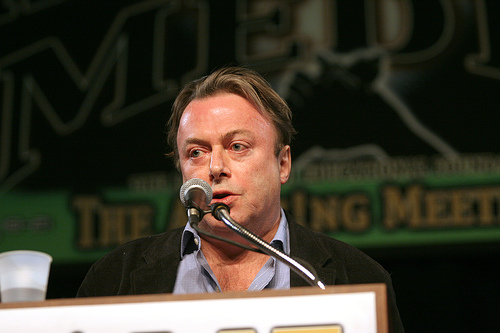
Christopher Hitchens, in a new Vanity Fair piece, sets out a few guidelines about cancer etiquette.  How to deal with the repeated questions, beginning with the simple “How are you”?  When oncology clinic staff ask, he replies simply, “I seem to have cancer today.”

He’s aware of the perils in cataloging gaffes on the part of either patient or non-patient.  He describes the patient’s “unreasonable urge to have a kind of monopoly on, or a sort of veto over, what was actually sayable. Cancer victimhood contains a permanent temptation to be self-centered and even solipsistic.”

While he points out the pitfalls of inevitable awkwardnesses, and the dangers of saying too much and too little, he once again grapples with the clichés of cancer — a subject we discussed earlier.  I always enjoy the ferociousness with which he takes on calcified thinking and stale modes of feeling.  For example, witness this digression into Randy Pausch‘s Last Lecture:

It would be in bad taste to say that this—a pre-recorded farewell by the late professor Randy Pausch—had “gone viral” on the Internet, but so it has. It should bear its own health warning: so sugary that you may need an insulin shot to withstand it. Pausch used to work for Disney and it shows. He includes a whole section in defense of cliché, not omitting: “Other than that, Mrs. Lincoln, how was the play?” The words “kid” or “childhood” and “dream” are employed as if for the very first time. (“Anyone who uses ‘childhood’ and ‘dream’ in the same sentence usually gets my attention.”) Pausch taught at Carnegie Mellon, but it’s the Dale Carnegie note that he likes to strike. (“Brick walls are there for a reason … to give us a chance to show how badly we want something.”) Of course, you don’t have to read Pausch’s book, but many students and colleagues did have to attend the lecture, at which Pausch did push-ups, showed home videos, mugged for the camera, and generally joshed his head off. It ought to be an offense to be excruciating and unfunny in circumstances where your audience is almost morally obliged to enthuse.

Robert Conquest is “Getting On”: A great poem after a century of living

Share

.

One of life’s unforgettable moments: a great poet hands you a typescript copy of an unpublished poem.  Its strike-outs and marginalia still mark the page.  It hasn’t found its readers yet, and there is no body of opinion about it to influence your own.

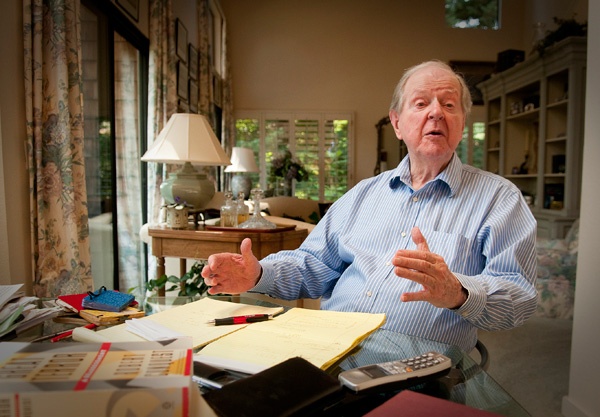
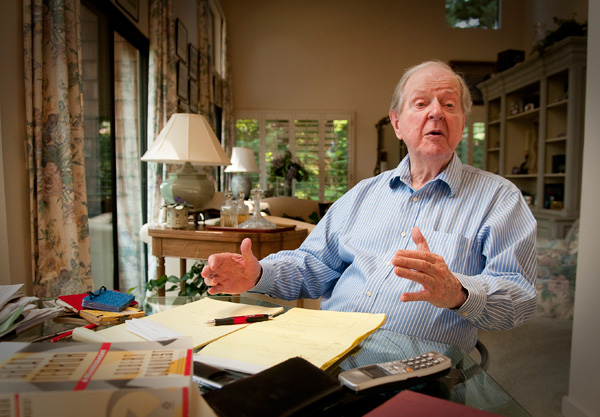
So, sitting in an immaculate Stanford condo on a balmy August afternoon, with the his forebears’ books and maritime paintings as a backdrop (the family goes back pretty much to the Conquest), I felt a quiet thrill when Robert Conquest handed me his latest poem, “Getting On,” which opens:

Into one’s ninetieth year.
Memory? Yes, but the sheer
Seethe as the half-woken brain’s
Great gray search-engine gains
Traction on all one’s dreamt, seen, felt, read,
Loathed, loved…
.              .              And on one’s dead.
-Which makes one’s World, one’s Age, appear
Faint wrinkles on the biosphere
Itself the merest speck in some
Corner of the continuum.

“Great poet and even greater historian" (Photo: L.A. Cicero)

It won’t be quite the same thrill for you, but you can now read the whole poem online — Dave Lull, patron saint of bloggers, tipped me off that it’s finally been published in the October 2nd edition of the British magazine Standpointhere.  “I don’t think any poet has written as well about aging as he has,” said R. S. Gwynn, Bob Conquest‘s friend and fellow poet.

The 93-year-old poet is also the courageous historian who wrote  the landmark books that exposed Soviet Communism in the years when too many were defending it — The Great Terror and Harvest of Sorrows.  He published his seventh collection of poems last year and a book of limericks this year. He and his absolutely charmer of a wife Liddie were fretting about the health of their close friend Christopher Hitchens when I dropped by; Hitchens had just been diagnosed with esophogeal cancer, and cancelled his usual visit in for Bob’s birthday on July 15.  Hitchens wrote in his new memoir, Hitch-22, that Conquest is “great poet and even greater historian.”

Bob finished his 200-line poetic summa about the same time he handed it to me.  I wrote then that this poem might prove to be among his greatest.  See if you agree (though I could have done without the Goldie Hawn reference.)

Not into great poems?  Try a few of his limericks here.

René Girard, meet Terry Jones, Andrew Sullivan, Christopher Hitchens, and the gang

Share

Avoiding crowds (Photo: L.A. Cicero)

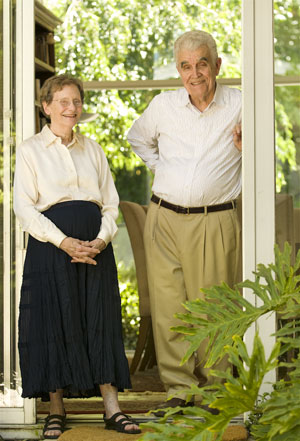
A brief conversation with Martha and René Girard brought forth the startling fact that René had made an unaccustomed appearance in Andrew Sullivan’s Dish blog over the weekend.  The subject was, of all things, would-be Koran-burner Terry Jones.

Quietly nestled among his posts on the sex lives and habits of other people is  “What Qu’ran Burning and Crucifixion Have in Common.” Sullivan cites an article by Eric Reitan:

[A]t least one theologian—S. Mark Heim—has taken up Girardian themes to argue that the crucifixion is best understood as a potent repudiation of sacrificial scapegoating… If Heim is right about this, then Jones and Phelps and their respective congregations are symbolically enacting the very thing that the passion stories central to Christianity were intended to repudiate. Where they are called to see the crucified Christ in those who are being symbolically burned at the stake, they instead see a righteous sacrifice to God. Where they are called to identify with the victim of sacrificial scapegoating, they become the practitioners.

Reitan’s article adds:

Some, such as Christopher Hitchens, would see such sacrificial scapegoating as a natural extension of Christian theology—which, after all, has at its heart the doctrine of the vicarious atonement, which Hitchens finds an appalling extension of the idea that wrongs can be righted by sacrificing an innocent scapegoat to God.  But the crucifixion, like book burning, is a complex symbol.

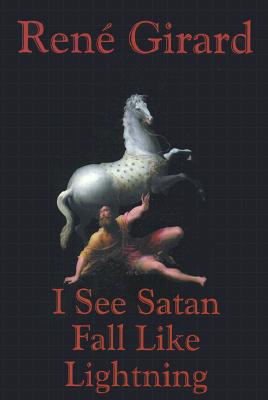
Of course, what Reitan calls Heim’s idea is not Heim’s idea at all.  René Girard himself has written  — for example, in I See Satan Fall Like Lightning — that  “the Gospels are aware of what they are doing. They not only tell the truth about victims unjustly condemned, but they know they are telling it, and they know that in speaking the truth they are taking again the path of the Hebrew Bible.”

But more and more I find myself coming back to the René’s writings about the role of the mob, which seems very apropos  to the discussion at hand:

In a society that has fallen prey to anarchy, the voracious appetite for persecution feeds on victims indiscriminately, as long as they are weak and vulnerable.  The least pretext is enough.  No one really cares about the guilt or innocence of the victim.  These two words, without cause, marvelously describe the behavior of human packs.

W.H. Auden wrote put it this way:

… the crowd rejects no one, joining the crowd is the only thing all men can do.Only because of that can we sayall men are our brothers …

Auden understood

With the inevitable consequences:

All if challenged would reply– ‘It was a monster with one red eye,
A crowd that saw him die, not I. —

Reitan seems to be haunted by the same theme.  He writes that “the nation has, through extensive media attention, conferred on this tiny congregation an enormous power it otherwise wouldn’t have—a power to make their symbolic violence do more actual harm than it otherwise might have done, to make their vicarious scapegoating less vicarious, and so to more effectively reach their intended targets.”

He concludes:

The media rushes to the next dramatic spectacle because to do so will attract ratings. And why does it attract ratings? A congregation of 50 can hardly be blamed for that. All of us in our own ways play the roles of betrayer, deserter, and denier. And while we should not condone the Dove Center’s desire to burn Muslims in effigy—nor should we fail to repudiate it when it becomes a public spectacle—it is important that our response not re-enact on another symbolic level the very pattern of sacrificial scapegoating that we repudiate.

In others words, societies of hundreds of millions of people have many subsets, niches, and off-the-beaten-track pockets.  The scapegoat-maker in one subset becomes the scapegoat of another.  As Girard writes, “Persecutors think they are doing good, the right thing; they believe they are working for justice and truth; they believe they are saving their community.”

On both sides of a discussion, too.

Robert Conquest: Still going strong

Share

Conquest at work (Photo: L.A. Cicero)

His advice to young poets: “Write under a pseudonym, and pretend it’s a translation from the Portuguese.”

Many people were intrigued when I said I was writing an article about Robert Conquest — well here is my piece on Robert Conquest, the poet who doubles as a groundbreaking historian of the Soviet era.  His close friend Christopher Hitchens said his was “the softest voice that ever brought down an ideological tyranny.”

He’s just completed a powerful poem, “Getting On.”  The 200-line reflection, forthcoming this fall in the British magazine Standpoint, opens:

Into one’s ninetieth year.
Memory? Yes, but the sheer
Seethe as the half-woken brain’s
Great gray search-engine gains
Traction on all one’s dreamt, seen, felt read,
Loathed, loved …
.                              And on one’s dead.
– Which makes one’s World, one’s Age, appear
Faint wrinkles on the biosphere
Itself the merest speck in some
Corner of the continuum.

As the years spin by, the more I appreciate those who, as life is ebbing (and it is ebbing for all of us), in the face of inevitable mortality and uncertainty, won’t let go of the rock.  There is a certain grace to persistence, when it passes beyond foolishness and becomes a principled position — a way to resolve the mismatch between the unimpeded intellect and the diminished will.  (In which case, I suppose, it becomes will.)  And to accomplish all this with panache … kudos, Mr. Conquest, for not sitting on your considerable laurels.

And yes, Elena, you are right (she commented on an earlier post, “I think he qualifies as one of the underrated writers. He was labeled as anti-Soviet and was lumped with political hacks.”)  Perhaps the training he got in telling the truth when everyone else was lying helped hone his poetic skills — or maybe it was the other way around.

Not that there weren’t a few factoids floating around the Conquest story as well — I use the term “factoid” as Norman Mailer, who invented it, meant it to be used: a lie that is repeated so often it becomes the unchallenged truth.

A couple bits that didn’t make it into the final piece:

1)  From Hitchens:  “A few years ago he said to me that the old distinctions between left and right had become irrelevant to him, adding very mildly that fools and knaves of all kinds needed to be opposed and that was really needed was a ‘United Front Against Bullshit.'”  Expletives were deleted.

2)  When his American publisher asked for the new title for the republication of The Great Terror, he came up with, “I told you so, you fucking f0ols.” The story, Bob Conquest told me, was entirely made up by Kingsley Amis — hence its omission.  I have to quote Ken Kesey on that — “It’s the truth, even if it didn’t happen.”

“Mortal combat”: Illness as cliché

Share

"In whatever kind of a 'race' life may be, I have very abruptly become a finalist."

Christopher Hitchens usually summers in the sunny, mild climate of our own beautiful Palo Alto — not, obviously, this year.  He writes about his chemotherapy in “Topic of Cancer,” in Vanity Fair here.

In Susan Sontag‘s 1977 Illness as Metaphor, she writes: “Everyone who is born holds dual citizenship, in the kingdom of the well and in the kingdom of the sick.  Although we all prefer to use only the good passport, sooner or later each of us is obliged, at least for a spell, to identify ourselves as citizens of that other place.”

Here is Hitchens’s version of the 911 call that launched a very different kind of journey during his book tour:

“Any movement, however slight, required forethought and planning. It took strenuous effort for me to cross the room of my New York hotel and summon the emergency services. They arrived with great dispatch and behaved with immense courtesy and professionalism. I had the time to wonder why they needed so many boots and helmets and so much heavy backup equipment, but now that I view the scene in retrospect I see it as a very gentle and firm deportation, taking me from the country of the well across the stark frontier that marks off the land of malady.”

Hitchens continues Sontag’s metaphor in his piece, with an unexpected detour for Edna St. Vincent Millay (of all people).  Hitchens at his best when his observations are sharp, pungent, and iconoclastic, even when his offensive observations land like a pie in the face (and any with an IQ over 73 will meet something that offends).  Oddly, it’s only in his prejudices that he descends to conventionality.  So cancer has found him, ironically, in good hands — his bracing attempts to come to grips with sudden illness will have a familiar echo for anyone who has suffered a forced deportation to this unwished-for valley.

With his illness, he has entered the land of cliché, and for a writer that is mortal combat indeed.  As someone who survived a terminal cancer diagnosis nearly a decade ago, I appreciate the vividness of his own internal experience contrasted with the shopworn expectations and conventions of the “well people” (for example, I recall their sentimentality, as if I had crossed the final border into terminal self-pity when I was merely struggling to breathe or swallow).  I also recognize his startled confrontation with the barbaric practices that are the very best modern medicine has to offer — but that remain outrageous assaults on the body and its sense of well-being.  One views as a stranger one’s own, equally barbaric will to live:

“Myself, I love the imagery of struggle. I sometimes wish I were suffering in a good cause, or risking my life for the good of others, instead of just being a gravely endangered patient. Allow me to inform you, though, that when you sit in a room with a set of other finalists, and kindly people bring a huge transparent bag of poison and plug it into your arm, and you either read or don’t read a book while the venom sack gradually empties itself into your system, the image of the ardent soldier or revolutionary is the very last one that will occur to you. You feel swamped with passivity and impotence: dissolving in powerlessness like a sugar lump in water.”

Among the clichés one confronts are the strictures of Elisabeth Kübler-Ross, whose constructs are often seen as ironclad, rather than commonplace patterns. Hitchens of course has a few clichés of his own:  I rather doubt his chest hair was once “the toast of two continents” — in fact, I’d rather not think about it at all.

His piece is well worth the read.

Wow. Why Hitchens won’t be in Palo Alto.

Share

Christopher Hitchens

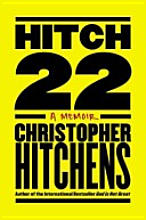
Back when Ayaan Hirsi Ali was visiting Palo Alto courtesy the Commonwealth Club, I mentioned Christopher Hitchens was to appear next on June 27.  He was plugging his new memoir, Hitch 22.

A few days ago, I received an email that his appearance was “postponed until further notice.”  I wondered what the story was.

It’s this:  Hitchens has esophageal cancer.  From Vanity Fair:

“I have been advised by my physician that I must undergo a course of chemotherapy on my esophagus. This advice seems persuasive to me. I regret having had to cancel so many engagements at such short notice.”

This is one of the nastier and more aggressive cancers.

Whatever one’s opinions of him, his books, his journalism — wish him well. (I was about to say Godspeed — a thought he would hardly have encouraged.)