
What he meant: postscript on Adam Michnik, Czesław Miłosz, and the Warsaw Uprising

Share

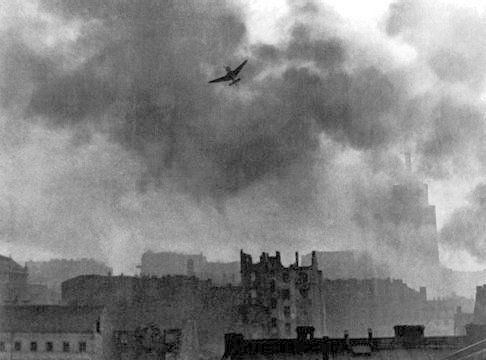
The bombing of Warsaw's Old Town

A few days ago,  I reported on Adam Michnik‘s haunting remarks during the Czesław Miłosz festival.  He recalled a few brief months of freedom in 1981, with the heady rise of Solidarity and the Polish poet’s return to Warsaw after decades of exile:


“It was a time of euphoria, carnival – it was our victory,” he said.

Miłosz was more cautious.  He told Michnik, “The atmosphere feels like just before the Warsaw Uprising. Please be careful.” Tanks rolled into Warsaw and martial law was declared a few months later.

I was intrigued, but somewhat puzzled by Miłosz’s comment.  I had always assumed that the days before the Warsaw Uprising were full of terror and apprehension. I chalked up Michnik’s recollection to pure prescience on Miłosz’s part.

Then, bumping along in the train between Warsaw and Vilnius, I found my answer.  I ran across this passage in the new collection of essays, Proud to Be a Mammal, in a reprinted piece called simply “G.G.”

Little by little the time was drawing near for the destruction of Warsaw. The uprising was a blameworthy, lightheaded enterprise … Handfuls of people stood on street corners, watching with a quiet smile as trucks were loaded with wardrobes, mirrors, rugs – the contents of German offices and private homes. They were fleeing. No one was afraid of them anymore.
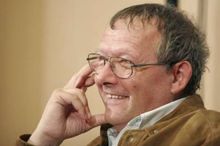
Michnik remembers

In other words, what the Polish people saw as a retreat was simply the Germans evacuating a city they knew was about to be destroyed.

The posters that had been tacked up, ordering all males to report for work on the fortifications, were received with jeers.  You could already hear Russian artillery fire. Rumors of an armed uprising were greeted joyfully: a chance to throw oneself at one’s tormentors and take revenge … Soon, however, came the news that there would be no uprising. One of my Socialist colleagues told me that to take any sort of action now, when Mikołajczyk, the premier of the London government [in exile], was flying to Moscow, would be nonsense.  Stalin was too clever to negotiate with anyone using such a trump card, and whoever tried to outsmart him would never be forgiven.

The military leaders (caught between two fires, because the Russian Radio broadcasts called for the taking up of arms) did not enter into such subtleties; as a result their judgment was incompetent. The command was given so suddenly that it found most of the units without weapons. …

That day, the first of August, Janka and I were walking over to Tiger’s for an after-dinner chat and a cup of tea. I had something terribly important to discuss; namely, my new translation of an English poem. On leaving for a walk one should never be too sure of returning home, not only because something may happen to one personally, but also because the house may cease to exist.

The older I get, the more uncomfortable I am with any group emotions – whether crowd hatred or crowd euphorias.  And sometimes the euphorias are more blinding than the hatreds.

“The Wolf Who Ate Books”: Michnik, Vendler, Hirshfield, and others remember Miłosz

Share

Aleksander Fiut in foreground, Michnik in striped shirt, Vendler in back (Photo by my Droid)

Jane Hirshfield recalls that Czesław Miłosz lived in a “storybook” cottage on Grizzly Peak in the hills of Berkeley.  But to describe the fairy tale that took place within the cottage, you’d need a new character, a new story – “The Wolf Who Ate Books,” she suggested.

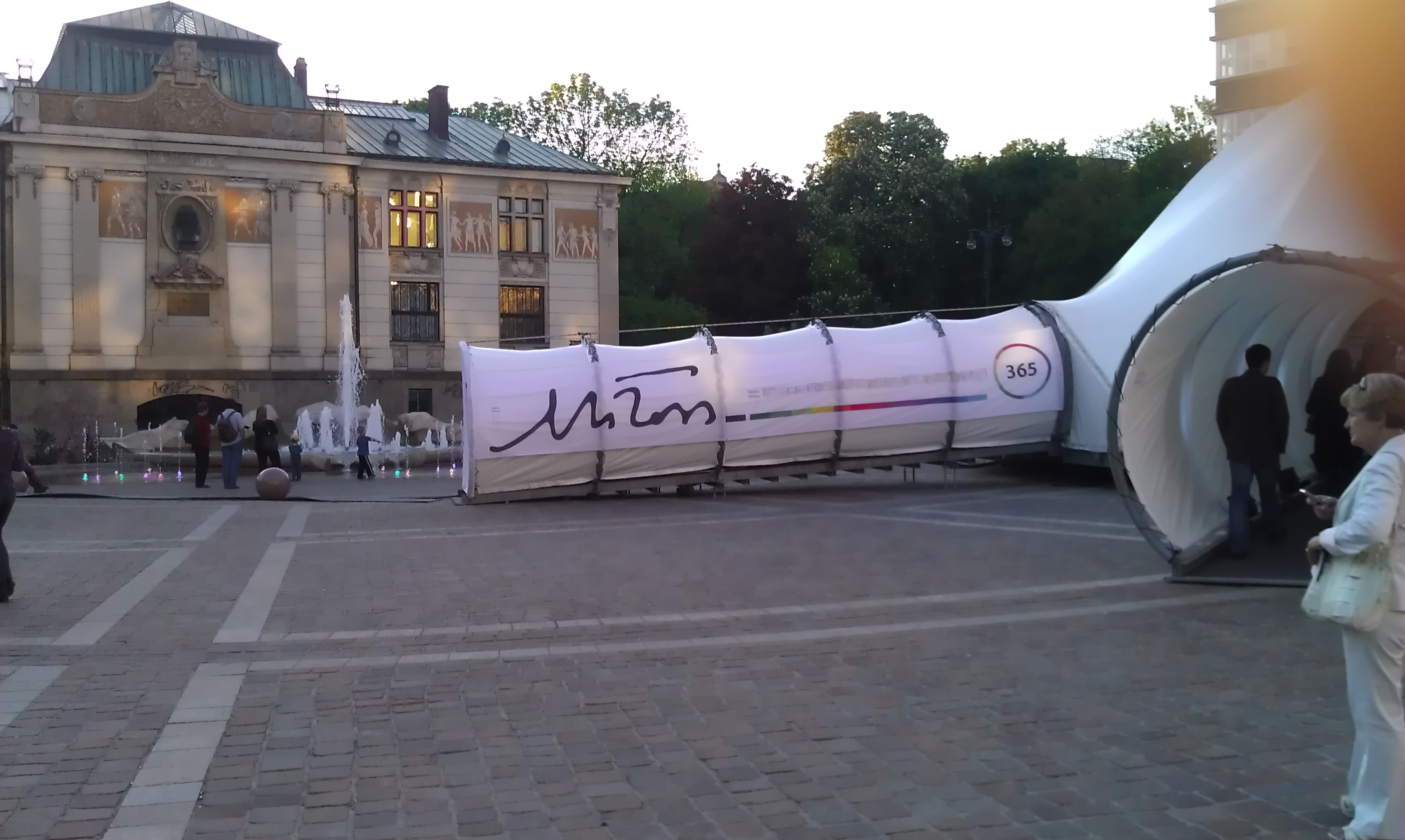
In the elegant and newly revamped Szczepanski Square, the Miłosz Pavilion – a strange, science fiction-y formation of hemispherical  tents and tunnels – hosted a range of activities during the Czesław Miłosz centenary festival. One spotlighted reminiscences with, as well as Jane, scholar Aleksander Fiut, Gazeta Wyborcza editor Adam Michnik, poet Tomas Venclova, leading critic Helen Vendler, and poet Adam Zagajewski. As with so many of the events, Znak publisher Jerzy Illg hosted.  Here are a few of their memories:

Michnik recalled Miłosz trying to meet him at a very particular Bulgarian restaurant in Paris, where Miłosz spent the lonely, tormented decade following his lonely defection from Communist Poland.  “Then Miłosz said a sentence I would remember for the rest of my life:  ‘I wanted to meet you here, because here, in the 1950s, very often I kept feeling I would commit suicide,'” he confided to his friend.  Michnik recalled his famous essay of the time, “Nie” [No], where he explained his defection to the world.  It opened: “What I’m going to tell now could well be called a story of a suicide…”

He also remembered Miłosz’s triumphant return to Poland in 1981, with the heady rise of Solidarity.  “It was a time of euphoria, carnival – it was our victory,” he said.

Miłosz was more cautious.  He told Michnik, “The atmosphere feels like just before the Warsaw Uprising. Please be careful.” Tanks rolled into Warsaw and martial law was declared a few months later.

Tomas Venclova recalled when Stanisław Lem was rumored to be up for the Nobel prize.  “I don’t care about the Nobel prize,” Miłosz told him, “but if any other writer gets it, I wouldn’t be too happy.”

A 21st century monster of hemispheres and tunnels (from my Droid)

Aleksander Fiut traveled with Miłosz to Stockholm for the 1980 Nobel.  On the way to the event, in a chauffeur-driven limousine, Miłosz was hungry.  Where did they stop?  He told the chauffeur to pull into McDonald’s.  “Her facial muscles didn’t even move,” Fiut recalled.

Jerzy Illg recalls the poet at 90, looking deeply into a vodka and a piece of herring – two of his favorite things.  “Happiness is accessible,” he declared finally. Illg had him write that down and sign it. “It’s a valuable security paper I hold,” Jerzy reflected.

Jane met both Carol and Czesław at a Bay Area picnic, where the hostess urged her beforehand to chat with the Miłoszes, since many were too intimidated to be social.  So, unfortunately, was Jane.  It was as if, she said, she had been told, “Please go talk to Yeats.  Please go talk to Shakespeare.”

Jane also recalled the death of Miłosz’s much-younger wife Carol, in 2002.  At the memorial service in Berkeley, she remembers Miłosz sitting erect, “evidence of decades of unbearable loss being carried.” She spoke to him afterward, and “for three seconds he completely broke down.”

“I never held a grief that large in my arms,” she said.

The Poles throw a party: postcard from Kraków

Share

Jagiellonian University's Collegium Novum

When the Poles throw a party – they don’t settle for half-measures.  And what better occasion than the Czesław Miłosz centenary?  This is easily the most lavish, labor-intensive, high-class shindig of its kind I’ve ever attended.

We’re not just talking about the obvious:  swag bags with books and DVDs; Miłosz pencils, pens, and t-shirts; Miłosz’s signature on the dinner napkins, and just about everywhere else.  It’s not only the stunning setting at Jagiellonian University, one of the oldest universities in Europe.

Collegium Novum's Assembly Room

Everyone is here:  Derek Walcott, Bei Dao, Thomas Venclova, Adonis, Natalia Gorbanevskaya, and Adam Michnik are among the luminaries – but only among. There are many more.

Queen Jadwiga's portrait watches over us

Though the Book Haven has been relatively silent lately, obviously I have not been idly eating bonbons.  Or at least, not only. This conference at the university’s Collegium Novum and the “Miłosz Pavilion” has pretty much been running me ragged – and the Milosz365 festival continues into the weekend and next week.

And organizers Jerzy Illg, publisher of Znak, and Aleksander Fiut, Miłosz scholar, have bags under their eyes …  Well, they’re not the only ones.

Consider this a down payment.  More later.

Postscript on 5/14:  Walcott’s a no-show, nobody knows why, though a pleasant, vague letter was read by Jerzy Illg at one of the events.  I understand this is not the first time Walcott has bailed.