

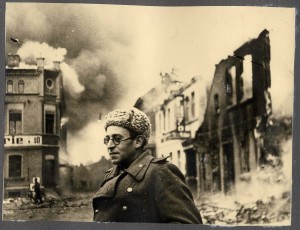
Grossman saw it all firsthand in the Red Army.
Many of you may remember my post some weeks ago on Vasily Grossman‘s Life and Fate (here). If you read the whole excerpt, you may wonder what becomes of Ikonnikov, the Tolstoyan Russian prisoner in a German concentration camp, who refuses to pour cement for a gas chamber.
He dies, of course. But in his last scribblings, he maintains that “Kindness is powerful only while it is powerless. If Man tries to give it power, it dims, fades away, loses itself, vanishes.” He explains:
“My faith has been tempered in Hell. My faith has emerged from the flames of the crematoria, from the concrete of the gas chamber. I have seen that it is not man who is impotent in the struggle against evil, but the power of evil that is impotent in the struggle against man. The powerlessness of kindness, of senseless kindness, is the secret of its immortality. It can never be conquered. The more stupid, the more senseless, the more helpless it may seem, the vaster it is. Evil is impotent before it. The prophets, religious teachers, reformers, social and political leaders are impotent before it. This dumb, blind love is man’s meaning.
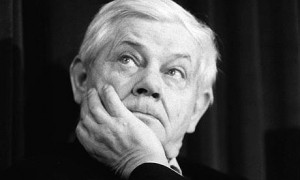
Shouldering a lot.
“Human history is not the battle of good struggling to overcome evil. It is a battle fought by a great evil struggling to crush a small kernel of human kindness. But if what is human in human beings has not been destroyed even now, then evil will never conquer.”
As I was reading those words, I remembered something very similar from Warsaw poet Zbigniew Herbert – a writer who, as Seamus Heaney said, “shoulders the whole sky and scope of human dignity and responsibility.” In his essay, “The Mercy of the Executioner,” Herbert describes the execution of the statesman Johan Van Oldenbarnevelt, who had “defended his honor rather than his life” at trial:
When they brought in the condemned man, the crowd fell silent. Van Oldenbarnevelt was hurrying toward death: ‘What you must do, do it fast,’ he urged the executors of the verdict.

A crumb of helpless goodness for him.
The something happened that went far beyond the ritual of execution, beyond the procedure of any known execution. The executioner led the condemned man to a spot where the sunlight was falling and said, ‘Here, Your Honour, you will have sun on your face.’ …
Van Oldenbarnevelt’s executioner broke the rules of the game, left his role, and, what is more, violated the principles of professional ethics. Why did he do it? Certainly it was an impulse of the heart. But didn’t the condemned man, who was stripped of all earthly glory, perceive derision in it? After all, it is indifferent to those who are leaving for ever whether they die in the sun, in shadow, or the darkness of night. The executioner, artisan of death, became an ambiguous figure filled with potential meaning when to the condemned man – in his last moment – he threw a crumb of helpless goodness.
Read with avid interest. Very compelling perspectives regarding unique ideologies of morality versus amorality and the “power of love” metric. There is a circular, ideological oxymoron in the interpretation of the of kindness, power and the sacred that cannot be avoided. Like a surreal pondering of the chicken or the egg, co-mingled with the do you want to win the battle or the war concept. Who ultimately is rendered impotent in the face of the “lesson?” The recipient of the lesson in morality or, the one who unfairly succumbs to execution based upon loftier ideals? It depends on one’s system of belief and belonging, despair and hope. Ultimately, the sword falls harshly upon those honourable, principled tragic sacrifices to time. There are so many fascinating “-ologies” to reflect upon in this splendid piece. Thank you.
You’re certainly welcome, Stephanie! A pleasure to have you here.