

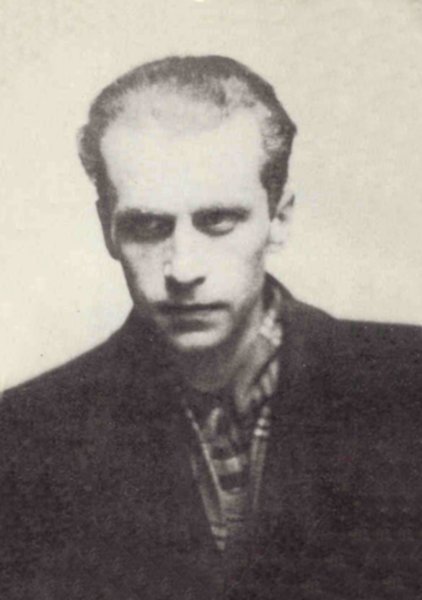
“Asthmatic, of frail health…a disciplined soldier…sheer effort of will.”
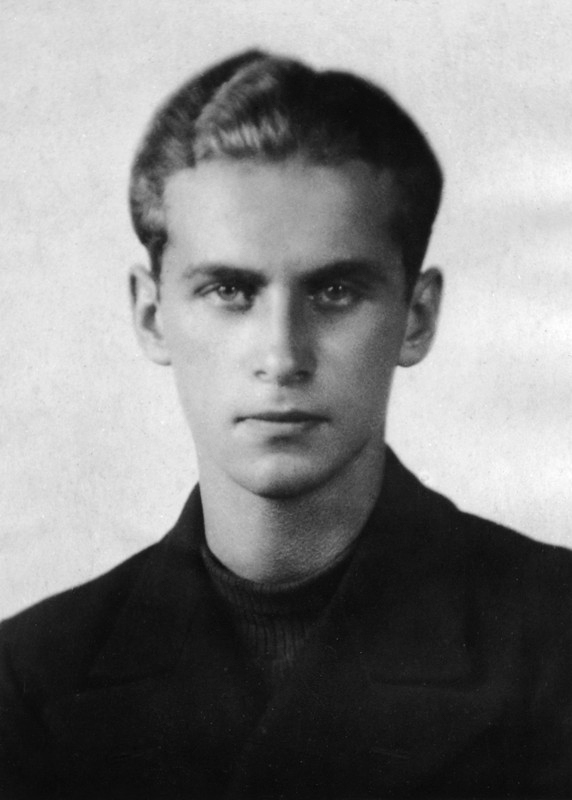
My friend Kasia Wozniak reminded me that today is the day Krzysztof Kamil Baczyński was killed as a platoon commander, on the fourth day of the Warsaw Uprising, August 4, 1944. He was 23.
It was what he himself imagined, apparently: a shower of bullets, grenades, hitting the dirt, and “one charge only, straight up to heaven.” Let us hope so.
His beloved wife Basia was wounded and died a month later, not knowing of her husband’s death. The ancient city was entirely leveled – the vengeful Germans brought in architects to more effectively make sure the city was demolished block by block. “In January 1947 Baczynski’s body was dug out of the ruins of the City Hall and Krzysztof and Basia were finally laid to rest together in one grave at the Insurgents’ cemetery at Powazki,” according to this page commemorating him.
He was an only child, the son of a father who was a literary critic and a mother, Stefania Zielenczyk, the sister of the well-known philosopher, Adam Zielenczyk. He grew up in one of those rare periods of Polish history, a free and independent Poland. His early enthusiasm for Marxism-Trotskyism evolved into a romantic nationalistic Messianism. “Asthmatic, of frail health, he became a disciplined soldier of the Home Army by sheer effort of will,” Czesław Miłosz wrote.
Little from this prolific writer exists in English – no book, certainly, but there are a few poems here. He was considered a very fine poet, “whose rich imagery served more and more overtly, as he developed, to point up his central theme of self-immolation for the sake of an ideal Poland.” That’s from Miłosz again. “Those critics were right who maintained that he strangely resembled Juliusz Słowacki in his concept of redemptive martyrdom.” Miłosz had little sympathy for this Polish nationalism and idealism, yet he mourned its many victims in the doomed attempt to protect Warsaw from the Nazis. And he memorialized them.
While search for something online to say about him, I ran across my own article about the Miłosz and Robert Hass collaboration, here, in which I quote from the then (in 2001) newly translated edition of Treatise on Poetry:
Idealists died first.
No ancient Greek hero entered into combat
So deprived of hope, in their heads the image
Of a white skull kicked by feet in passing . . .
Trzebinski, the new Polish Nietzsche,
Had his mouth plastered shut before he died.
He took with him the view of a wall, low clouds
His black eyes had just a moment to absorb.
Baczynski’s head fell against his rifle.
The uprising scared up flocks of pigeons.
Gajcy, Stroinski were raised to the sky,
A red sky, on the shield of an explosion.
On this day I also think of the Nobel poet’s famous “Dedication.” Miłosz scholar and translator Clare Cavanagh impressed upon me that this poem, often read didactically, with a rhetorical flourish, in fact has a singular “you.” It was directed at a single listener, which very much changes the way one read it. Was it Baczyński? I wonder.
You whom I could not save
Listen to me.
Try to understand this simple speech as I would be ashamed of another.
I swear, there is in me no wizardry of words.
I speak to you with silence like a cloud or a tree.
What strengthened me, for you was lethal.
You mixed up farewell to an epoch with the beginning of a new one,
Inspiration of hatred with lyrical beauty;
Blind force with accomplished shape.
Beautifully written, Cynthia. Do you have a personal connection to Eastern Europe? I wonder because you have written so many things about Polish and Czech writers.
Some of my family were slaughtered in Warsaw. I love these poems.
best, arielle (a grandmother now, with another on the way!)
Thanks, Arielle. I’m half-Hungarian, but yes, I’ve written tons on Eastern Europe, with more on the way.
The top photograph is a photograph of Andrzej Romocki nom de guerre Morro…and not of Baczynski. Please fix that.
Thanks, Anna. You’re right, and I see I’m not the only one to make that mistake on the ‘net. They do look alike.