

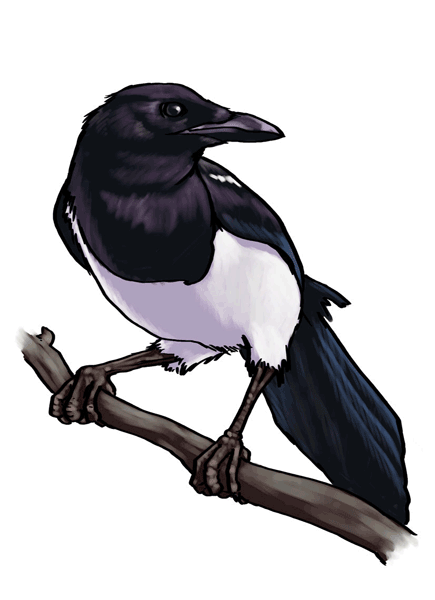
 Czesław Miłosz wrote, as he recalled the familiar cry of a bird during a stroll through an oak forest:
What is magpiety? I shall never achieve
A magpie heart, a hairy nostril over the beak, a flight
That always renews just when coming down,
And so I shall never comprehend magpiety.
I have since heard scholars and poets discourse learnedly on this particular poem (which is here).
In a binge of self-improvement a year or two ago, I signed on for the Oxford English Dictionary’s “Word for a Day.” The binge ended long before the avalanche of words stopped – they were either already familiar, easy to figure out, or otherwise not the etymological treat I was expecting.
But look what arrived in my inbox today:
magpiety, n. Pronunciation: Brit. /maɡˈpʌɪəti/ , U.S. /mæɡˈpaɪədi/
Forms: 18 mag-piety, 18– magpiety.
Etymology: Humorous blend of magpie n. and piety n. Compare also mag n.3, mag v.2
Talkativeness, garrulity (esp. on religious or moral topics); affected piety.
1832 T. Hood Jarvis & Mrs. Cope in New Sporting Mag. Mar. 323 Not pious in its proper sense, But chattring like a bird, Of sin and grace—in such a case Mag-piety’s the word.
1841 T. Hood Let. in Memorials (1860) II. iii. 118 Such solemn questions as..whether your extreme devotion has been affected or sincere..in short, Piety or Mag-piety?
1891 Blackwood’s Edinb. Mag. 150 400/2 Conceive the agony of suppressed speech when a man is as garrulous as a magpie by nature; and my friend is that, though his magpiety is of an elevated sort.
1987 M. Daly Websters’ First New Intergalactic Wickedary Eng. Lang. 145 Magpiety, the impious impropriety of Prudes; irreverence for sir-reverence; Nagpiety’s Hagpiety.
 Who knew? The usage of the word does not begin with Milosz, as I had assumed. In fact, it goes all the way back to 1832, and has a life of its own.
You can hear the poet read the poem here. He says: “There is a very short poem, which when we translated with Peter Dale Scott – quite a trouble to find an equivalent for a notion of magpieishness … if there is a bird magpie, there should be magpieishness. We hit on the idea of translating that magpiety.”
Postscript on 2/3: Poet and translator Peter Dale Scott has made an appearance in the comment section below. He wrote: “’Magpiety’ was my suggestion. Later I was ambivalent about it, but Michael Palmer assured me it was not such a bad idea after all. Apparently not, if it occurred to others before me.”
“Magpiety” was my suggestion. Later I was ambivalent about it, but Michael Palmer assured me it was not such a bad idea after all. Apparently not, if it occurred to others before me.
I hope I made it clear in my last note that I thought I was inventing the word for the first time.