
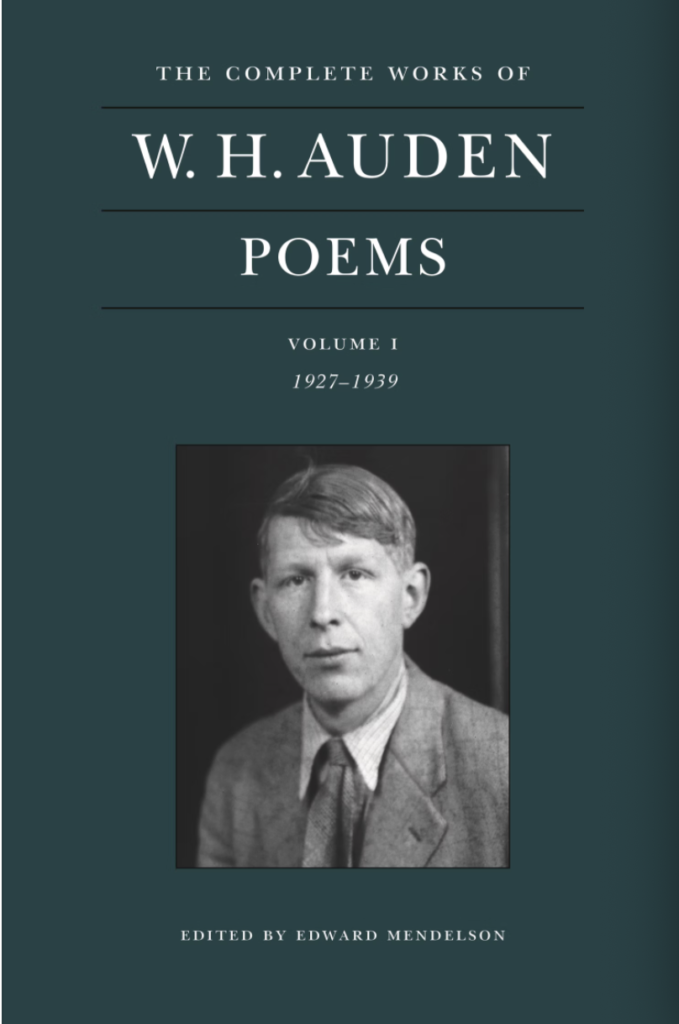
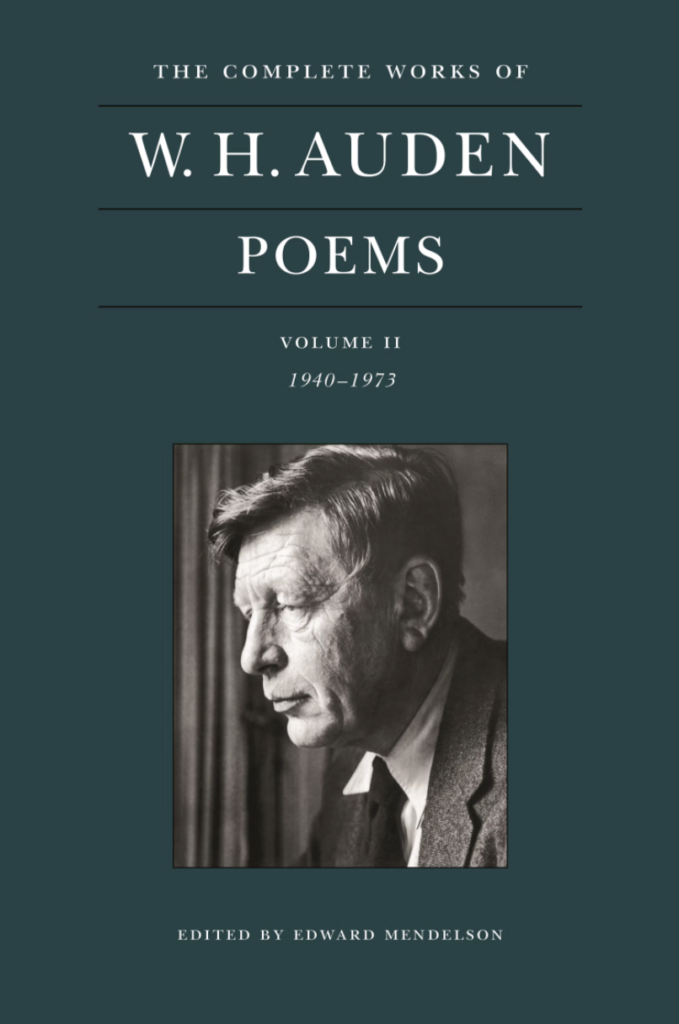
Some good news in a sad year: Princeton University Press has just published the two-volume set of the complete poems of W.H. Auden, one of the foremost poets of the twentieth century. The volumes, edited, annotated and introduced by leading Auden scholar Edward Mendelson, include unpublished poems, songs, juvenilia, original texts and revisions. Together, the two volumes total nearly 2,000 pages.
There’s significance in the publication date: 2022 marks the hundredth anniversary of the year Auden began writing poetry. Had Princeton waited another eleven years, it would have marked the centenary of another remarkable event in his life, which Mendelson describes in his introduction:
“At the same time, when he was looking publicly toward social revolution, he was quietly approaching an inner one. In May 1933 he wrote a sestina, ‘Hearing of harvests rotting in the valley’, one of his bravura historical summaries of many centuries in a few rapid stanzas. After describing earlier centuries’ fantasies of escape from ‘the sorrow’ of unhappy cities to the happiness of utopias somewhere else, the poem ends by imagining a different kind of transformation, not an escape from sorrow, but the sorrow itself melting into a revitalizing flood, after which ‘we rebuild our cities, not dream of islands.'”
“A few weeks later, in June 1933, he experienced what he later called, in a lightly-disguised autobiographical essay, a ‘Vision of Agape.’ This occurred when, sitting with three fellow teachers at the Downs School, he knew for the first time, because he was experiencing it, ‘what it means to love one’s neighbor as oneself.'”
An excerpt from the essay:
“One fine summer night in June 1933 I was sitting on a lawn after dinner with three colleagues, two women and one man. We liked each other well enough but we were certainly not intimate friends, nor had any one of us a sexual interest in another.
Incidentally, we had not drunk any alcohol. We were talking casually about everyday matters when, quite suddenly and unexpectedly, something happened. I felt myself invaded by a power which, though I consented to it, was irresistible and certainly not mine. For the first time in my life I knew exactly—because, thanks to the power, I was doing it—what it means to love one’s neighbor as oneself…. My personal feelings towards them were unchanged—they were still colleagues, not intimate friends—but I felt their existence as themselves to be of infinite value and rejoiced in it.”