

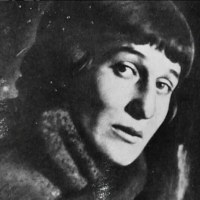
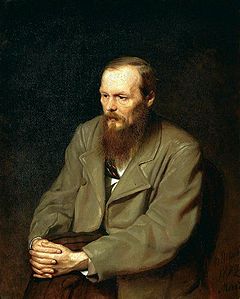
 The great poet Anna Akhmatova wrote of Fyodor Dostoevsky, “The prisoner of Omsk understood everything and gave up on everything.” But did he see our future, too? In Crime and Punishment, René Girard notes: “Raskolnikov has a dream during a grave illness that occurs just before his final change of heart, at the end of the novel. He dreams of a worldwide plague that affects people’s relationship with each other. No specifically medical symptoms are mentioned. It is human interaction that breaks down, and the entire society gradually collapses.”
From Crime and Punishment (trans. Constance Garnett):
 He dreamt that the whole world was condemned to a terrible new strange plague that had come to Europe from the depths of Asia. All were to be destroyed except a very few chosen. Some new sorts of microbes were attacking the bodies of men, but these microbes were endowed with intelligence and will. Men attacked by them became at once mad and furious. But never had men considered themselves so intellectual and so completely in possession of the truth as these sufferers, never had they considered their decisions, their scientific conclusions, their moral convictions so infallible. Whole villages, whole towns and peoples went mad from the infection. All were excited and did not understand one another. Each thought that he alone had the truth and was wretched looking at the others, beat himself on the breast, wept, and wrung his hands. They did not know how to judge and could not agree what to consider evil and what good; they did not know whom to blame, whom to justify. Men killed each other in a sort of senseless spite. They gathered together in armies against one another, but even on the march the armies would begin attacking each other, the ranks would be broken and the soldiers would fall on each other, stabbing and cutting, biting and devouring each other. The alarm bell was ringing all day long in the towns; men rushed together, but why they were summoned and who was summoning them no one knew. The most ordinary trades were abandoned, because everyone proposed his own ideas, his own improvements, and they could not agree. The land too was abandoned. Men met in groups, agreed on something, swore to keep together, but at once began on something quite different from what they had proposed. They accused one another, fought and killed each other. There were conflagrations and famine. All men and all things were involved in destruction. The plague spread and moved further and further. Only a few men could be saved in the whole world. They were a pure chosen people, destined to found a new race and a new life, to renew and purify the earth, but no one had seen these men, no one had heard their words and their voices.