“Mark Twain, but with a harder edge”: new film on Flannery O’Connor – and here’s the trailer!

Share

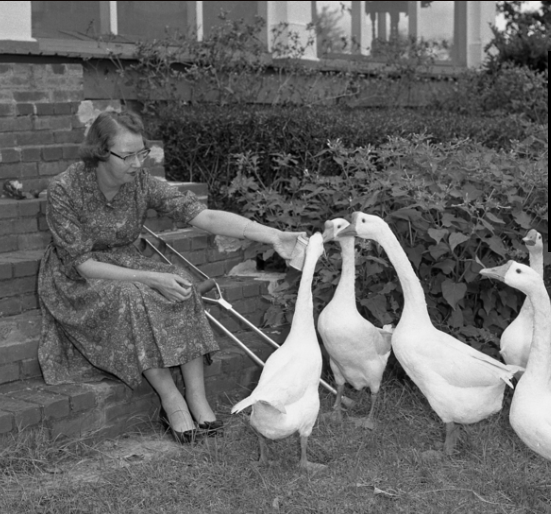
Among the highlights during my brief Chicago visit last week was the first-ever full screening for a general audience of Flannery: The Storied Life of the Writer from Georgia, funded by the National Endowment for the Humanities. The film, directed by Elizabeth Coffman and Mark Bosco, includes never-before-seen archival footage and photographs. Mary Steenburgen narrates, with interviews from Alice Walker, Tobias Wolff, Tommy Lee Jones, Mary Karr, Alice McDermott, Conan O’Brien, Mary Gordon, and people from O’Connor’s life. (The film includes “motion graphics,” rather than “dramatic reenactments,” in keeping with the requirements of the O’Connor Trust.)

“Most literary biopics and most documentaries about writers fail in my opinion because they tend to exclude or at least minimize the writing when of course the writing itself is the key element that defines why we care about the writer,” said film critic Jonathan Rosenbaum, in remarks before the screening. He was critic for the Chicago Reader from 1987 to 2008, and author of a number of books on films. “There’s an analogous problem for me in most films that feature jazz, where it’s felt that audiences are too restless to sit still for uninterrupted writing.”

Then he cited Wendy Lesser, writing in Bookforum: “Flannery O’Connor is like Mark Twainbut with a harder edge. Both the pathos and the ludicrousness of the life she perceives and creates are always present to her, and which one will win out depends on how wrathful she feels her God to be at any given time.”

“Ignorance is by no means her only target. Knowingness, of a highly educated and smug sort, also comes under fire, especially in the later stories that are more visibly self-mocking.”

But the final word in his remarks was from O’Connor herself, in her preface to Wise Blood: “Does one’s integrity ever lie in what he is not able to do? I think that usually it does, for free will does not mean one will, but many wills conflicting in one man. Freedom cannot be conceived simply. It is a mystery and one which a novel, even a comic novel, can only be asked to deepen.”

George Saunders, author of Lincoln in the Bardo, called it “a beautiful and important film about one of our great American artists.” The screening at Loyola’s Damen Cinema was part of the “Catholic Imagination” conference, launched by Dana Gioia in 2015.

Flannery O’Connor onstage: racial divide becomes a chasm in “Everything That Rises Must Converge”

Share

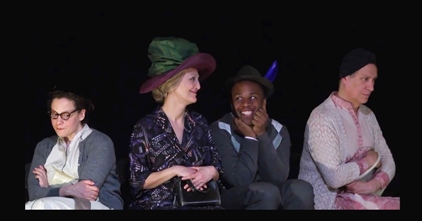
A flirtatious “toddler” (Carlton Terrence Taylor) crosses the racial divide. (Photo: Paula Court)

An interesting evening in Chicago with Flannery O’Connor‘s “Everything That Rises Must Converge,” a short story movingly performed (every word of it, including the “he saids” and “she saids”) by the NYC-based company Compagnia De’ Colombari at Loyola University’s Newhart Family Theatre last week. (It moves to Yale and Fordham this weekend, see here.)

The storyline underscores the racial tensions in the Jim Crow South, but, this being Flannery O’Connor, nuance and contradictions take center stage. The focus is on the tense relationship between a mother who reflects the unabashed racist views of the era, and a resentful “liberal” son returning from college – wholly  dependent on his mother’s pocketbook, pantry, and home.

Excerpt from Time Out New York‘s review of the play: “The ensemble is terrific, smoothly slipping in and out of character. …  dark unsettling magic of O’Connor’s art—coming through full force in this exceptionally sensitive translation.” (The translation from the written word to the stage, that is.)

To much of the audience, commenting during the onstage discussion with the cast afterwards, the racism was a shock. But my interest is, I think, where O’Connor’s was: the son is a hundred percent “right” in his message, but who he is interferes with what he says. The mother with the repugnant attitudes may be the more humane of the two. She flirts charmingly with a black toddler on a bus – the only time in the play there is a real connection across the racial divide.

Incidentally, the title “Everything That Rises Must Converge” refers to a sublime phrase from Pierre Teilhard de Chardin: “Remain true to yourself, but move ever upward toward greater consciousness and greater love! At the summit you will find yourselves united with all those who, from every direction, have made the same ascent. For everything that rises must converge.”

Back to the story. O’Connor’s text drips with irony, noting that, in spite of his mother, Julian had turned out so very well. The story continues:

In spite of going to only a third-rate college, he had, on his own initiative, come out with a first-rate education; in spite of growing up dominated by a small mind, he had ended up with a large one; in spite of all her foolish views, he was free of prejudice and unafraid to face facts. Most miraculous of all, instead of being blinded by love for her as she was for him, he had cut himself emotionally free of her and could see her with complete objectivity. He was not dominated by his mother.

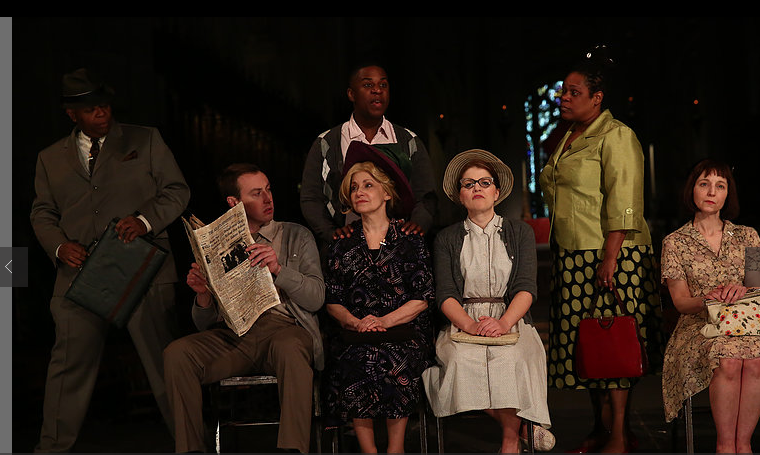
The bus stopped with a sudden jerk and shook him from his meditation. A woman from the back lurched forward with little steps and barely escaped falling in his newspaper as she righted herself. She got off and a large Negro got on. Julian kept his paper lowered to watch. It gave him a certain satisfaction to see injustice in daily operation. It confirmed his view that with a few exceptions there was no one worth knowing within a radius of three hundred miles. The Negro was well dressed and carried a briefcase. He looked around and then sat down on the other end of the seat where the woman with the red and white canvas sandals was sitting. He immediately unfolded a newspaper and obscured himself behind it. Julian’s mother’s elbow at once prodded insistently into his ribs. “Now you see why I won’t ride on these buses by myself,” she whispered.

The woman with the red and white canvas sandals had risen at the same time the Negro sat down and had gone farther back in the bus and taken the seat of the woman who had got off. His mother leaned forward and cast her an approving look.

Julian rose, crossed the aisle, and sat down in the place of the woman with the canvas sandals. From this position, he looked serenely across at his mother. Her face had turned an angry red. He stared at her, making his eyes the eyes of a stranger. He felt his tension suddenly lift as if he had openly declared war on her.

He would have liked to get in conversation with the Negro and to talk with him about art or politics or any subject that would be above the comprehension of those around them, but the man remained entrenched behind his paper. He was either ignoring the change of seating or had never noticed it. There was no way for Julian to convey his sympathy.

His mother kept her eyes fixed reproachfully on his face. The woman with the protruding teeth was looking at him avidly as if he were a type of monster new to her.

You can read the whole short story here.

Racial discomfort on a public bus. (Photo: Paula Court)

Two views of a milkpod, and a (very) few words from Richard Wilbur

Share

The Richard Wilbur and his wife Charlee

As readers of the Book Haven may have gathered, I am out and about, speaking here and there about Evolution of Desire: A Life of René GirardI am currently visiting the University of Notre Dame for the very first time, and a friend advised me to take a walk around the lake.  So I did.

There must be milkweeds in California – Google tells me there are. But I don’t think I’ve seen a specimen of “Asclepias” since I left my native Michigan. Of course my they brought back another memory: the late great Richard Wilbur‘s poem to them, part of “Two Voices from a Meadow” (the two views below of a particular Notre Dame milkpod were taken by Denise Hergatt). Read it, and you’ll never look at them the same way again.

Anonymous as cherubs
Over the crib of God,
White seeds are floating
Out of my burst pod.
What power had I
Before I learned to yield?
Shatter me, great wind:
I shall possess the field.

Rest assured that the Book Haven will be returning to beautiful Palo Alto in the next few days, and resume it’s regular programming.

September 11, 2001: for some that day will never end

Share

Today is the 18th anniversary of the attack on the World Trade Center. We share a few memories from three writers below. One is the story of a “mind-numbing” few hours, another from a “short view” kind of guy, and a third of a job offer refused.

John Guzlowski, author. His parents were survivors of Nazi work camps – we’ve written his story about it here.

I got a letter on Sept. 12, 2001, from my friend Bill Anderson who tended to take a cynical view of people and government and the human animal in general.

The following was the response I wrote to him that day:

I wish I could take the long view the way you do, Bill: look at the attack, and see it the way it probably is –  President Bush seeing this as his way of putting a lock on his second term, Americans showing their true nature by making money on increased gas prices, Hollywood being angry because this will put the next Bruce Willis film on hold for two weeks. The long view: we’re all self-serving crooks.

I’m not good at the long view. I’m more of a short view guy: One of my wife Linda’s cousins saw the first tower go down from her office. Her name is Lisa. She was a wonderfully fat baby. One time her mom, Linda’s Aunt Anne, dressed her in a tutu, and Linda’s dad Tony laughed and laughed, and still 25 years later the family talks about the tutu and how much we all loved her in her tutu and laughed with joy at her beauty.

“I’m more of a short view guy.”

Lisa got out okay. She was evacuated, and finally found herself across the river at a phone booth in Hoboken, New Jersey. She called home to Aunt Anne and Uncle Buddy. He’s also a short view guy: He was with Patton’s soldiers when they freed the first concentration camps. He still shakes and cries when he remembers the piles of corpses.

My niece is an emergency room nurse at NYU hospital. (I think I saw her in the background on an NBC spot about the hospital – but I wasn’t sure. She looked old and tired and gray with pain.) Her dad, Linda’s brother Bruce, was calling her and calling her to make sure she was okay. Finally she got through to him late in the afternoon on Tuesday. He begged her to leave the hospital, said he would drive down from Connecticut and get her. Cried and begged her. He said he was her father and she had to listen to him. (Bruce isn’t much of a crier. He’s a jokey, tough Brooklyn guy.) But she was his baby and he wanted her away from all of it. And she said she couldn’t leave. He cried some more and pleaded, and she hung up on him. She had to get back to work.

And all those people looking for their relatives and friends, holding pictures up to the TV cameras and telling us about how some guy was a great friend, and he was a waiter in a restaurant at the top of the building. And I see a photo of this poor foreign-looking schmuck with a big nose and a dopey NY baseball cap that’s way too big, who probably came here with a paper suitcase and thought that working up at that restaurant was the greatest thing possible in the world. And the friend hoping to find this guy thinks this guy is alive someplace, maybe in a coma in some hospital.

And I know there’s not a chance in hell this guy or any other guy or gal in any of these pictures is alive. They’re dead, all dead, but I wouldn’t tell this guy holding the picture.

Boy, these are stories that touch me so hard I can’t think about the other stuff, the long view.

Mary Morris, author. We’ve written about her anniversary here. This is a different kind of story, for a different kind of anniversary:
MIA for several “mind-numbing” hours

Eighteen years ago Larry and I went for a walk. Normally he took the R train to work but it was a beautiful morning so he took a different train. One that didn’t let him off inside the World Trade Center. A beautiful morning, a twist of fate. When my mother-in-law called and asked if Larry was home, I told her she could call him at work. When she said, “Where exactly is his office?” my heart stopped.

During those mind-numbing hours our house filled with people. Someone brought sandwiches. The dog barked every time

a person came or went. And then he ran to the door, not barking, I knew that Larry had come home, covered in a fine dust of glass that would send splinters into my flesh and our daughters’.

This is very personal and hard to say. This is not something we will ever get over. When I see the lights in the sky, it takes my breath away. We were lucky that day. And I am grateful. My heart goes out to those for whom that day will never end.

Erin Huntzinger, professor at the University of Wisconsin, Milwaukee, who also recalls the 1993 attack on the World Trade Center, with a rental truck filled with explosives – “a blind cleric was the master mind.”

I was on Wall Street during the first World Trade Center bombing [in 1993]. I had a lunch interview at the Trade Center’s Windows on the World restaurant with the firm of Canter Fitzgerald. I got too busy trading around a client’s big position and had to cancel our lunch. It was a overcast day with intermittent rain. The markets slowed, I got a coffee, and I took a phone call from my dad. Suddenly our building shook. At first I thought it was a lighting strike to our building. Soon after I looked down and saw black smoke which billowed from the Peninsula Hotel and the World Trade Center parking entrance. Then helicopters circled the towers. Our secondary generators, backup cell connections, computers, and trading platforms kicked on.
It’s personal.

As I walked home to my condo in battery park, I passed scores of cop cars, ambulances, and fire trucks. The Peninsula hotel was taped off as a crime scene. Its facade was unrecognizable. The West Side highway was closed at 14th street and traffic was backed up for miles. I eventually turned down the job a Canter Fitzgerald, even though a number of friends begged me to join them.

On September 11, 2001, I was in Los Angeles. I was woken by my girlfriend who was on location in Vancouver. She was almost incoherent as she directed me to “just turn the TV on.” I did. I watched in horror as my phone just kept vibrating from call after call. I watched as fire streamed from the towers from the commercial airlines. It was surreal. I wept and wept as I watched the looped visual of the planes impacting the buildings. Then the networks flashed to live shots. I watched as friends and acquaintances, many from Canter Fitzgerald, died in front of me. The firehouse, where I had hung out playing cards, was vaporized. As I unblinkingly watched the screen, Boris, my NYPD dog, comforted me by sitting in my lap intermittently licking the salt streaming down my cheeks. I was speechless for hours as my eyes just fixated on the bodies falling amongst the flames. For me the slogan never forget is extremely emotional and personal.

May God Bless them all.
Crimean filmmaker Oleg Sentsov was tortured and sentenced to 20 years – now he is free!

Share

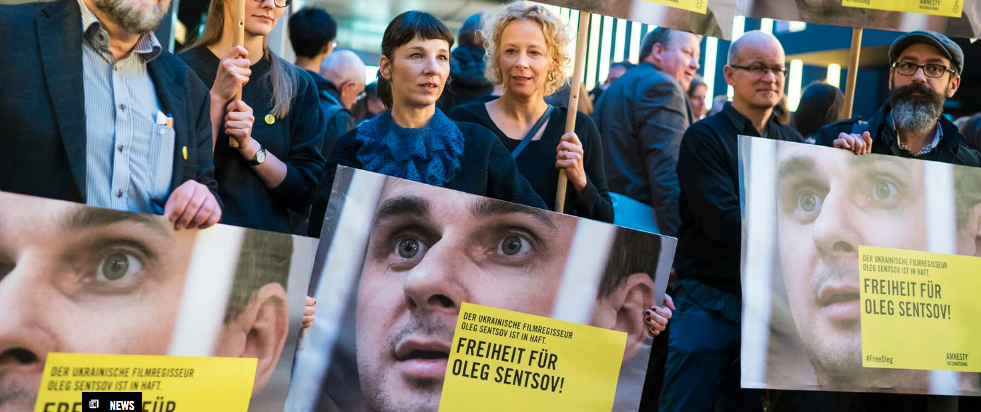
International protests for his freedom. (Photo: Amnesty International / Henning Schacht)

When asked if he understood his sentence, Crimean filmmaker and writer Oleg Sentsov stood up in his glass cage and sang the Ukrainian national anthem. Surprising to some perhaps, because he is an ethnic Russian, although Crimean-born. But he never recognized Russia’s brutal 2014 annexation of his homeland, and he said so. (Film clip below.)

With the testimony of tortured witnesses, a Russian court was sentenced for “terrorism” and sentenced to a series of Siberian prisons until August 2035. Now he is free.

Awarded by PEN in 2017

On Saturday, Russia and Ukraine finalized the exchange of 70 prisoners held in both countries. They include 24 Ukrainian sailors captured off the coast of Crimea last year as well as Sentsov. They returned to Kiev where they were  welcomed by Ukrainian president Volodymyr Zelenskiy and where Sentsov was reunited with his family.

His imprisonment has not been uneventful: at one point, he was beaten for 24 hours to force a confession. When he tried to prosecute for torture, the Russians accused him of sado-masochism and inflicting his own wounds. He and three other Ukrainian freedom-fighters were charged with planning to bomb power lines, bridges, and public monuments.

Over four months ago, he had declared a hunger strike, demanding Russian authorities to free all Ukrainian “political prisoners.” He lost 66 lbs. before ending the strike after 145 days under threats of force feeding. Sentsov, the 2017 PEN/Barbey Freedom to Write Award winner is best known for his internationally acclaimed 2011 (non-political) feature film Gamer

Reacting to the news that Ukrainian filmmaker Oleg Sentsov and dozens of other detainees have been released as a part of prisoner exchange between Russia and Ukraine, Marie Struthers, Amnesty International’s Director for Eastern Europe and Central Asia, said:

“Oleg Sentsov and many others jailed following Russia’s occupation and illegal annexation of Crimea are simply victims of politically-motivated prosecution and they should never have been imprisoned in the first place. While it is a relief that they are now free, it is a travesty to see them being used as human bargaining chips in political deals.

“The conflict in eastern Ukraine opened a new and tragic chapter for human rights in the country and beyond. Following his arrest, illegal transfer to Russia and deeply flawed trial by a military court, Oleg Sentsov spent more than six years behind bars.

“The Russian authorities derisively refused to recognize his Ukrainian citizenship and transported him 3,000 kilometers away from his family and native Crimea to the frost-bitten penal colony at Labytnangi in the far north of Russia.

“No-one should be prosecuted and imprisoned solely for political reasons; we demand justice for all remaining prisoners subjected to these politically-motivated trials, those who had been imprisoned solely for exercising their human rights, should be immediately and unconditionally release.”