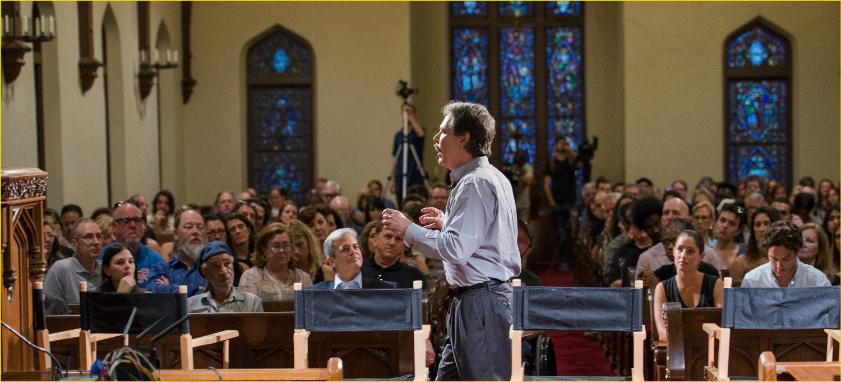
It’s been 70 years since Europe’s last pogrom. Kielce is beginning to face its past. “Bogdan’s Journey” is the reason why.

Share

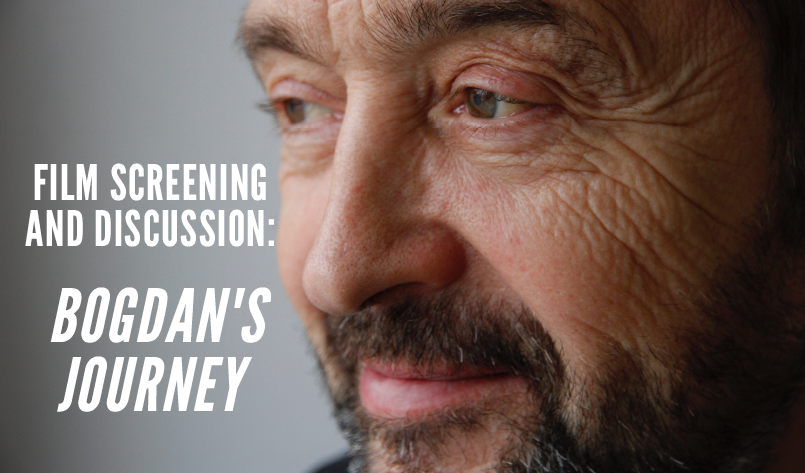
Poland’s Kielce was the site of Europe’s last Jewish pogrom – only a year after World War II ended. In 1946, the city’s militia, soldiers and ordinary townspeople killed more than forty Holocaust survivors seeking shelter in a downtown building and injured eighty more around the city. As news of the pogrom spread across Poland, Jews fled the country. The Kielce pogrom became a symbol of Polish post-war anti-Semitism in the Jewish world. Under communism, the pogrom was a forbidden subject in Poland, but the event was never forgotten.

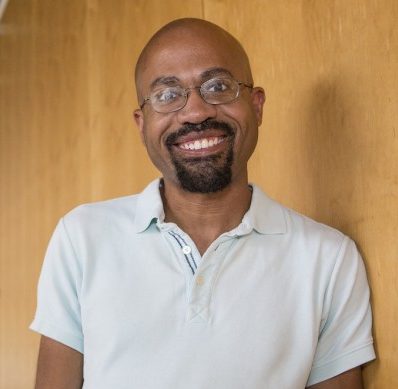
Sixty years later, Bogdan Białek, a Catholic Pole, psychologist, and journalist, began to talk publicly about the darkest moment of the city’s past, persuading the people of Kielce to confront its terrible history. He began alone, but attracted others as he went along. Together, they cut through the miasma of repression and denial in the city’s competing narratives, unveiling his fellow citizens’ deepest prejudices. He worked to reconnect Kielce with the outside Jewish community. Bogdan’s Journey tells his story, and took almost a decade to film.

Bogdan’s Journey tells a unique story about one man and how he redeems seventy years of bitter, contested memories – by telling the truth with love. This film contains subtitles.

Białek will attend the Santa Clara University screening on November 19, from 7 to 9 p.m. at the St. Clare Room in the library. Afterwards, there will be an onstage conversation with Bialek and the co-directors of the film, Michal Jaskulski of Warsaw, and Lawrence Loewinger of New York.

Can one man heal a community? The film will screen next Tuesday, 7 p.m., at Santa Clara University. Bogdan will be there. (Trailer included.)

Postscript: And thanks, as always, to George Jansen for his vigilant eyes.

“All I Have is What I Have Given Away”: an encounter with Dante, a reading with Robert Pinsky, and a Roman friendship

Share

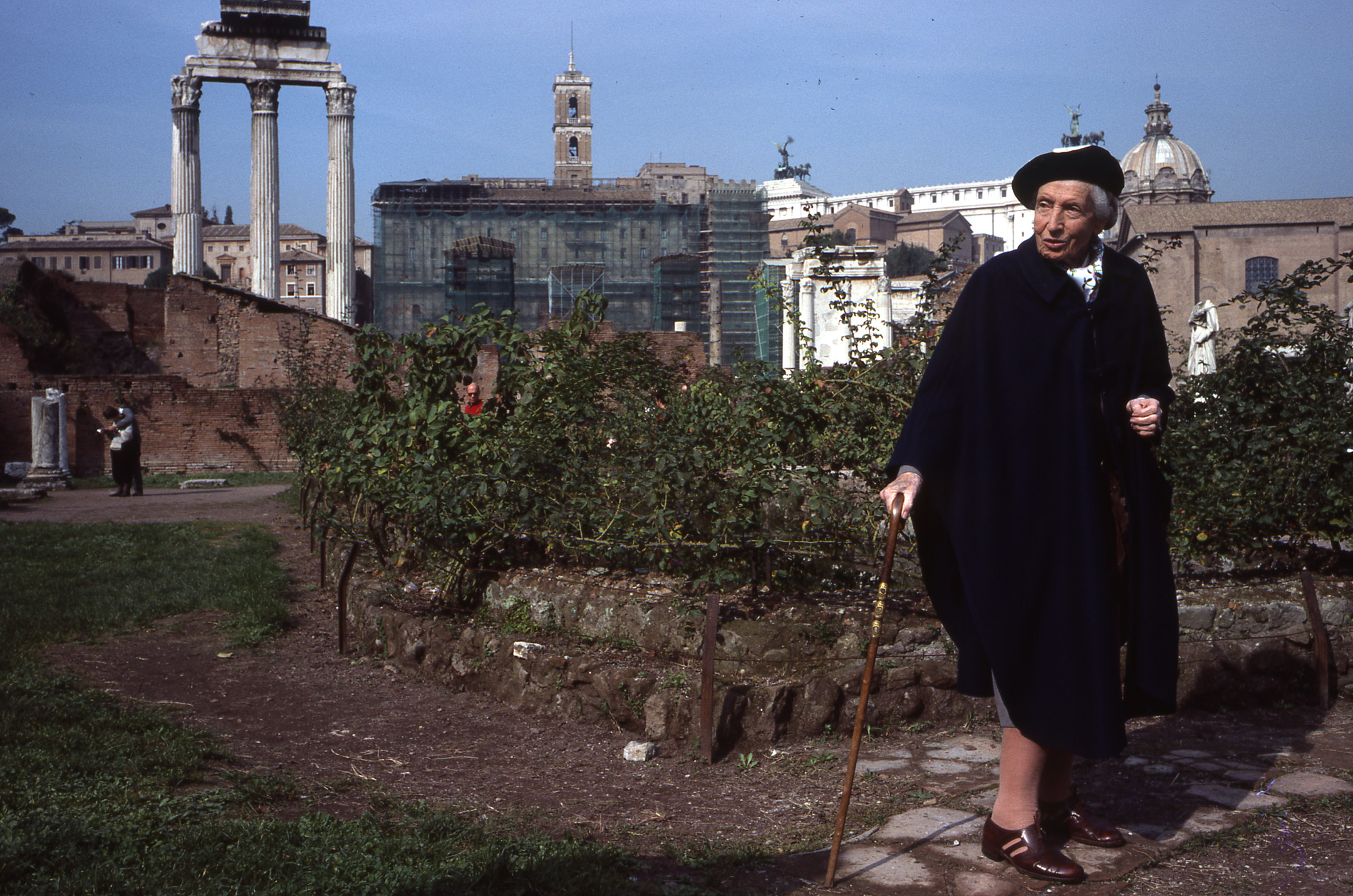
“When my time comes, I want to die here. Here on this ground.” (Photo: Patrick Troccolo)

“All I Have Is What I Have Given Away,” a smooth, enchanting, and elegant tale, is up at The Commonan Amherst journal. I am proud of my small role in encouraging its publication. Susan Troccolo tells the story of a meeting in Rome with an educator and Dantista who had been imprisoned as part of Italy’s WWII resistance. The encounter, decades ago, changed her life:

On that bright morning in November—the first day I saw her—Anna Lea Lelli wore the outfit that distinguished her on the streets of Rome: a long cape and beret. The beret emphasized her craggy jaw and prominent Roman nose. Under her Scottish wool cape, Lea wore a gray suit in gabardine and a cream-colored silk blouse with French cuffs and pearl cufflinks. Just the right amount of cuff showed under the suit, no doubt perfectly tailored to her years ago. At her neck was a silk scarf, on her hand a carnelian ring carved with the face of Mars. She held a cane with the silver head of a horse, the patina worn from the warmth and pressure of her hand.

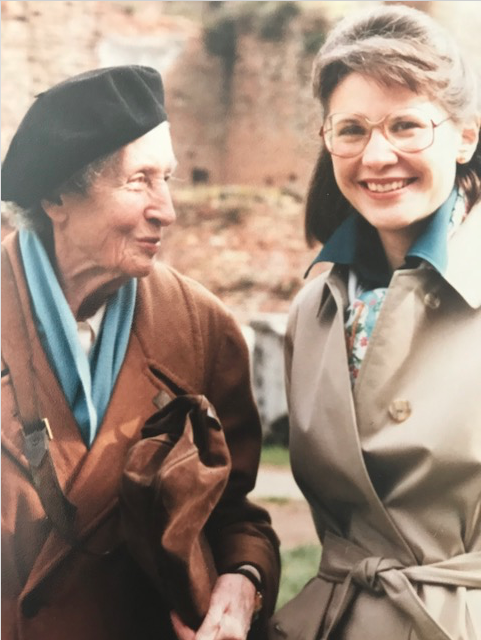
At the Forum together (Photo: Patrick Troccolo)

I don’t know why I was drawn to her that day in Rome. She was eighty-three years old. I was thirty-two. We were clearly from different worlds, with nothing apparent in common. My husband and I had gone to live in Rome for what we thought would be one whirlwind year. Now that year had passed, and I felt I hadn’t really touched the heart of the place. I was in love with Italy, and wholly taken with the music of the language, but I wanted something deeper from my experience. …

It was only during our second visit that Lea began to inquire about my Italian studies. She could hear that I was a beginner, she said, but my accent was very natural. She studied me again with that penetrating gaze I never got used to and, in her refined English, said, “We have a space for you in the Dante class that meets here every Monday.” Motioning to me to pour her another cup of tea, she said, “You are young, but you have the quality of devotion. Devotion matters to Dante.”

We sipped our tea in silence for a moment. Her compliment had been unexpected, and it made me thoughtful. What did she mean by “devotion”What kind of devotion could a Dante class possibly require? As if she had heard the voice inside my head, Lea explained just how devoted I’d need to be: “You must first learn Italian. Then you will begin to learn the Italian of Dante. Our class meets once a week for three hours. Of course, the class must go on for three years, a canto a week….” Lea’s voice dropped low, as if she knew she might scare me off.

Susan sent me a draft of the story ages ago, and I helped with editorial suggestions. However, there is a coda to the story that didn’t survive the final cut. Since I know the cast of characters –both Robert Pinsky and Susan – I thought I’d include it here. Susan continued:

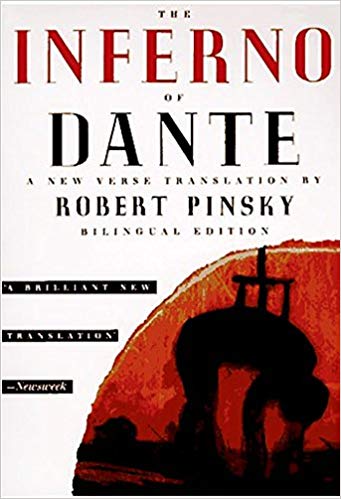
In November 1998, Robert Pinsky, who was the U.S. Poet Laureate at the time, did a reading at Powell’s Books in Portland, Oregon. A few years earlier, he had completed a new bilingual verse translation of Dante’s masterpiece called The Inferno of Dante.

I arrived early and sat in the third row, with Pinsky’s new book in my hands and the sales slip as a bookmark. The reading was drawing a big crowd—a staffer was setting up extra chairs so everyone could have a seat.

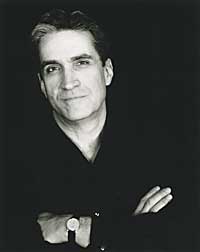
Pinsky (Photo: J. van Otteren)

Robert Pinsky arrived and began to set up at the lectern. He was a handsome man with dark brooding eyes—heavy lidded with thick brows. Dante could have picked him personally from beyond the grave to represent his words.

The reading began and then Pinsky said something that floored me: he said he didn’t speak Italian. Yes, he could read Italian, as a poet, he could do a fresh translation.

But the real music of the language was something he could not lay claim to. Was there anyone here in this crowd who could read the original before he read his translation?

I froze. My mind raced and the book almost fell from my hands. What if I didn’t raise my hand? What if I let an opportunity like this pass by? Lea would never forgive me.

I raised my hand.

What happened next lives in a sun-lit corner of my mind. It lasted ten minutes. I recited what Pinsky pointed out in his copy, then he took back his book and read the English. Then, I showed him my favorite passages and recited them as music, as Lea had taught me. No book. Robert Pinsky replied with his magnificent translation.

After our reading, the line to have Mr. Pinsky sign his book was long. While we waited—all of us poetry lovers—people came up to me.

“You know, I didn’t understand you, but I did understand you, do you know what I mean?” Someone else said: “I think this is the first time I’ve ever really known that poetry is music.”

When my turn came, I thanked Mr. Pinsky for allowing me to share Dante with him. He was warm and enthusiastic: “Where do you teach? I don’t hear Dante like that. Where do you teach?” he repeated.

“I don’t teach, but you see…I had this friend…..in Rome…”

Read the whole story here. Or watch the video, filmed in Rome, 1990, and aired on San Francisco public television KQED. Part 1 on Youtube is here. Part 2 is here. Or stay put and watch the Vimeo clip below. (The video quality has not borne the burdens of time well – the youtube quality is a better than the short Vimeo clip below – but it will give you a taste.)

Omaggio: A Portrait of Anna Lea Lelli from Digital Bindery on Vimeo.

Director at JHU Press: “Stanford has a great university press. It’s not clear the Stanford committee believes this.”

Share

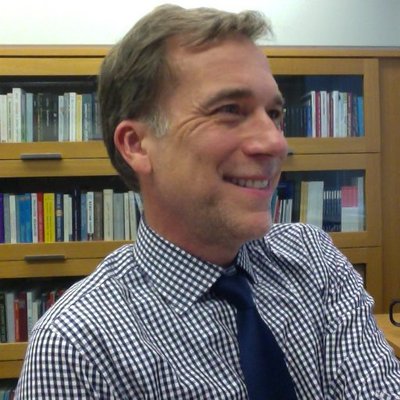
Britton on Twitter. Call him “His Dudeness.”

Last June, the Book Haven reported on some remarkable developments at Stanford University Press. We wrote about it here:

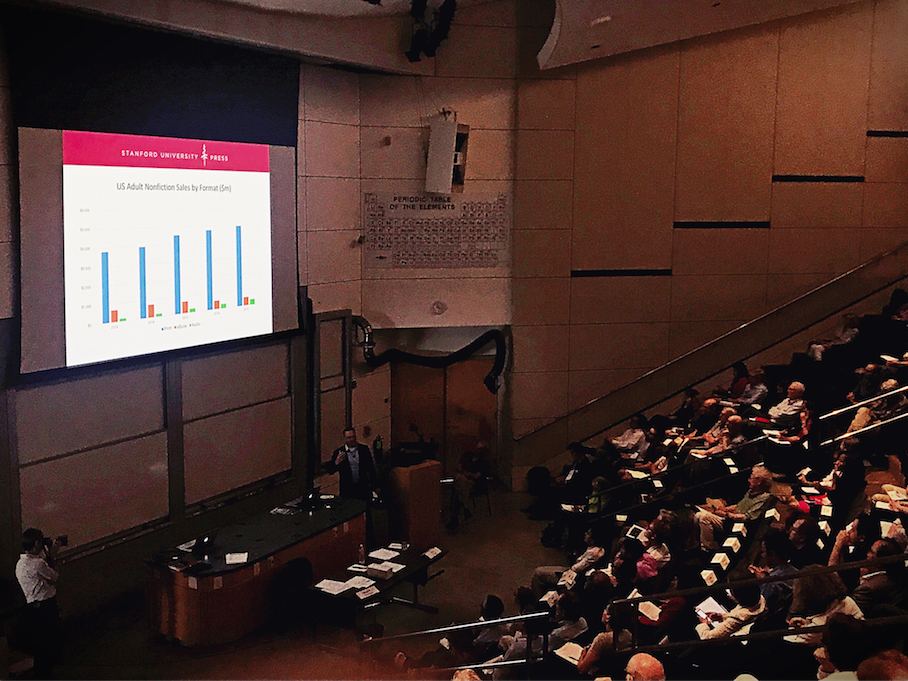
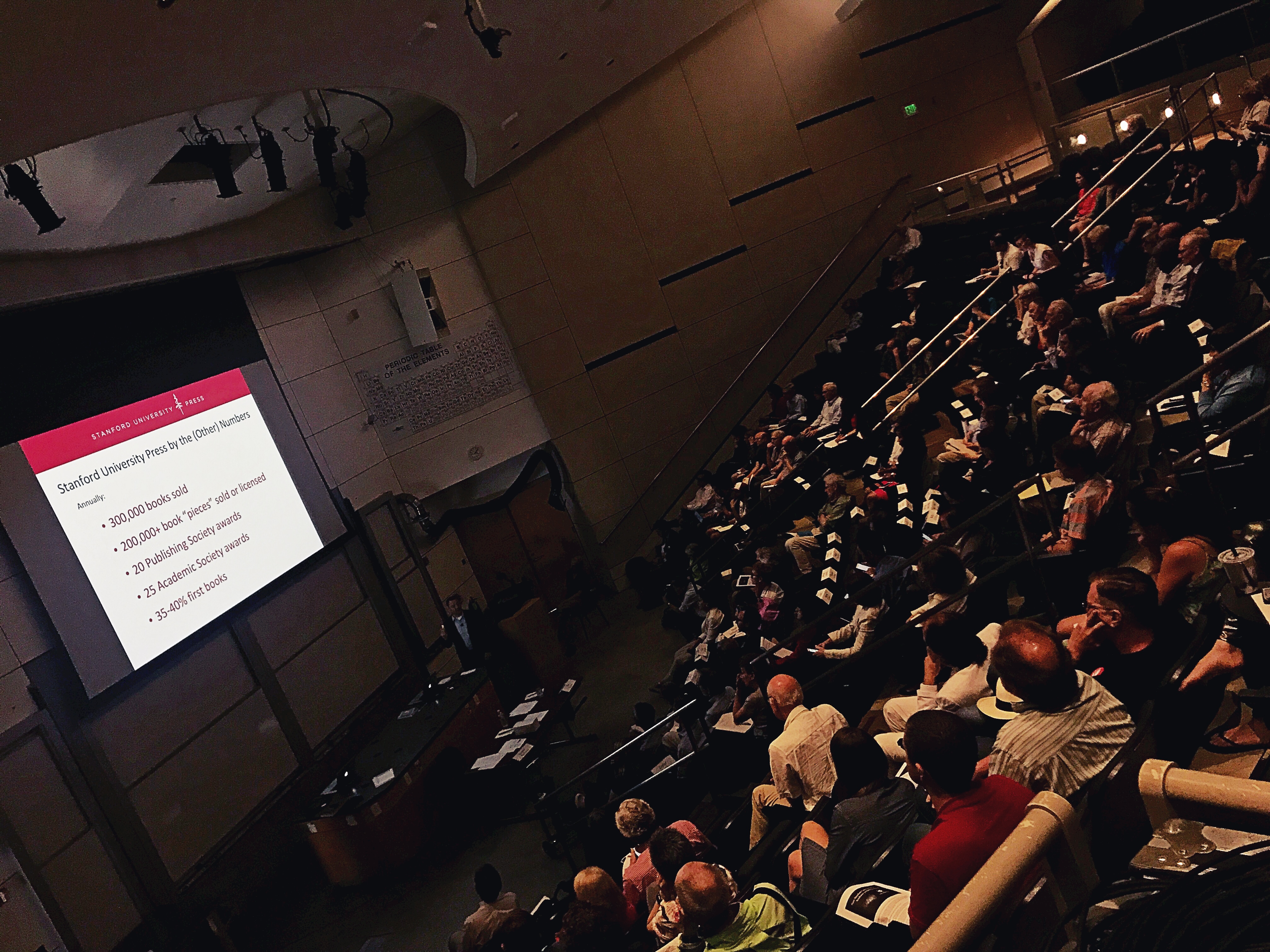
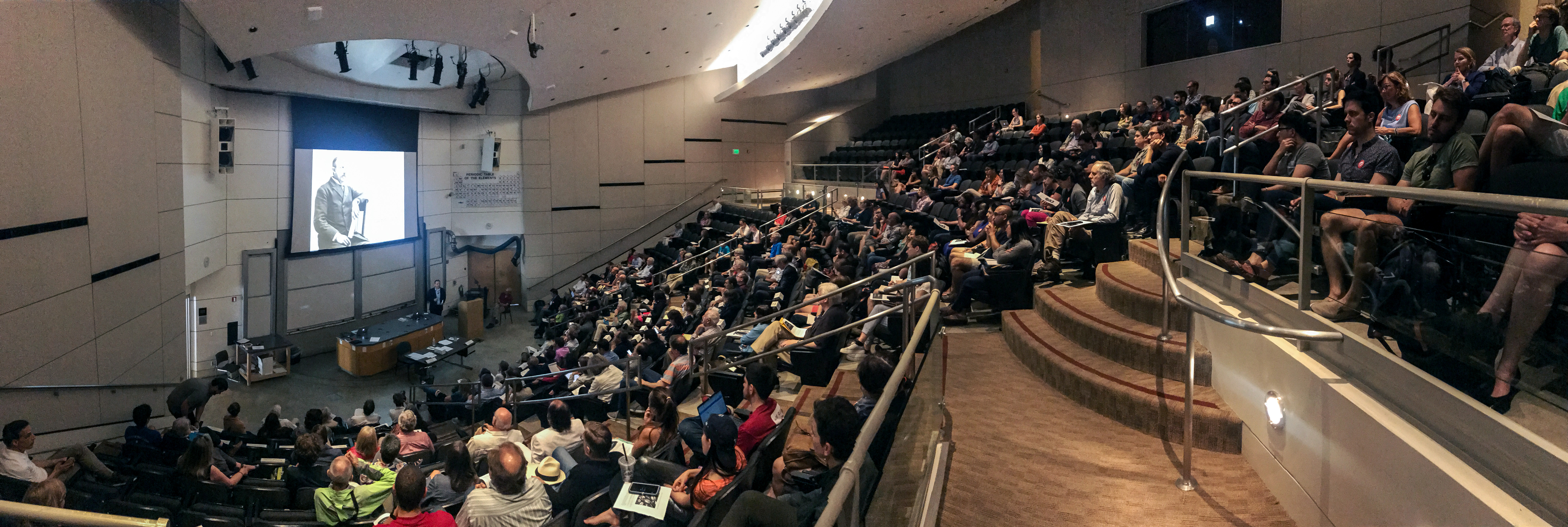
Passions ran high and emotions were raw at yesterday’s Stanford Faculty Senate meeting, which had to be moved to a larger venue to accommodate the crowd. One faculty said that the fury around this issue was unlike anything he’d seen at Stanford in more than a decade.

A recap: The university decided to terminate its support of Stanford University Press, which had been given $1.7 million supplements for several years. The amount, as many pointed out at the meeting, is chump change, about .027% of Stanford’s annual operating budget. The move, seeking to make the press “sustainable,” spurred national and international outcry and letters from thirteen Stanford departments, schools, and programs and sixteen letters from national and international learned societies, as well as extensive press coverage (including The Chronicle of Higher Education here). The controversy has been discussed on the Book Haven here and here and here.

Now the report from Stanford’s Office of the Provost is in. You can read it here. The reaction from Greg Britton, editorial director of Johns Hopkins University Press over at “Slouching Toward Palo Alto” at Inside Higher EducationAn excerpt:

200+ attended last June’s meeting. (Photo: Ge Wang)

What is clear from the report is that the administration does not think the press has achieved the same excellence as the university: “While the relationship between Stanford and its Press has some elements of the most successful presses, both the University and the Press have failed systematically to aspire to, and reach, this standard” (emphasis my own). Or later: “Yet, reaching the goal of a press that is equal to the status of Stanford University has been difficult.”

He continues:

Most remarkable about the report, however, is the committee’s preoccupation with the press’s status compared with its elite peers. The committee relied on a research assistant to search webpages of other academic presses to calculate the percentage of authors from elite institutions, although the exact methodology of this research isn’t described. They assumed that faculty at “the top 10 or 20 universities” must write better books, which presumably would sell better. The committee also admonishes the press to publish more senior faculty and fewer books by new scholars. The assumption, again, is that these will sell better, and, if not, at least bring luster to the operation. This ignores a core mission of a university – to foster, assess and support the work of junior scholars. Further, it ignores a truth that every editor knows: that that excellent work comes from scholars in every corner of higher education regardless of faculty rank or institutional ranking.

High passions at last June’s meeting. (Photo: Ge Wang)

This status obsession runs throughout higher education. In one sense, universities and their diplomas are Veblen goods – luxury products whose demand increases as their prices go up. (How else does one understand the Varsity Blues admissions scandal?) Because of this, universities are fiercely protective of their place in the rankings. Anything that detracts from that perceived status must be dealt with, including a university press.

In conclusion,

Lost in the recommendations for how to fix the Stanford situation is any recognition that university presses have continued to innovate their way out of this. University presses publish books that extend the reach of scholars beyond the gates of their universities. Yes, they produce field-specific monographs, but they also publish deeply thoughtful books that inform the human condition, solve problems and extend knowledge far and wide. Stanford University Press is no exception.

Stanford has a great university press. It’s not clear the Stanford committee believes this.

Read the whole thing here.

“For most of history, music was a kind of cloud storage for societies”: Ted Gioia talks music with Tyler Cowen

Share

“Most people in my generation had better sound systems as teenagers than they do now.”  (Photo: Brenda Ladd)

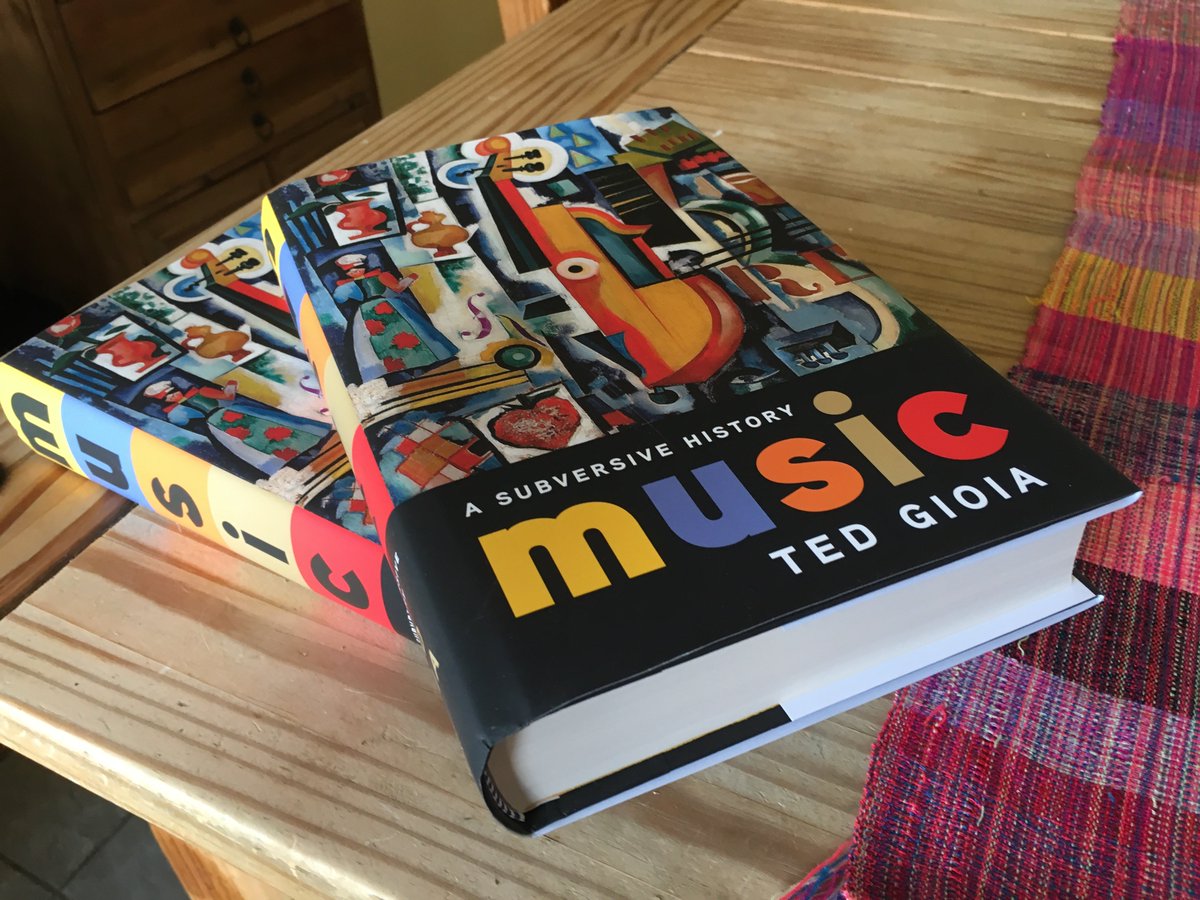
Jazz scholar Ted Gioia listens to three hours of new music per day and over 1,000 newly released recordings in a year. (We’ve written about him here and here and here.) His latest book, Music: A Subversive History covers the evolution of music from its origins in hunter-gatherer societies, to ancient Greece, to jazz, to its role in modern-day political protests such as those in Hong Kong. Over at Medium, he joined the popular economist Tyler Cowen to discuss music in a wide-ranging interview (the podcast is here) that also takes on the music industry, technology, and the reason for loud restaurant music (hint: René Girard).

The news is not all good: “In fact, I would say that music is the only form of entertainment in which the technology has gotten worse during my lifetime. I go to movies now, and it’s this big screen and surround sound. Video games put the Pong that I used to play to shame. TV is so good, it’s being called a golden age of television. But in music, most of us listen to songs on these lousy handheld devices. Most people in my generation had better sound systems as teenagers than they do now. That worries me more than the whole idea of how songs are written. I’m really concerned about the technology lessening the whole listening experience.”
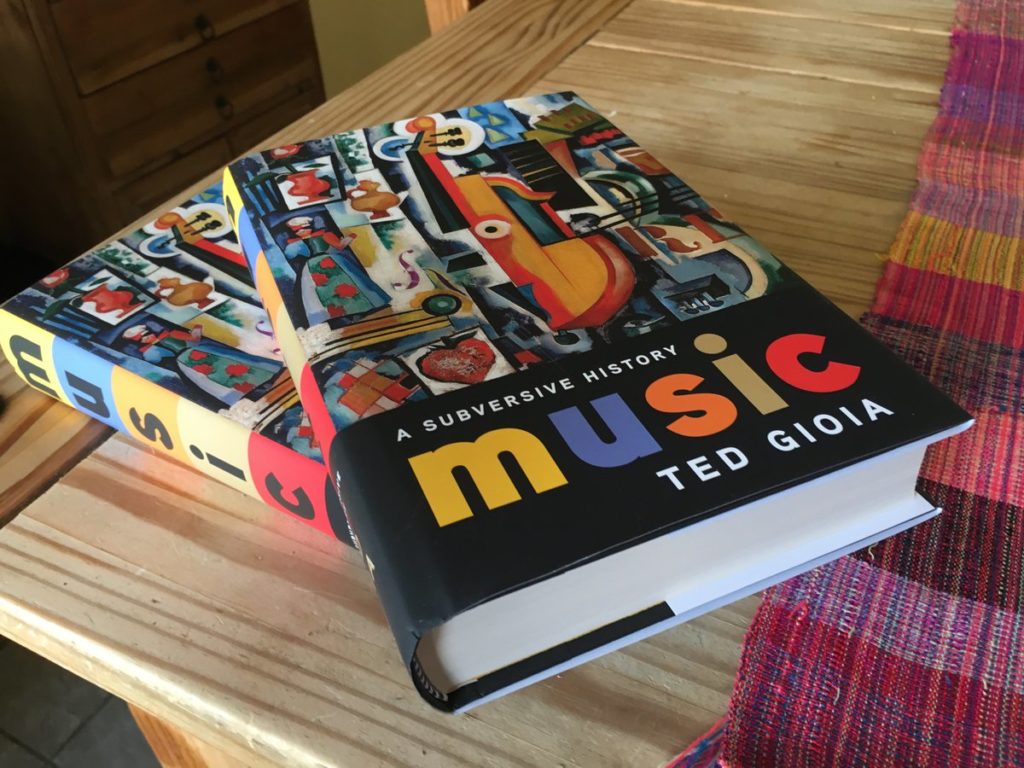
Ted’s first copies of his new book. (Via Twitter)

An excerpt:

COWEN: … Do you think our collective memory from music is decaying more rapidly because communications technologies move so much faster and preserve things so much better?

GIOIA: What people don’t understand is that, for most of history, music was a kind of cloud storage for societies. I like to tell people that music is a technology for societies that don’t have semiconductors or spaceships. If you go to any traditional community, and you try to find the historian, generally it’s a singer. Music would preserve culture; it would preserve folklore.

Well, nowadays, we rely on cloud storage to be the preserver of these same things. And I think there’s a strange shift. Both we rely on the cloud to preserve our music, but also, we no longer rely on music to preserve our culture. This is potentially a dangerous thing because it could create a situation where our musical lives grow more and more distant from our actual social lives with the people around us in our larger community.

Here’s another excerpt:

COWEN: But what really embarrasses you? What admission can I squeeze out of you?

GIOIA: When I was a teenager, I listened to Emerson, Lake, and Palmer.

COWEN: Now that’s embarrassing.

GIOIA: Right before I discovered jazz, I was listening to Keith Emerson. This was the quandary I was in.
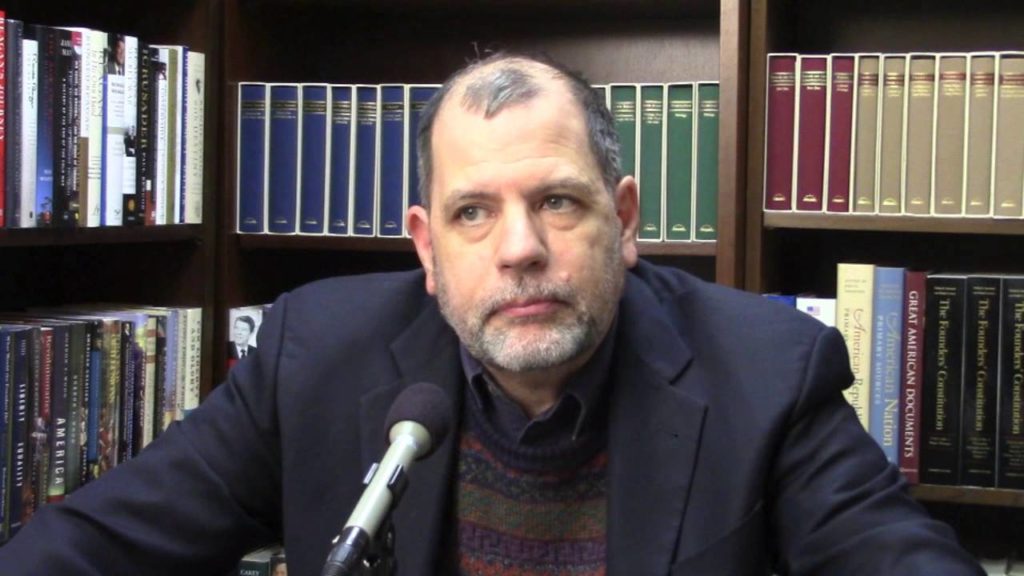
Economist Tyler Cowen asks an embarrassing question

COWEN: It was jazz, in a way.

GIOIA: It prepared me for jazz. It really did. When I was a teenager, I was playing piano, and this was the problem I faced. I liked rock because of its emotional immediacy, but it didn’t have the sophistication I wanted. Then I loved classical music like Bach for the sophistication, but it didn’t have the emotional immediacy. And I said, “I need something that brings together both.”

Then I walked into a jazz club. Literally, I walked into the Lighthouse in Hermosa Beach, California. I was a high school student. I sat down, the music started, and within 10 seconds, I said to myself, “This is what I’ve been waiting for.” Really, it was this epiphanal moment. But before that, it was Keith Emerson.

And a third, about one of my own pet peeves – loud restaurants:

COWEN: Why are restaurants so much noisier today? And they’re still getting noisier.

GIOIA: In fact, I’ve got to say I prefer the quiet restaurant, but I understand everybody else wants the noisy restaurant. And I do think we’re going back to René Girard territory, where everything’s imitation, where you choose the restaurant not on what’s the best food, but what other people are doing that I can imitate. There are two restaurants in town. You go in the one with the most people. I think that imitative behavior patterns explain much more in society than we care to admit.
Merci, René Girard.

COWEN: But there’s much more noise pollution more generally. Restaurants are noisier. It seems that music, in general, is louder. And in terms of dynamic compression, the range is much narrower. So why is there this general tendency toward more noise? Why are markets undersupplying peace and quiet?

GIOIA: Because they want to stand out. It’s interesting, in my book I talk about the very first musicians, who were hunter-gatherers. What they did was fascinating because back then there were no loud sounds. You could live your whole life in prehistoric times and maybe never hear a loud sound unless you went near a waterfall or maybe during a thunderstorm. But for the most part everything was quiet.

So that’s why there’s a plausible theory that the early hunter-gatherers invented choral singing to hunt. They were scavengers, and they didn’t try to kill the lion themselves. They let the lion kill the prey. Then they would sing together to scare away the lion, and they would get the food. That tells you that back then, loud sounds were so rare that they were an amazing expression of power.

The thing to remember is, even today, loud sounds are an expression of power, notoriety. So you have competition in terms of sound, and the restaurants believe — and maybe rightly — that they’re going to stand out with the noisier environment. Now, once again, I will avoid those restaurants. I’ll go to the quiet one, but I really think the same way there was an arms race in the 1960s, there’s a noise race in society right now.

There’s lots more. Read the whole thing here

Harvard man gets tenure! “I want to thank all of the enemies that I had to destroy to achieve this great honor.”

Share

Congratulations! Now head for your bunker.

Some men are graceful in success. James Mickens is not one of them. He just received tenure at Harvard, and is now Gordon McKay Professor of Computer Science at the John A. Paulson School of Engineering and Applied Sciences. He is also an “Authority on All Things” (according to his own webpage).

Harvard made some sort of announcement, but here’s his: “Excellence. Quality. Science. These are just a few of the words that have been applied to the illustrious research career of James Mickens. In the span of a few years, James Mickens has made deep, fundamental, and amazing contributions to various areas of computer science and life. Widely acknowledged as one of the greatest scholars of his generation, James Mickens ran out of storage space for his awards in 1992, and he subsequently purchased a large cave to act as a warehouse/fortress from which he can defend himself during the inevitable robot war that was prophesied by the documentary movie The Matrix.”

On the landmark occasions of life, people are often magnanimous towards enemies and grateful to those they have met on their road to success. Mickens is not of that ilk, either. He crowed on the occasion: “I want to thank all of the enemies that I had to destroy to achieve this great honor.” 

Then he enumerates them: “Roger Davis at Princeton’s department of nutrition—you questioned my research on the efficacy of an all-Pop-Tart diet, but I am living proof that the diet works. Yes, I have nose bleeds every day and my pancreas has the dysfunction of a failing Soviet client state, but I believe that having constant double vision makes me twice as optimistic about life.”

Smarter than they look. (Creative Commons)

He continues: “And Bruce Jøhansen of the Oslo School of Economics—my sweet, sweet prince! I still remember your scathing book review of my grand opus Not Even Once: A History of Birds Using Money to Pay for Things. You claimed that my findings were “obvious” and “belabored,” and that Chapter 17 (“Red-tailed Finches and the Stock Market Crash of 1819”) was “so insane that I briefly convinced myself that birds have deep opinions about macroeconomic theory but have failed to act on them for millions of years.” Such little thanks I receive for midwifing your brief moment of lucidity! When I learned that I would be Reviewer #3 for your journal article, I covered my naked body in war paint and waited for Saturn to ascend so that the ancient ones could gaze upon my wickedness. I printed your manuscript on paper deemed unfit for office use, replacing my printer’s standard ink with a foul, vengeful tar that I made from discarded Waffle House cooking oil and a shredded copy of your sixth-grade report card. Triumphant, I dragged your manuscript through brackish ponds, allowing ghastly amphibious creatures to gnaw on your preposterous arguments until just a single tattered page was left.”

It’s nice to know that some stories have happy endings: “Martha and the boys are doing well; we built a cabin by the hills. We pluck the blueberries beneath the torch of moonlight and watch the stars dance in the ocean of the sky. When little John sits on my knee, I see my father in him, and my father’s father too. He points to the field that lies just before the curve of the river, and he says, ‘Papa, why have you attached a plow to Bruce Jøhansen and forced him to plant ragweed despite his crippling seasonal allergies?’ One day, son, you’ll understand—when you have tenure.”

Read the whole thing here. And there’s more from him on Boing Boing’s “Here’s the funniest, most scathing, most informative and most useful talk on AI and security” here And thanks to Abbas Raza of 3QuarksDaily for the heads up.
Remembering Vladimir Bukovsky (1942-2019): a long-ago lunch with a man who loved freedom and roses

Share

Elena Danielson: archivist, correspondent

A guest post from one of our favorite guests: Elena Danielson, former director of the Hoover Library & Archives at Stanford, who has written for us here and here and here. Today she shares her memories of a man who is already missed.

While he probably wouldn’t have remembered us, we remember him. My husband Ron pointed out the obituary in the New York Times: Soviet dissident Vladimir Bukovsky died October 27, 2019 in Cambridge at age 76. I hope at the end he was quietly able to declare victory for surviving as long as he did, considering the foes he had fought and the demons he had battled.

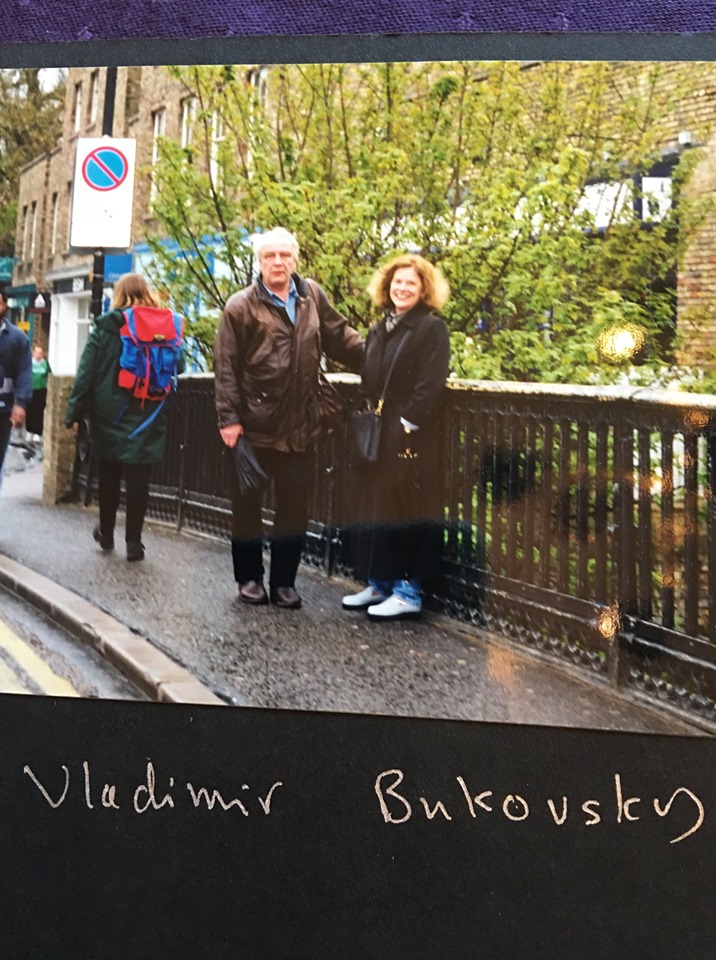
Ron and I had a memorable lunch with him in Cambridge in April 1998. More than memorable. On business for the Hoover Institution Archives at Stanford, I was on an archival collecting tour in Europe and visited various families of Russian dissidents in Paris, Fontenay-aux-Roses, London, Oxford, Cambridge. Keeping in touch with historically significant people was part of my job, a dream job: after establishing connections, their documents and papers would generally arrive at the Hoover Archives in due time. On this trip I met with members of the Pasternak family, the Siniavsky family, even a Romanov, Rostislav Romanoff (“you can call me Rosti”). My travel reports are full of all the practical details regarding scope of collection, contracts, shipping issues, etc., yet what comes through when I review my personal notes is the warm and generous reception I received from mostly strangers. It is still overwhelming to me. The Russian dissidents and emigres are a remarkable lot of human beings with amazing stories and a generosity of spirit totally at odds with their experiences. And even in this extraordinary group, Bukovsky stood out for both Ron and me.

With Bukovsky on the Bridge over the River Cam, April 1998

I had met him over a decade earlier when the was at Stanford to study psychology, and also to work with anti-Soviet activists. He had survived over a decade as a Soviet political prisoner in various jails and psychiatric treatment centers until he was sent into exile in a prisoner exchange program in 1976. The Hoover Institution published one of his books in 1987. My supervisor there asked me to drive Bukovsky to a human rights conference in Berkeley. As his chauffeur on this long drive, I remember vividly his wild and engaging conversation. It was clear that this man would challenge abuse of authority where ever he encountered it. It was built into his personality. This mindset enabled him to take on one of the most powerful and ruthless political structures in the world. “You have to do it,” he told me, “despite the fact we knew we would lose.”

A decade later, since I was going to be in London anyway, I wrote Bukovsky a formal letter in 1998 and asked to meet him in Cambridge. His response was coy. He said he’d be in Colorado the whole time of my trip – available on April 24 only. Closer to the time, I faxed back that I could take him to lunch on April 24, and decided to leave a voice mail to that effect on his answering machine, since he could access that while traveling. Bukovsky answered his Cambridge home phone immediately, he was most certainly not in Colorado.

Ron and I showed up exactly on time, noon on April 24, at 145 Gilbert Road in Cambridge. He lived alone in a charming classic English cottage with an entry path lined with lushly blooming tree roses … for all his disruptive behavior this was a man who loved roses. And a man who did not always answer the doorbell. It was the era before cellphones, so Ron and I left the house to walk to a public telephone down the street. Halfway down the block we hear someone yelling, “Hey, you!” We turned and saw a very rumpled Bukovsky leaning out his doorway and inviting us to come back. “I just woke up,” he said, smelling of alcohol. And he offered us each a lovely cup of smoky tea, the very best lapsong suchong. This was a man who would never drink Lipton’s tea.

On his table were heaps of photocopies of once top secret Soviet documents, archival heaven for me. And he knew it. Rumpled as he was, he had prepared assiduously for our meeting. He did his homework.
Ron and I offered to take him out to lunch. A congenial tour guide, he took us for a walk through Cambridge, showing us the sights along the way, smiling gargoyles on churches, Christopher Wren’s library, college courtyards. Then we came to the historic café/bar “The Eagle,” where he showed us the graffiti left by World War II pilots, some of whom never returned. As he ordered us a lunch of savory moules marinière accompanied by generous pourings of red wine, he began to reminisce about his life as a dissident: “We knew we were playing a game; we didn’t know the stakes were so high.” He had enormous respect for Reagan for paying attention to the human rights movement, which he felt many intellectuals tried to ignore.

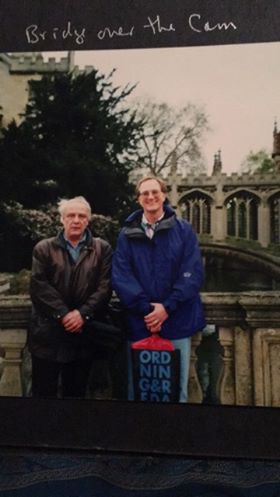
Bukovsky, Ron Danielson at Cambridge

Since the fall of Soviet communism in 1991, Bukovsky had advocated vigorously for a Nuremberg style trial of communist leaders to finally discredit the Soviet system. He did not see any point in putting old villains in jail, he said he wanted to use the documentary evidence to totally ruin their credibility and to prevent any return of the repressive system. Such an effort at a judicial process began in 1992 with Bukovsky serving as an expert, determined to open up the archives.

Bukovsky was himself a scientist who tried to approach the factual data in a systematic way. He used new technology including a hand held Logitech scanner, that was 4-5 inches wide, with which he would swipe the documents several times across each page and then use a computer program to join the pieces together. It was uncharted territory both in terms of legal access and in terms of technical access. He successfully captured an enormous amount of data including heavily guarded secrets from the Politburo and even copies of KGB documents held in Central Committee files. He said he worked with an official named Poltoranin to declassify the materials he wanted to read. Apparently, they worked and drank together simultaneously. Bukovsky would tell Poltoranin what he needed and Poltoranin would order his staff to bring materials out on that topic, which Bukovsky would then scan on the spot. The Russians were unfamiliar with scanning technology at the time and apparently unaware that the documents were being copied. “I paid for every document with my blood,” he explained in an almost matter-of-fact way. “I paid for every document with my liver.” Already in 1998 he had plans to put the scanned data set on the internet. He said it would be ready to go online by October 1998. Today the documentation he secured in 1992 can be found online here. Now it all looks so obvious, but at the time it was exceedingly experimental and daring.

But the process was not completed. He complained: “Reagan and Thatcher ruined the USSR, but they didn’t finish them off.” He covers all of this in his books, but hearing it from him in person, in the presence of his remarkable personality, made it clear how he managed to maintain the good fight against all odds.

The Hoover Institution has kept up its active archival acquisitions program under the direction of Eric T. Wakin. Eventually about 57 boxes of Vladimir Bukovsky’s papers were secured for the Hoover Archives by Lora Soroka under the guidance of the Russian and Eurasian curator Anatol Shmelev.