
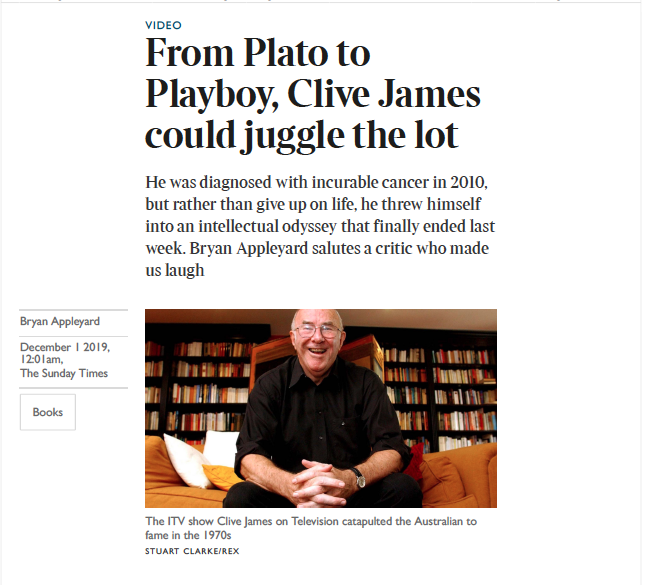
Bryan Appleyard has written a vibrant retrospective in The Times of London with the title (don’t blame him for it; he didn’t write it): “From Plato to Playboy, Clive James could juggle the lot.”
The article on the death of the celebrated literary critic and author, published today, begins:
In 2010, already knowing that he had emphysema, Clive James was admitted to hospital with kidney failure. There he was also diagnosed with terminal leukaemia. But somehow he just kept going. Until now. Since that day nine years ago, there have been four books of essays and, just published, a collection of his writing on Philip Larkin. There have also been several books of poems and a translation of Dante’s Divine Comedy.
“I feared the world of men.”
Approaching death, the nuisance of incapacity and constant medical care drove Clive to ever greater heights of creativity.
In fact, before 2010 he had been in decline. Dying turned out to be just what he needed.
“I was getting tired of life,” he told me in a 2012 interview. “I’ve lived long enough. I’ve done what I can. I had suicidal thoughts when I was young. I fancied myself as a melancholic; quite a lot of people do — it’s a fashionable thing. Anyway, all these ideas were coming to me when I was going to sleep, ideas of self-destruction. They all promptly vanished the moment I was under real threat. There was a sudden urge to live. I wanted to do more, to write more.”
What happened next? Lots. “He went on to do, well, everything: novels, satirical poetic epics, essays, anything that came his way or into his head. Whatever it was, it had to be out there, protecting him from the abyss. It would be wrong to think this was simply existential dread, the fear of personal extinction — we all have that, and Clive had more than most in his final nine years. His own analysis suggests the heart of the matter was the death of his father in 1945, when Clive was six.
“We are all lucky to have got here.”
“His father had survived a Japanese prisoner-of-war camp and was on his way home when his plane crashed, killing him. Clive was with his mother when she got the telegram. He wrote: ‘I understood what it did to her in one second. I understood everything. I knew she had spent all that time waiting and she could not bear it. When she collapsed I saw suffering she could not bear and it marked my life, no question. I had a feeling of helplessness. I was man of the house . . . I couldn’t help her, and I had been helpless ever since. I sometimes thought . . . that everything I had ever written, built or achieved had been in order to offset that corrosive guilt, and that I loved the world of women because I feared the world of men.'”
He concludes:
It is a sadness that I cannot claim Clive was a friend. We met, we talked, we said nice things about each other, but we were not friends. …
Friend or not, I owe him. He extended the playground in which I play. And what a death he died! He showed us all how to do that. He attained serenity amid the frenzy of his late work, and he lived and worked with that supreme insight of the poet Wallace Stevens: “Death is the mother of beauty.”
“By complaining at all,” he once told me, “I am complaining too much. We are all lucky to
have got here.” And in one of his final poems he wrote: “Life cries for joy though it must end in tears.”
Read the whole thing here. Online comment from around the net: “An intellect lightly worn. Rest in pages, Clive.”