Best American Poetry: the movie and a launch on Thursday, Sept. 20!

Share

We’re on the road (in New York City, in fact), but wanted to let you know about the “Best American Poetry Reading 2018” on Thursday, September 20, at 7 p.m.

The event will take place at the New School’s auditorium (Room A106), the Alvin Johnson/J.M. Kaplan Hall. Series editor David Lehman and Dana Gioia,  guest editor for the Best American Poetry 2018 volume, will headline an all-star cast of poets to launch the volume. I’m told this is an annual rite of fall in New York.

Dana is also former chairman of the National Endowment of the Arts and now California’s poet laureate (and always, always a cherished friend). In the video below, he calls his guest editorship  “a privilege and a challenge.”

The book includes poets we’ve written about before – A.E. Stallings, Kay Ryan, Dick Davis, David Mason, Tracy K. Smith, Robin Coste Lewis and more.

We’ve run an excerpt from his introduction, “A Poet Today is more Likely to be a Barista than a Professor,”  here.

Below a sampler of the Thursday event. It was filmed by Dana’s son, Michael Gioia.

David Foster Wallace’s worst friend

Share

He got what he didn’t want.

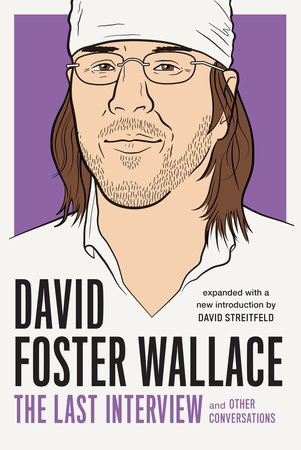
I wasn’t the only link with René Girard in the current Times Literary Supplement, which included a review of Evolution of Desire: A Life of René Girard  (read about it here). David Streitfeld‘s own book David Foster Wallace: The Last Interview Expanded with New Introduction was generously excerpted. Since the Pulitzer prizewinning New York Times journalist was one of the blurbers for Evolution of Desire, our co-appearance in the TLS was a pleasant coincidence.

The journalist admits that he was David Foster Wallace‘s worst friend – he says so in the first sentence, so my headline isn’t just clickbait. “He would send me letters and I wouldn’t answer them. He would send works in progress with forlorn notes.”

For the most part, he discusses a central paradox in Wallace’s life: “For twenty years, his entire career, Wallace wrestled with a question: How much of myself am I willing to give away to get what I want?”

It wasn’t a choice in the end. And David … Streitfeld, that is … describes what happened:

He got what he wanted and didn’t want. One way to measure his posthumous fame is to note an interview he did with Rolling Stone, which was never published in 1996 but became the basis for a story after his suicide that won a National Magazine Award in 2009. The interview transcript became a bestselling book in 2010 and then a very unlikely movie – who ever heard of a movie about an interview with a writer? – in 2015. The Wallace estate firmly distanced itself from The End of the Tour, noting quite accurately that it would have horrified Wallace as a trivialization of everything he believed, but Wallace was dead and what he would have thought didn’t matter anymore. The movie got excellent reviews.

I wrote about the movie here. David … Streitfeld again, that is … tells how twenty-one of Wallace’s letters were auctioned at Sotheby’s five years ago. “They were, as usual with Wallace, explicit and entertaining. … Sotheby’s estimated the package would fetch as much as $15,000. Instead, it made $125,000.”

Worst friend? Perhaps not.

He continues: “Wallace in 1996 had to reveal himself to interviewers to sell copies of Infinite Jest, and seventeen years later the auction house had to reveal Wallace to sell his letters, which in this case fetched $70,000. The guy who always cringed at publicly showing himself was having his deepest secrets divulged, not only to the winning bidder but to anyone with an internet connection. He wrote in Infinite Jest about a future in which everything was for sale – the years are rented out to corporations; part of the novel takes place in the Year of the Depend Adult Undergarment – and now, as that future was relentlessly transformed into mundane reality, he himself was for sale.”

“That, perhaps, is what happens if, instead of trusting no one, you trust everyone.”

Here’s the good news: David’s piece is fully online … unlike the review for Evolution of Desire (so far). The excerpt is here. Read it, and be glad you aren’t famous.

Is this man the “godfather of like”? The TLS thinks so. Praise for Evolution of Desire: A Life of René Girard

Share

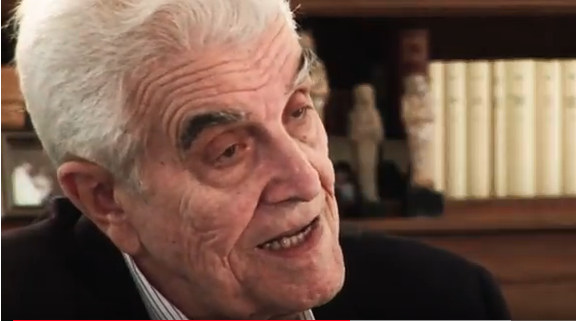
A screenshot from one of our conversations, now on Youtube.

Nothing like a mid-week surprise to add some luster to the daily routine, and we got one this week with a long, wise, and insightful essay on Evolution of Desire: A Life of René Girard in the brand-new issue of the Times Literary Supplement. 

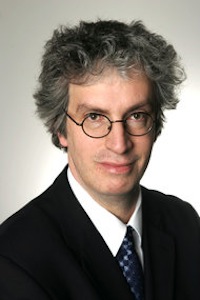
The reviewer, Jonathan Benthall, is a former director of the Royal Anthropological Institute (1974-2000) and founding editor of Anthropology Today. So, un très grand merci to the smart anthropologist and the TLS.

He begins:

No drama. (Photo: L.A. Cicero)

There were dramatic contexts to the development of René Girard’s ambitious thinking about violence and conflict. Some bleak years as a student in Paris, where he had moved from Avignon, his birthplace, near the end of the German occupation, followed by liberation and the épuration, in the course of which some 20,000 women suspected of collaboration had their heads publicly shaved. A year (1952–3) spent teaching French literature at Duke University, North Carolina, just before the United States Supreme Court ruling that segregated education was unconstitutional. A professorship (1968–76) at the State University of New York, Buffalo, which was a focus of campus  protest against the Vietnam war. But his biographer Cynthia L. Haven notes Girard’s “affectless reaction” to such experiences. He never intervened in politics. He and his wife Martha, an American from the Midwest, were a devoted “no-drama couple” until his death at the age of ninety-four in 2015 in Stanford, California, where they had made their home since 1981. [Actually, he died at 91 – ED.]

Given the apparent serenity of Girard’s personal life, Haven, a colleague at Stanford University and a close family friend, might have confined herself to hagiography. Readership would have been guaranteed among the six or more associations and foundations set up to promote and develop Girard’s work internationally, producing an extensive secondary literature across many academic disciplines: not merely history and literary criticism, his starting points, but also religious studies and all the human sciences. Fortunately Haven’s Evolution of Desire: A Life of René Girard is exemplary in its sensitivity.

She expresses openly her affection and admiration for her friend, who comes across as more of a teasing humorist than his public persona might suggest. Yet she recognizes the various intellectual arguments against Girard and the girardiens. Her readers are challenged but left free to make up their own minds.

Well, you can read the rest here, but it’s behind a paywall.
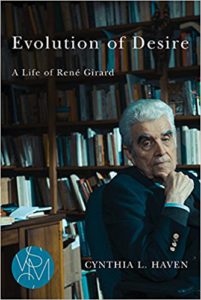
You may wonder on the title: “Godfather of Like.” Benthall explains: “One of Girard’s students at Stanford was Peter Thiel, now a billionaire philanthropist, who credits Girard with his decision to make a key initial investment in Facebook: Girard has been called ‘the godfather of the Like button’.” Well then, he has a lot to answer for.

Benthall makes a couple missteps on details. For example, René’s writings didn’t take hold in the Solidarity days and Velvet Revolution of Eastern Europe because “Christianity was under attack,” or at least not only, but primarily because the mechanisms of conflict, violence, and scapegoating were everywhere apparent to the Poles, the Czechs, the Lithuanians, Latvians, and Estonians as communism rule was overthrown.

He concludes:

In the years since his death, political developments in many countries have resonated increasingly with his scapegoating model. Girard’s seriousness and range assure him of a posthumous following, not necessarily limited to fellow Christians. One admirer, interviewed by Haven, spoke of his work as “like a rock: it will be there and it will last”. But there will be dissenters. In old age, he confessed to “academic narcissism”, a self-diagnosis that hits his own fingernail on the head. Moreover, though in some ways a most perceptive reader (having been trained in historical sciences at the École Nationale des chartes), he treated language as a vehicle for ideas and showed no interest in the craftsmanship of words – as noted by Haven, who herself writes with acuity and wit. Reading Girard’s publications is indeed like climbing a rocky promontory, but only to find at the summit a road and a coach park. Those not yet ready for the climb on foot may take advantage of a stimulating drive to the top in Cynthia Haven’s air-conditioned Californian limousine.

I’d settle for this.

I’d quibble a bit at that, too: René’s writings are enormously polished and droll – but I’d never heard him admire a passage of Proust for the loveliness of his prose, or Hölderlin’s poem for a masterful image, rather than the concepts behind them.  But it’s the closing image tickles me.

Moi. An air-conditioned limousine? I would have settled for a nice little silver Citroën, skirting the circular highway around Avignon’s ramparts.


Was Hölderlin nuts? The jury is out. Maybe.

Share

He preoccupied interesting men.

One statement had been repeatedly spray-painted onto a turret in Tübingen, beginning way back in 1981, as an unusually bitter winter warmed into spring. Over the years, the words, in Swabian dialect and usually written in the old Sütterlin script, became a part of the tourist attraction, so no one scrubs off the paint anymore. “Der Hölderlin isch et verrückt gwae” translates roughly into “Hölderlin wasn’t nuts.”

The insanity of Friedrich Hölderlin (1770–1843), who died in obscurity but who has since become a towering presence in German poetry, had long been accepted—so the idea that he was in his right mind was still a minority opinion. But the cause found an unlikely champion in René Girard. He had never taken much of an interest in poetry, except for a short-lived interest in Saint-John Perse at the beginning of his career. He would finish his life with Hölderlin.

So begins the fourteenth chapter of Evolution of Desire: A Life of René GirardAnd my point was, well, René Girard really thought Hölderlin wasn’t nuts. But he wasn’t the only man to round out his life with the German poet. A fellow poet, Wilhelm Waiblinger, was another.

Waiblinger visited the older poet and wrote a record of his visits. Friedrich Hölderlin’s Life, Poetry and Madness has just been republished by Hesperus Press (translated by Will Stone) – the the third time the Waiblinger biography has been translated in recent years.

Elizabeth Powers writes about him in “When Winter Comes: A Poet’s Descent into a ‘Twilight Existence,'” in the August 21 Time Literary Supplement, where it shares a smashing double-page spread with Hans Christian Andersen and Sigrid Unset.

René Girard’s life story was long and unusually serene. The Waiblinger story, however, didn’t have a happy ending. Waiblinger’s misfortune and mishaps ended the life of “a man of considerable native refinement, unworldly sensibility, and an absolute lack of self-parody,” according to Powers.

She writes:

Like many German writers, Waiblinger was the son of a parson. By 1822, when he was eighteen, he too displayed considerable gifts in the Greek and Latin classics and began to study philosophy and theology at the same Tübingen seminary where Hölderlin had studied alongside Hegel and Schelling. Waiblinger was ambitious and not lacking in self-belief, but it was the age of Metternich, a quiet time for geniuses. He began to visit Hölderlin regularly, perhaps drawn by a perceived relationship between the genius and madness. (Hesse’s “In Pressel’s Garden House” of 1914 charmingly recreates one of their outings.) The visits ceased when Waiblinger was expelled from the seminary in 1826 for apparently reprehensible conduct. He departed for Rome where he wrote accounts of Italian sites and a novella called “The British in Rome”, as well as transcribing the notes he had made of his visits to Hölderlin. Having climbed Etna and contracted malaria in the Pontine marshes, he suffered a lung infection. Eight haemorrhages and fourteen bloodlettings later, Waiblinger died in Rome in 1830 at the age of twenty-six and was buried near Keats and Shelley in the Protestant Cemetery. Friedrich Hölderlins Leben, Dichtung und Wahnsinn was published a year later.

The link is here, but it’s behind a paywall. Enjoy the first one-and-a-half paragraphs, then look for the August 21 Times Literary Supplement, with Andersen and Unset thrown in for good measure.

The spat over the Nation poem: if these are snowflakes, why aren’t they melting?

Share

Lionel Shriver calls fraud. (Photo: Tony Sarowitz)

Last month, The Nation published a poem that upset a few people. Well, more than a few. The poet adopted an African-American dialect, and he used the word “cripple,” too.

The Nation backed down, and the editors said they were sorry. Even the poet apologized for his poem. Katha Pollitt, a columnist for magazine, called the apology “craven,” “a letter from re-education camp.”

Grace Shulman, a poetry editor at the magazine from 1971 to 2006, wrote in The New York Times: “I was deeply disturbed by this episode, which touches on a value that is precious to me and to a free society: the freedom to write and to publish views that may be offensive to some readers.”

But now the U.K.-based American author Lionel Shriver has taken off the gloves. In The Spectator, she has called the protest a “screaming emotional fraudulence in the public sphere.”

A few excerpts:

“Employing today’s prescribed lexicon, those apologies regretted the ‘pain’, ‘harm’, and ‘offence’ this sad-ass little poem had caused to stricken communities. But let’s get real. None of those poetry readers felt any pain. (Remember pain, actual pain? Drop a brick on your foot in sandals. Yeah. That’s ‘pain’.) No one suffered any harm — either tangible or psychic. Why, I wager that those irate chiders in the peanut gallery were no more genuinely offended than the magazine editors doing damage control were genuinely sorry.”

***

“I don’t buy into the notion that the ‘snowflake’ generation is all that sensitive, either. Antifa protestors in balaclavas can be quite violent for little specks that melt. ‘Snowflakes’ may have induced institutions to employ the language of fragility, but I think a lot of these kids are tough as old boots.”

***

“When during that Evergreen foofaraw a rabid convocation of students cowed the college president into lowering his arms at the podium because they found his hand gestures ‘threatening’, those students didn’t feel jeopardised; they were dominating and emasculating a man supposedly in authority. The students cowering in ‘safe spaces’ don’t feel endangered; they’re claiming territory. In protecting the faux-helpless from noxious opinions via no-platforming, they’re exercising power. The experience of exercising power isn’t scary, except on the receiving end; it’s supremely gratifying. These people aren’t frightened. They want you to be frightened of them. And we’re not talking ‘microaggression’. PC police often prefer macroaggression, the kind that can get people sacked.”

***

“Reliably entwined with self-deceit, the problem isn’t solely among the young. When American liberals my age claim to suffer from white guilt over slavery and the slaughter of Indians, I question whether they really feel guilty. They weren’t personal agents of these crimes, and they know it. Nothing wrong with being historically aware. But white guilt is often a blind for moral vanity.

“We keep hearing about the terrible ‘distress’ caused by, say, a Canadian production that uses whites to sing slave songs, or a straight actor playing a trans role. But bullies on the left ply weakness to conceal aggression, and today’s torrent of touchiness is bogus. No one’s truly in distress. No one’s feelings are hurt really. This stuff is all about pushing other people around.”

You can read the whole thing here. It’s worth it for the use of the word “foofaraw” alone. However, I don’t think Millennials should take the rap. I sense a lot of aging Boomers on a tear. Thoughts?