“He never returned”: on the centenary of the end of World War I

Share

Today marks the hundredth anniversary of the armistice that ended World War I. Out of all the rivers of words I’ve read and pictures I’ve seen, I found this image especially poignant today, from Catherine Lambert on Facebook:

“I lived in a tiny village called Essendon in England for a few years. We had a neighbor who had a tree in the front garden with a big knot – as you can see below. The story she told was that her grandfather tied the knot in the tree when he left to fight in World War I, telling his young bride that he would untie it on his return from the war. He never returned.”

“The tree died while we lived in Essendon and our neighbor actually gave us this knot – which I’ve had ever since as it makes me remember the forgotten lives of that painful war.”

L’art pour l’art in Paradise Lost

Share

He’s got his priorities straight. (Screenshot from news footage)

Paradise has been destroyed – the city leveled to smoke and ashes, with 25 killed so far. We’ve been breathing the smoke in Palo Alto all weekend. “Three fires began Thursday — the largest in Northern California, where a Sierra Nevada town of 27,000 was destroyed by a fast moving-fire that quickly grew into the state’s most destructive on record. In Southern California, two fires were burning in the drought-stricken canyons and hills north and west of downtown Los Angeles,” according to the Associated Press today.

During my decade living in the Sierra foothills, I fled three wildfires before walls of flame. The first, which came within blocks of my home, was the year’s most destructive wildfire. I remember returning, several days later, not knowing if I’d have a home or merely cinders. The third and smallest started on my front lawn, when an old car backfired sparks onto the dry grass as it passed. Within a few hours, scores of helicopters were circling overhead, dropping chemical retardants and water.  (I made a post about those wildfire years here.)

I recall the process of sorting through what to take with our family (which then included two or three cats and a dog). My laptop first, of course. But after that … a Dali, a Chagall, and a few other original works of art. Family heirlooms. Clothes, of course, clothes. But I was living to live in my skivvies to save the my art and my labor and my history.

So I fully understand John Mescall, a cellist for the Paradise Symphony Orchestra. As the town was burning, he tried to flee by car. But his car wouldn’t start. So he grabbed his bike and pedaled to safety with his cello on his back. He’s headed for Chico.

He tells the story on Chico’s KCRA in the clip below. (You can read his story here.)

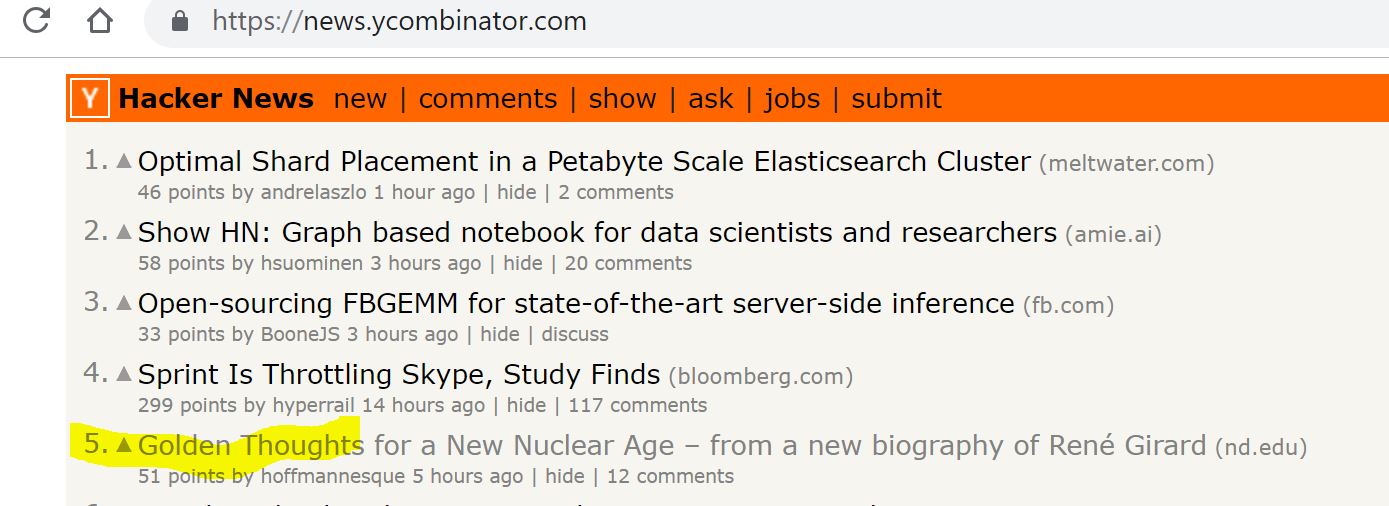
René Girard, meet the techies: Evolution of Desire climbs the charts at Hacker News.

Share

Even though the Book Haven lives in the heart of Silicon Valley, I generally avoid the sphere of computer nerds and techies, except when I need my Macbook Pro repaired or I’m battling a spam attack. But every so often, I get something that sends me into this brave new world.  So it was with yesterday’s news on Evolution of Desire: A Life of René Girard.

Artur gave me the heads-up.

It began when I received a Facebook message from Artur Rosman at 6 a.m.: “Happy news, a techie link picked up your book excerpt that we ran earlier this year. It has 1,700 hits today so far. You’re going to crash our site!”

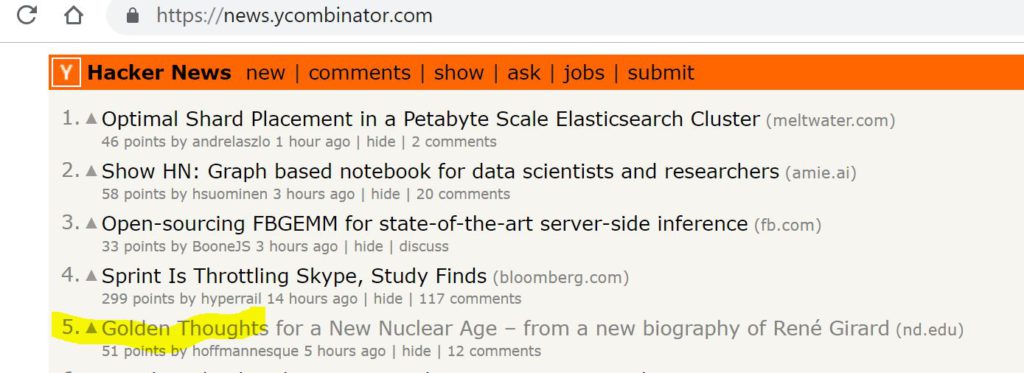
He was referring to the introduction to Evolution of Desire, which was excerpted on a Notre Dame University journal as “Golden Thoughts from a Nuclear Age” here. The techie link was an unknown website to both of us, but that’s what Wikipedia is for. I looked up Hacker News there:

Hacker News is a social news website focusing on computer science and entrepreneurship. It is run by Paul Graham‘s investment fund and startup incubator, Y Combinator. In general, content that can be submitted is defined as “anything that gratifies one’s intellectual curiosity”.

The site was created by Paul Graham in February 2007. Initially it was called Startup News or occasionally News.YC. On August 14, 2007, it became known by its current name. It developed as a project of his company Y Combinator, functioning as a real-world application of the Arc programming language which Graham co-developed.

Paul Graham turns out to be kind of a big deal. Computer scientist, entrepreneur, venture capitalist, author and essayist.

But meanwhile, back in Indiana, Artur was beginning to panic. The numbers kept climbing minute by minute. He was pondering whether he should take the page down quickly so the server wouldn’t go boom. It didn’t, but meanwhile it quickly racked up 2,700 visits in a few short hours.
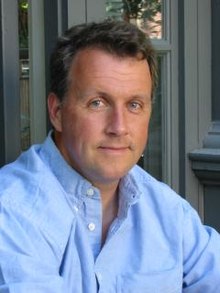
Paul gave us the lift-off.

Faithful Book Haven reader George Jansen, who runs a terrific blog 20011 (we’ve added it to our blogroll), also saw us on Hacker News. “I was going to post about this on my own blog, but then figured that you should get first dibs.” We let him go first.

From his blogpost: “I often check the Hacker News to see what topics interest the tech world. Perhaps 60% of the linked items have to do with computing, science, or mathematics, another 20% to do with politics or economics, and the remainder can be curiously assorted. Over the last couple of days a link to an article about whether Nero killed Agrippina has been in the first few pages.

“Though I do now and then see them, I don’t go to Hacker News looking for links to pieces about the humanities. I was surprised, then, today to see what was evidently an item by Cynthia Haven about René Girard on the first page… A sometime co-worker has made it to the first page of Hacker News a few times. However, his blog mostly has to do with old computer hardware, which suits what I take to be the interests of most of the Hacker News readership. I am interested to see that the techies find mimetic desire so well worth reading and arguing about.”

In the Hacker News comment section, Oliver Jones urged people to read the article over at Notre Dame: “Our trade is strongly influenced by René Girard’s understanding of competitive mimetic desire and its violence. Why? The people who organize the ad-driven internet know all about Girard. Peter Thiel invested in Facebook because he saw its potential for harnessing mimetic desire to drive engagement. (reference: https://www.lrb.co.uk/v39/n16/john-lanchester/you-are-the-pr…)
“Facebook-style social media is addictive precisely because of the fear of not being as good as ‘friends.’ Mimetic desire is the the human yearning behind the Fear of Missing Out. Driving engagement is most effective when it exploits that fear. It works very well indeed. Other attempts at building social media networks (Stack Overflow, Linked In, Slack, for example) try to avoid that exploitation. They try to use other motivators than FOMO [“Fear of Missing Out” to the rest of us. – CH] to drive engagement. Can they be successful without overusing mimetic desire? It’s the key question they must answer to be successful. The obligatory panel of customer logos just below the fold on SaaS landing pages engages mimetic desire in IT buyers. ‘Wow! Schwab uses this! I want to be like Schwab!’ It’s benign in these cases.

“Girard offers a good unifying framework for understanding the human nature behind all sorts of marketing work. Convincing people their hair is ablaze and offering them ways to put it out is the heart of building new businesses. Getting people to set each others’ hair on fire, then putting it out, is the holy grail of new businesses.

“It’s no accident that Silicon Valley employs that framework in lots of ways: he was a scholar at Stanford’s Hoover Institution. [He wasn’t – CH.] It can be a hard slog to learn about him. But it’s worth your trouble.”

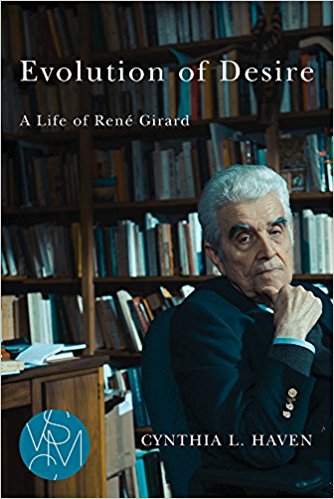
I hope I’ve made the job a little easier for Oliver and the others with Evolution of Desire: A Life of René Girard. Meanwhile, read the whole discussion here. It includes the best quote ever from Peter Thiel, who studied with René at Stanford: “To believe yourself invested with divine self-sufficiency is not the mark of a strong individual, but of a person who has mistaken the crowd’s worship – or jeering – for the truth. The single greatest danger for a founder is to become so certain of his own myth that he loses his mind. But an equally insidious danger for every business is to lose all sense of myth and mistake disenchantment for wisdom.”

The excerpted introduction to Evolution of Desire, “Golden Thoughts for a Nuclear Age” is here.

Postscript: Speaking of signal honors, I received this Facebook comment, from another gentle reader, Marianne Bacon: “Cynthia, we are re-reading your book. Aloud. I am absorbing much more deeply and we are both loving it!”

Pushkin shows us how to write a government report in a single quatrain.

Share

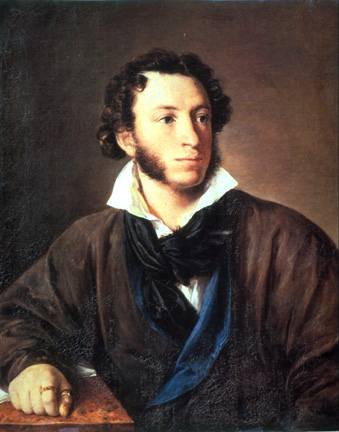
Russia’s ur-poet Alexander Pushkin was among the literary radicals of the czarist regime, but politics and poetry don’t often mesh. The government was anxious to sideline him. In 1820, he was exiled to the imperial backwaters to cool his heels.

And that’s where I found his lovely little abode in Kishinev (see above). My post a few days ago about homes of famous writers returned my thoughts to Moldova, among his many other homes as he traipsed the empire. But the Kishinev hideaway was particularly cozy and I have fond memories of it. He stayed there till 1823 – a rather long sojourn, given his peripatetic life.

Pushkin was then sent to Odessa, where he became entangled with Eliza Vorontsova. Bad move: she was the wife of the city’s governor. The cuckolded Vorontsov decided that Pushkin should be given an official project far away from Odessa. He was sent eastward to the Dnieper area to study the habits of locusts, so that the government might develop a plan for their eradication.

Pushkin’s response was in immortal verse, and perhaps should be a model for all government reports:

The locusts flew and flew over the plain.
They landed on the ground.
Ate everything they found.
And then the locusts flew and flew away again.

A wise and timely note from Gandhi on election day…

Share

A note from my friend George Dunn, via Facebook, writing all the way from Ningbo, China:

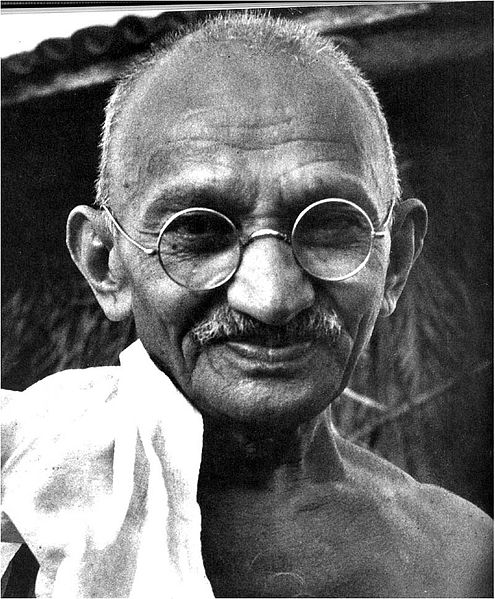
Here’s a new New Yorker essay from Age of Anger author Pankaj Mishra, in which he argues for the contemporary relevance of Mahatma Gandhi. His importance, according to Mishra, lies not just in his elevation of non-violence as political tactic, but also in his critique of modern liberalism. He saw self-restraint and the imposition of ethical limits, rather than the celebration of individual liberty and the emancipation of human desire, as the foundations of a healthy political community. He clearly saw that a society predicated on self-exaltation and the perpetual manufacturing of new desires was courting disaster.

“At every point,” writes Mishra, “Gandhi still upends modern assumptions, insisting on the primacy of self-sacrifice over self-interest, individual obligations over individual rights, renunciation over consumption, and dying over killing.”

Like René Girard, he believed that the alternative to self-sacrifice was sacrificing others. And, like Girard, his principle teachers were the Western religious tradition and contemporary thinkers who had been deeply shaped by it.

But what makes Gandhi’s thought especially timely is the understanding of truth and dialogue contained in his doctrine of Satyagraha. In addition to encouraging humility and obliging us always to remain open to the possibility that we may be wrong and our adversaries right, it entails the recognition that “we shall always see truth in fragments and from different angles of vision.” Understood in this way, Satyagraha leaves no room whatsoever for moral or political dogmatism. Can we imagine a world where our progressive activists and devoted conservatives take that lesson to heart?

Read the article here.

Philip Larkin declared, “He is a genius”: the unpublished poems of Robert Conquest

Share

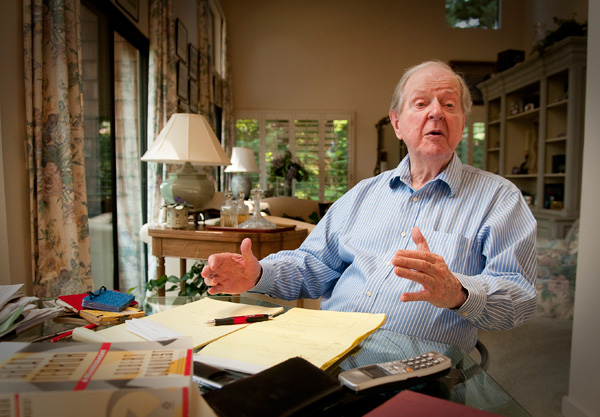
Conquest at work at his Stanford home (Photo: L.A. Cicero)

To say someone is “irreplaceable” is clichéd and self-evident. But there’s really no one quite like the late Robert Conquest – famous as the courageous and groundbreaking historian who exposed the horrors of Stalinism, and also as the poet who launched the influential “Movement” poets in England during the 1950s (a circle that included Philip Larkin, Thom Gunn, Kingsley Amis, Donald Davie, Elizabeth Jennings, and others). He ran  a powerful sideline in light verse and limericks that tended to eclipse his elegant, serious lyrics.

Liddie Conquest extends the legacy.

The current issue of Britain’s Standpoint features some of his unpublished poems, with an excellent article by Elizabeth Conquest, his widow and executor – and a scholar in her own right. Thanks to her labors, The Collected Poems of Robert Conquest will be published by Waywiser Press on October 15, 2019. The 50th-anniversary edition of The Great Terror has just been published by Bodley Head. (Book Haven readers will remember that Standpoint also published his last great poem, “Getting On.”)

“Liddie” Conquest reflects on her husband’s long, productive life until his death in 2015, at age 98:

“Why do some creative people continue to write, while others retire from the field? Part of the reason is simply that people age at different rates. Kingsley Amis, complaining to Philip Larkin that he was getting ugly, old, and fat, wrote: ‘What was that quote about free from care? Certainly applies to ole Bob. He just goes on and on, as if nothing has happened.’ And so he did, possessing characteristics of successful people noted by Diane Coutu in her Harvard Business Review article ‘How Resilience Works’: a staunch acceptance of reality; a deep belief, often buttressed by strongly-held values, that life is meaningful; and an uncanny ability to improvise.” …

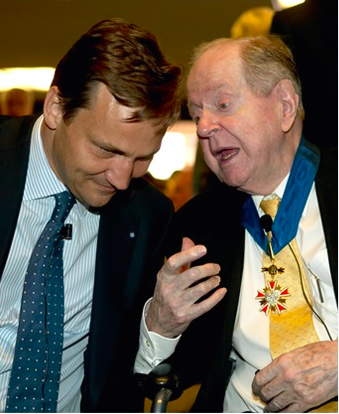
Receiving Poland’s Order of Merit in 2009 (with Radosław Sikorski)

“Seven years later, the week before he died Bob was hard at work editing final chapters of Two Muses — his memoirs — and also writing a poem. At the same time, with the aim of publishing a final collection of his verse, he’d been going through his earlier collections correcting misprints, and in some cases making minor alterations. After his death, as his literary executor I was tasked with sorting through his papers (a vast undertaking with an inventory running more than 120 pages); editing a comprehensive volume of Bob’s poetry; pulling together the last chapters of his memoirs from the bits he’d written (but not put in final order); and editing a selection of his letters. ”

Bob took his light verse seriously, though some lament that his reputation for light verse tended to push aside his “serious” work:

“[Critic Clive James] himself has often expressed regret that there were not more of the ‘fastidiously chiselled poems which proved his point that cool reason was not necessarily lyricism’s enemy’. I share that view, but remember the opening remarks of Bob’s 1997 address to the American Academy of Arts and Letters, when he said that of all the various awards for histories and serious verse he’d received over the years, he was ‘particularly touched and delighted to receive the Michael Braude Award for Light Verse — which honours those who are often thought of as skirmishers and sharpshooters rather than solid citizens of the world of arts and letters’.”

Read the whole article here.