A book is born! A celebratory lunch for “‘The Spirit of the Place’: Czesław Miłosz in California” with publisher, friend Steve Wasserman

Share

The Bandol Rosé was excellent.

A toast, a book, and bon appétit with Steve Wasserman at Chez Panisse. He promised me a celebratory repast for my National Endowment of the Humanities Public Scholar grant, and he delivered. The book that I will undertake during 2018-19 will be “The Spirit of the Place”: Czesław Miłosz in California.

What did it mean for one of the greatest Polish poets of the 20th century for to spend most of his career in California? In a 1975 poem “Magic Mountain” the lonely exile expressed his isolation and alienation this way:

So I won’t have power, won’t save the world?
Fame will pass me by, no tiara, no crown?
Did I then train myself, myself the Unique,
To compose stanzas for gulls and sea haze,
To listen to the foghorns blaring down below?

Until it passed. What passed? Life.
Now I am not ashamed of my defeat.
One murky island with its barking seals
Or a parched desert is enough
To make us say: yes, oui, si.
“Even asleep we partake in the becoming of the world.”
.
But he also grew to love it, even as he criticized it – and he had a career here that would have been impossible in Communist Poland.

At Chez Panisse, we demonstrated some contrary California spirit with a French wine – a 2015 Bandol Rosé, Domaine Tempier. Steve told me it is one of the favorites of Chez Panisse founder and chef, the legendary Alice Waters, an old friend.

He worked quickly.

He recalled stories about his good friends Susan Sontag, Christopher Hitchens, and the experience of coming back to California after decades away, his most recent port-of-call at Yale University Press, where he was editor at large. I also recalled the Polish poet’s own adventures at Chez Panisse, as related by Ecco publisher Daniel Halpern in An Invisible Rope: Portraits of Czesław Miłosz. 

And I retold something that poet Robert Hass, a California native, once said after I mentioned I had grown up in Michigan. He paused a moment, and said, “Then your eye must be always searching for a shade of green it never finds here.” And so it does.

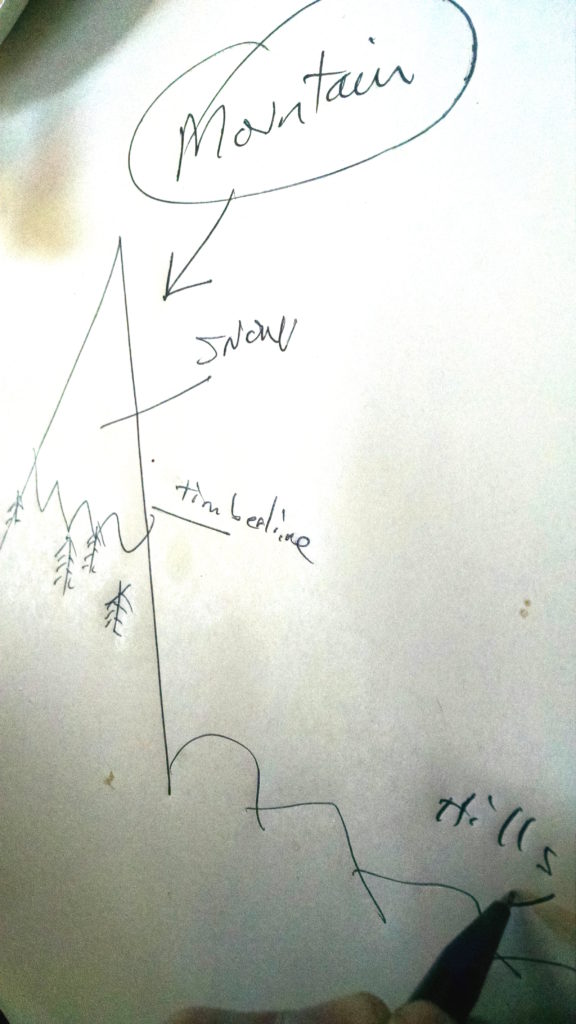
We talked about California – land of endless invention, miraculous weather, and addictive sunshine. Everywhere else is something of a disappointment. He recalled traveling through the Catskills as a child, and the adults pointing out the “mountains.” “Where?” he asked eagerly. “There!” they said. “I don’t see them!” “Over there.” Those were hills, he told me scornfully, “eroded stubs!” He pulled out a pen and swiftly drew a picture on the paper tablecloth. This, this is a mountain: snow at the top, timberline, hills at the bottom. The Sierras.

What did we eat? Normally I don’t say, but … Chez Panisse. I ordered the fettuccine with chanterelles, gremolata, and Parmesan; Steve had the summer vegetable tagine with shell beans, couscous, yogurt, and chermoula. I started with the baked andante dairy goat cheese with garden lettuces, he had the fennel and rocket salad with crème fraîche, mint, figs, and toasted almonds. We shared a bittersweet chocolate pavé with caramel ice cream and candied hazelnuts. No, we didn’t take any photos of our food. And yes, we had to ask the waiter what some of these words meant.

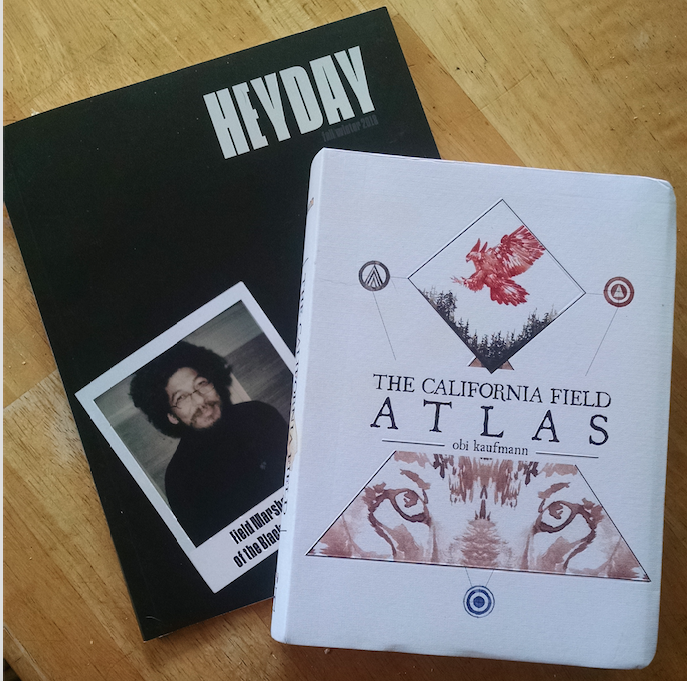
And I left with a celebratory gift from Steve: Heyday’s best-selling The California Field Atlas by Obi Kauffman, and a catalog of books-to-come. Spirit of the Place won’t be in it for a while yet.

René Girard and the Three Stooges

Share

It’s an honor when a highly esteemed writer takes on your book. I’ve had several to date, and yesterday brought another: Patrick Kurp of the matchless Anecdotal Evidence blog reviews Evolution of Desire: A Life of René Girard. It’s the lead story over at the University Bookman here.

He begins with the Three Stooges:

Merci, Monsieur Kurp.

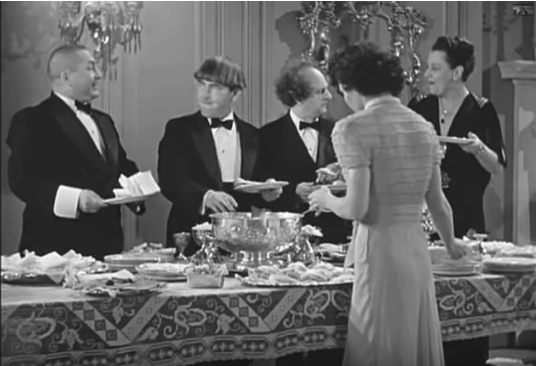
In their 1941 short feature In the Sweet Pie and Pie, Larry, Curly, and Moe are ex-cons hoping to marry three wealthy debutantes. The girls have other ideas. They throw a high-society party and bribe the butler to dump a cake on Moe’s head, expecting the Stooges to disgrace themselves. Moe responds with a cream pie to the butler’s face. A matron, recipient of collateral damage, prepares to retaliate when the butler points at Moe and says: “He did it.” The matron replies, “Thank you, but you started it,” and beans him with a pie. Soon the Stooges and guests in gowns and tuxedoes are enthusiastically heaving pies, and René Girard would have laughed and understood the scene perfectly. Once encountered, Girard’s theory of mimetic desire, his essential contribution to making sense of human nature, is irresistible, and helps to explain everything from slapstick, to social media, to the threat of thermonuclear cataclysm. …

He continues with some kind words for the reviewer and her subject:

Haven is a seasoned literary journalist who has devoted books to Czesław Miłosz and Joseph Brodsky. She is attracted to the theme of civilization embattled, the persistence of culture, and its defenders in the face of barbarism and indifference. Her study of Girard is neither clinical nor drily academic. It welcomes readers previously unfamiliar with Girard and his work, as well as specialists. It also serves as an hommage. Haven befriended Girard and his family in his later years at Stanford University, an intimacy that provides glimpses of the husband, father, colleague, and friend not immediately available to readers familiar with his thought strictly through his books. Haven draws an attractive portrait of a thoughtful man who, until his death in 2015, was never too self-important to treat others with dignity and respect.

He concludes:

Summarizing Girard’s insights, Haven writes: “We live derivative lives. We envy and imitate others obsessively, unendingly, often ridiculously.… We find it easy to critique the mimetic desires of others, but our own snobbishness and sensitivity to public opinion usually escape our notice. We wish to conceal our metaphysical emptiness from others, in any case, and from ourselves most of all.” As the pies are flying in the Sweet Pie and Pie, Moe pauses and sententiously declaims, “Stop, stop. This has gone far enough. Love thy neighbor.” On cue, five guests, including a pompous U.S. Senator, push cream pies into his face.  

Read the whole thing here. And just for you, Gentle Reader, we include the film clip below:

The Orwell Watch #28: Taking on “who I really am” and “evolve”

Share

We owe you a great debt, sir.

The Orwell Watch is not dead, though it hath slept… and here’s what woke it up again: Regularly on the social media and on the internet more generally, I see people advertising some particular activity or predilection because “that is who I really am.”

What? Are they facing death or exile for holding to a long-cherished principle or loyalty? Or, more in the spirit of vanitas, they are bragging about a virtue (“I gave $5 to a down-and-outer, because that’s who I really am“)? Not generally. More often they are talking about selecting a outfit for a party or justifying some aggressive behavior on Twitter. From what I can tell, it takes them years to discover “who I really am.” It involves naval-gazing, apparently, distancing ourselves from the others who challenge our notion of self. Often it’s an attempt to sway how others see us. (Maybe it would help if we simply think about ourselves less.)

“Who I really am” is neither that trivial nor that hard to discern. Here’s how you go about it.

Keep doing what you regularly do. Look at the history of your choices – because our “values” aren’t something we decide in our heads. They are formed by the choices that we make over time. We are what we do. Think about your decisions and actions over the last year, especially the important forks in the road. Which way did you veer?

Bingo! That’s who you really are. See? There’s no big reveal. It’s not something you need an extensive course in therapy or a Facebook group to figure out. It’s more fundamental than the sum of the items we pick on a restaurant menu or whether we wear Jimmy Choo shoes. (Are they still in fashion?)

If you are anxious to tell people what you prefer do in bed because that’s who you “really are,” please reconsider. We really don’t want to know that you are into leather or flesh-colored underwear. If such a thing were of interest to us, we would go to bed with you. (To borrow a thought from the inimitable Fran Lebowitz,“If your sexual fantasies were truly of interest to others, they would no longer be fantasies.” Or this one, on clock/radios: “If I wished to be awakened by Stevie Wonder, I would sleep with Stevie Wonder.”)

If you want to come to my dinner party dressed in your sweats or beach shorts, because that’s who you “really are,” please think again. Take a shower, comb your hair, and put on a pair of long pants. I am no more who I “really am” when I tumble out of bed than I am when I’m in dressed to the nines. In fact, I like to imagine that a little discipline and grooming is who I am really am – but hey, I could be kidding myself.

Fran is right. (Photo: Christopher Macsurak)

I know, I know… you’ll “evolve” your thinking on this. That’s another one.

People who claim to believe in “science” (don’t get us going) seem not to know what “evolve” means. It does not mean “getting better and better.” This is wrong in two ways: From a UC-Berkeley science website:

MISCONCEPTION: Evolution results in progress; organisms are always getting better through evolution.

CORRECTION: One important mechanism of evolution, natural selection, does result in the evolution of improved abilities to survive and reproduce; however, this does not mean that evolution is progressive — for several reasons. First, as described in a misconception below (link to “Natural selection produces organisms perfectly suited to their environments”), natural selection does not produce organisms perfectly suited to their environments. It often allows the survival of individuals with a range of traits — individuals that are “good enough” to survive. Hence, evolutionary change is not always necessary for species to persist. Many taxa (like some mosses, fungi, sharks, opossums, and crayfish) have changed little physically over great expanses of time. Second, there are other mechanisms of evolution that don’t cause adaptive change. Mutation, migration, and genetic drift may cause populations to evolve in ways that are actually harmful overall or make them less suitable for their environments. For example, the Afrikaner population of South Africa has an unusually high frequency of the gene responsible for Huntington’s disease because the gene version drifted to high frequency as the population grew from a small starting population. Finally, the whole idea of “progress” doesn’t make sense when it comes to evolution. Climates change, rivers shift course, new competitors invade — and an organism with traits that are beneficial in one situation may be poorly equipped for survival when the environment changes. And even if we focus on a single environment and habitat, the idea of how to measure “progress” is skewed by the perspective of the observer. From a plant’s perspective, the best measure of progress might be photosynthetic ability; from a spider’s it might be the efficiency of a venom delivery system; from a human’s, cognitive ability. It is tempting to see evolution as a grand progressive ladder with Homo sapiens emerging at the top. But evolution produces a tree, not a ladder — and we are just one of many twigs on the tree.

MISCONCEPTION: Individual organisms can evolve during a single lifespan.

CORRECTION: Evolutionary change is based on changes in the genetic makeup of populations over time. Populations, not individual organisms, evolve. Changes in an individual over the course of its lifetime may be developmental (e.g., a male bird growing more colorful plumage as it reaches sexual maturity) or may be caused by how the environment affects an organism (e.g., a bird losing feathers because it is infected with many parasites); however, these shifts are not caused by changes in its genes. While it would be handy if there were a way for environmental changes to cause adaptive changes in our genes — who wouldn’t want a gene for malaria resistance to come along with a vacation to Mozambique? — evolution just doesn’t work that way. New gene variants (i.e., alleles) are produced by random mutation, and over the course of many generations, natural selection may favor advantageous variants, causing them to become more common in the population.

What we mean when we say a politician has “evolved” on an point of view is closer to “conform to the herd,” usually to attract votes.  A better synonym would be “saving myself” or “looking out for Number One.” They had an opinion that was problematic or controversial, but nevertheless their own, and now they see there will be a price tag if they continue to hold it, so they “evolve” towards their own safety and reelection. It’s sort of an adaption to local coloration…

On the other hand, maybe that is a kind of evolution…

What happens when Joshua Cohen meets Harold Bloom? “The function of criticism now is to abandon politics.”

Share

“Rusticating mentor.”

Novelist Joshua Cohen took a train to Connecticut to interview legendary litcritic Harold Bloom: “As my train dragged its way through Bloom’s native Bronx — and continued upriver through the rising heat of Westchester and into that great humid smog-cloud that covers all of Connecticut beyond the stockbroker coast — I had the unsettling feeling that I’d been cast in some straight-to-YouTube adaptation of one those classic scenes of literary visitation, wherein a young bookish type makes a pilgrimage from the stifling city to pay homage to a rusticating mentor.” 

Here’s how the interview began:

Joshua Cohen: It’s an honor to meet you, Harold. You’re being very generous and kind and —

Harold Bloom: Okay, okay, enough. Sit down.

Cohen: I’m sitting.

“Young bookish type.”

Bloom: I was thinking all day, what questions will you ask? You’re recording?

Cohen: I am. I’m recording on my phone — and we might as well begin with that, because one of the things I wanted to speak with you about was memory. Everyone calls this “a phone,” but my generation in particular considers it as something more like an external brain. It stores our sounds, our images, our books. I need this extra storage space, this extra memory, to compensate for my own. But, famously, you don’t. You remember everything.

Bloom: Our backgrounds are similar, Joshua, but remember: We’ve lived half a century apart. So I can’t speak of technology. But my memory is a freak — this is true. I had it from when I was a little one, growing up in the Bronx, and going to the Sholem Aleichem schools. My first language was Yiddish. There was no English in our house, or even really in our part of the Bronx.

Puzzling.

It continued: 

Bloom: Kafka is the ultimate Jewish puzzle.

Cohen : I’ve always been troubled by his story “Josephine the Singer, or the Mouse-Folk” — which was the last story he ever wrote. And it famously ends with a line that says, in essence, to be forgotten is to be redeemed. I know you’ve written about this line: in your interpretation, it’s not a melancholy statement. Because though the singer might be forgotten, her song will be remembered: in fact, the more the song will be remembered, the more the singer can be forgotten, because her art remains secure. I agree with your interpretation, though I’d point out that when I reread this story last year, I found myself baffled and touched by the faith that Kafka has in “the community”: the “mouse-folk” who will preserve Josephine’s song. What do you make of Kafka’s belief in a “community” that doesn’t just preserve its culture, but incarnates it?

Bloom: It makes me unhappy. Whatever Jewish culture is, or is not, it will vanish with the last Jew. And who knows when that will be?

It ended: 

Cohen: And what about criticism — what is its relationship to the preservation, or survival, of our culture? If criticism becomes solely concerned with the political — the here and now — will there be no world-to-come?

Bloom: The function of criticism now is to abandon politics. Whatever the voice that is great in us is, it relates to perception and knowledge.

That’s the preview. Read the whole thing at the Los Angeles Review of Books here

One of the top six writers of the 20th century? Stalin didn’t think so.

Share

The Soviet FD locomotive, featured in “Immortality” (Photo: LHOO/Peter van den Bossche)

Who was the greatest writer of the 20th century? Not many would put Andrey Platonov in the top half-dozen. But Nobel prizewinning poet Joseph Brodsky did.

“I squint back on our century and I see six writers I think it will be remembered for.  They are Marcel Proust, Franz Kafka, Robert Musil, William Faulkner, Andrey Platonov and Samuel Beckett…. They are summits in the literary landscape of our century … What’s more, they don’t lose an inch of their status when compared to the giants of fiction from the previous century,” he said. Gorky, Bulgakov, and Pasternak might have seconded the vote for Platonov. Unfortunately, Stalin called him scum.

He ended his days sweeping streets.

According to The Irish Times literary critic Eileen Battersby writing eight years ago: “The poet Joseph Brodsky divided the world into those who had read Platonov, and so merited the title of readers, and those who had not, and thus were dismissed outright as lesser mortals. For Brodsky, Platonov ‘simply had a tendency to see his words to their logical – that is absurd, that is totally paralysing – end. In other words, like no other Russian writer before or after him, Platonov was able to reveal a self-destructive, eschatological element within the language itself.’”

At the time I first heard about him, however, I don’t think The Foundation Pit had been published in English yet. But now you can read Platonov’s short story “Immortality,” which Platonov published in 1936, breaking years of silence and official censure. (This short story was published an editorial saying the author had overcome his “grave, creative errors.”) The story is an experiment in social realism, but perhaps the best of that misguided genre had to offer – and, as the son of a railway worker, it perhaps borrows a bit of his own history.

It begins:

After midnight, on the approach to Red Peregon station, the FD locomotive began to shout and weep.1 It sang in the winter darkness with the deep strength of its hot belly and then began to change to a gentle, weeping human breathing, addressing someone who was not replying. After falling briefly silent, the FD again complained into the air: human words could already be discerned in this signal, and whoever now heard them must have felt pressure on his own conscience because of the engine’s torment—helpless, heavy rolling stock hung on the maternal hook of her tender and the station’s approach signal was signaling red. The driver closed the last steam cutoff—the signal was still an obstinate red—and gave the three toots of a complete stop. He took out a red handkerchief and wiped his face, which the winter night’s wind was covering all the time with tears out of his eyes. The man’s vision had begun to weaken and his heart had become sensitive: the driver had lived some time in the world and travelled some distance over the earth. He did not curse into the darkness at the fools in the station, though he was going to have to take two thousand tons, from a standstill, up the incline, and the friction of the locomotive’s metal wheel rims would draw fire from the frozen rails.

The selfless hero of the story is the station chief Emmanuil Semyonovich Levin. His housekeeper approaches his room to wake him up:

The telephone above her boss’s bed was silent; her boss also slept and his body, accustomed to brief rest, was gathering strength, quickly, hurriedly—his heart had stilled in the depth of his chest, his breathing had shortened, supporting only a small watchful flame of life, each muscle and each tendon was secretly tugging, struggling against monstrosity and the creases of daytime tension. But in the darkness of a mind abundantly irrigated with blood, one quivering spot still gleamed, shining through the half-dark of eyes half-shuttered by lids: it was as if a lamp was burning on a distant post, by the entry switch of the main track coming out from real life, and this meek light could be transformed at any moment into a vast radiance of all consciousness and so set the heart to run at full speed.

The translators are Lisa Hayden and the matchless Robert Chandler. (And read Chandler’s fascinating discussion of Platonov in The Guardian here.) Read Platonov’s “Immortality” in its entirety over at E-flux here.

“Gelassenheit”: what the world needs now

Share

Brazil’s João Cezar de Castro Rocha: an interpreter of “Gelassenheit”

I know what you’re thinking. Back at at the “Sepp Fest” last February for Hans Ulrich Gumbrecht (a.k.a. Sepp), I promised a third installment after “Public intellectuals, private intellectuals, and a professor of football” and  “’My weight is my love’: on Augustine, Calvino, and Sepp Gumbrecht”.  But what did you get from me? Silence.

Until now.

Sepp: More intense ’cause he’s more serene? (Photo: Reto Klar)

Here is the third post on the celebration from two-day retirement party for Sepp, and it comes all the way from Brazil. João Cezar de Castro Rocha of the State University of Rio de Janeiro gave a talk in February on “Gelassenheit.” The term became an important analytic tool for Sepp as he studied the life of Erich Auerbach, the author of Mimesis: The Representation of Reality in Western LiteratureBut the term has a long history, not only in Martin Heidegger but going all the way back to Meister Eckhart. When I interviewed Sepp, he used the term to describe René Girard, and defined it as a “Let-It-Be-ness,” or as I eventually described in Evolution of Desire: A Life of René Girard, “accepting things in their uncertainty and their mystery.” But it isn’t that simple.

João notes that Sepp’s initial translation of the world was composure:

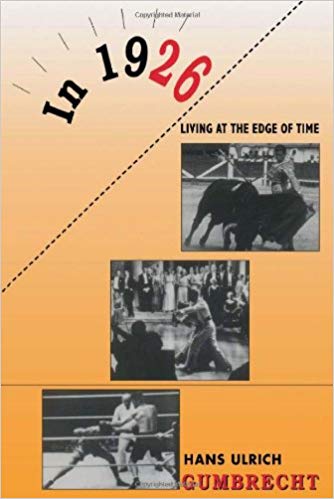
On the one hand, it signals Sepp’s initial engagement with Martin Heidegger’s philosophy. To put it more precisely: with an intense reading of Sein und Zeit; as a matter of fact and above all with Heidegger’s phenomenological descriptions of everyday life. Sepp’s 1998 book In 1926. Living on the Edge of Time is a first and robust outcome of this specific concern, which is related to lived experience as such, attributing to it, let us say, an intellectual dignity, which resembles Auerbach’s reconstruction of Western literary experience, and its serious and potentially tragic understanding of ordinary, everyday life.
On the other hand, it should be highlighted that from the very beginning of his engagement with the concept, and even in its translation as composure, Gelassenheit never meant to Sepp acceptance, resignation, in one word: quietude. Rather, I propose the following rendering of Sepp’s translation: composure implies a particularly active relationship with current events, in which the present is projected into a much wider chain of events, and going back and forth different historical periods is the trademark of Gelassenheit understood as composure – a trademark also of Erich Auerbach’s masterpiece, Mimesis.

Auerbach’s Mimesis, he pointed out, is “an impressive narrative of a failure” of Western culture, and can even be read as a powerful anti-Nazi statement.  “You see my point: composure has nothing to do with acceptance of a present filled with tragic happenings, but rather it entails an active withdrawal from the, let us say, tyranny of the present; withdrawal which enlightens the relativity of any given historical time.”

Then João cut to the chase: “I’ll now propose that from 1995 onwards Sepp’s understanding of Gelassenheit started to change slowly but steadily, and as time went by the change became so radical that it opened up a new path in Sepp’s work.”

Then he told a story:

In 1995 Sepp Gumbrecht, along with Jeffrey Schnapp, Ted Leland, Bill Egginton and Rich Schavone, organized what, with hindsight, can be seen as a breakthrough event, bringing together athletes and academics. I’m referring to the conference “The Athletes’s Body.”
In the Q&A session, the three-time Olympic gold-medal swimmer Pablo Morales was asked what he missed the most of his life as a top athlete. Morales’s answer was in itself eventful. He did not exactly miss the exhaustive training routine, although the discipline required by it can be fully appreciated. Indeed, almost all top athletes have impose on their bodies such stress throughout their careers that the most common outcome is a series of injuries they have to endure their entire lives. Nor even gold medals and world records were what Morales missed the most; after all a top athlete is obsessed with improving her performance, therefore, any victory may be clouded by the seemingly inescapable question: could I have done it any better?

So what was it that Morales really missed from his athlete’s life?

Pablo Morales told us that above all he longed for the moment immediately before jumping into the swimming pool in a day of an important competition just like the Olympic Games. Then, Morales felt the world to be a blank page, an untouched canvas, where everything is possible, and the best performance ever is at hand. In his own words, in this very moment he felt “lost in focused intensity”.

Being lost in focused intensity, I propose, has triggered Sepp’s new understanding of Gelassenheit, and it is not a coincidence that at the same time Sepp was engaging ever more intensely with a highly personal reading of Heidegger’s philosophy. The process was not without hindrances, and in 2003 Sepp published Production of Presence. What Meaning Cannot Convey, providing the basis for a theoretical framework of his own, which enabled him to turn intensity, that is, his new translation of Gelassenheit into a form of thinking. Intensity as a special form of Gelassenheit has become not only Sepp’s own Gedankenexperiment but also an everyday aesthetics – as you already know, no ethics should be attached to Sepp’s works.
After all, what is a seminar taught by Sepp if not an immersion in Gelassenheit? It is not the case with Sepp’s wrap-up of a panel – be it surprisingly good or merely mediocre? In both cases, while rendering more complex the ideas espoused by the speakers, Sepp is creating an environment where it becomes possible, almost at hand, to find themselves lost in focused intensity.

João concluded that Sepp’s most recent work redefines Gelassenheit, and perhaps we should, too. “I suggest that we move from composure to serenity.” He continued:

However, as we did with the notion of composure, we have to enrich our understanding of serenity. It should not be seen either as calmness or as quietude. I propose we equate serenity with stillness, but only insofar as the absence of motion, implied in the meaning of stillness, resonates Pablo Morales’s experience of being lost in focused intensity. In other words, in Sepp’s work, stillness means to be in absolute concentration immediately before jumping into the swimming pool in an Olympic Game or, for that matter, immediately before delivering a thought-provoking lecture. After all, academics also perform their intellect, even if they are not aware of it.

Then, to conclude I believe that we can pinpoint two or three definitions of Gelassenheit that may enlighten Sepp’s current work.

First: Gelassenheit demands a Messianic time, in the sense put forward by Walter Benjamin, but as long as the Messiah is not expected to come, so time remains open to the openness of time.
Second: Gelassenheit as serenity is the form of emergence, in the sense developed by Umberto Maturana and Francisco Varela, notion that along with autopoiesis were important in the unfolding of the theoretical framework of the materialities of communication paradigm.

Finally, as serenity, Gelassenheit is the emergence of form; form, in the sense developed by George Spencer Brown, as the difference between in and out, interior and exterior, propitiating what could be called the aesthetics of Sepp’s thought experiments.

If the ideas I proposed here are good to think with – as the myths are for Claude Lévi-Strauss – I may now conclude by suggesting that, as time goes by, Sepp becomes ever more intense because at last he has learned to be a bit more serene.

Well, I lost whatever small measure of Gelassenheit I have when João told me the eminent house É Realizações Editora in São Paulo would be translating and publishing Evolution of Desire: A Life of René Girard in Portuguese for a Brazilian translation. Wheee! Uncork the champagne!