Writer’s block? You’re not alone. Dorothy Parker sends you a telegram…

Share

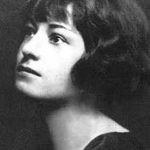
Overwhelmed? You’re not alone. So was Dorothy Parker. The witty writer penned hundreds of poems and short stories, and was also a popular book critic for The New Yorker. She even tried her hand at screenwriting – and two of the scripts she co-wrote won Oscars. The wisecracking writer, critic, and satirist, was also one of the leading lights at the legendary Algonquin Table circle of writers, columnists, and hard-drinking journalists who gathered daily for lunch at the Algonquin Hotel in Manhattan.

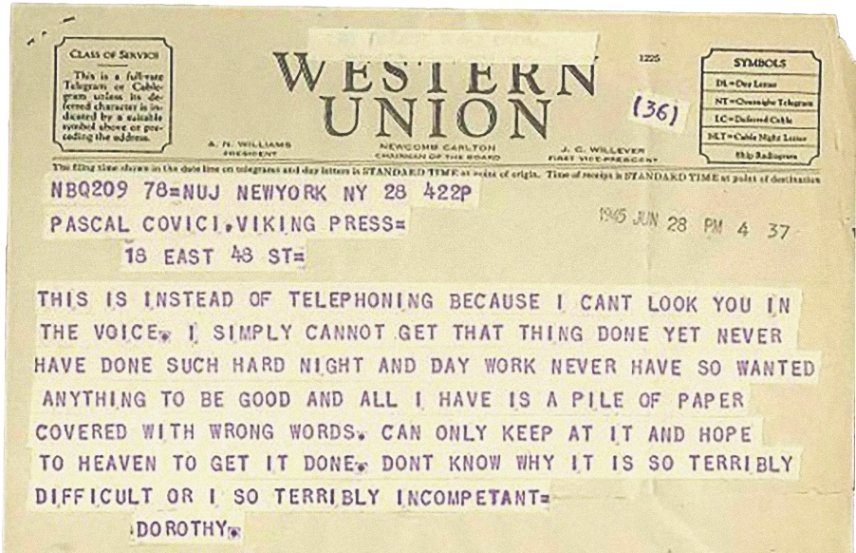
No wonder she couldn’t get everything done. Here’s a 1945 telegram she sent to her editor at Viking, Pascal Covici. And it’s for all of you readers, too, as you struggle to catch up with deadlines over the weekend.

Lena Herzog on photography: “It stuns me every time. It’s the stuff of magic.”

Share

“When I see an image come through in my developer, it stuns me every time. It’s the stuff of magic.”

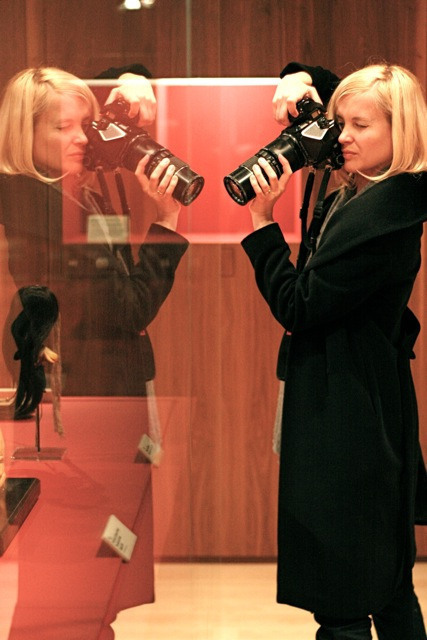
Lena at work

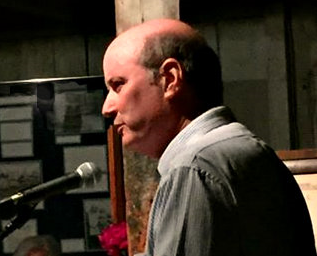
Lena Herzog is a visual artist and photographer who develops thoughts and ideas as well as images. In his introduction to their conversation, Entitled Opinions host Robert Harrison suggests that her camera follows Joseph Conrad’s aesthetic creed to “render the highest kind of justice to the visible world.” The interview is available on Entitled Opinions new channel over at the Los Angeles Review of Books, here.

Harrison and Herzog discuss the cultural transition to digital photography and Herzog’s penchant for a ghostly or alchemical – or even sacramental – approach to creating images. Herzog usually works with pre-digital cameras, where latent images are transformed into visible ones with emulsions in a darkroom.

The two discuss how many cultures have believed that photographs steal the soul. Have millions of digital images eroded meaning from places and people? Walter Benjamin said that photography is one of the most powerful instruments of desacralization of the world, so Harrison and Herzog discuss the over-familiarization of images of landscapes and objects, in an era when we live in oceans of images.

Herzog argues that the images capture the “inner state of being” of the photographer: “Five photographers are in a trench, they pop out, they take a picture if the same event, they pop back in. They come out with completely different images. Remember the picture of the naked girl at the napalm bombing during the Vietnam War? It’s Nick Ut’s very famous iconic image. On that bridge stood half a dozen photographers, including a photographer from the New York Times who was far more famous at the time. None of them produced images that stuck with us. They were shooting at the same time with the same group of Vietnamese running towards them. This is an extraordinary and fascinating aspect of photography.”

Listen to the whole interview here.

Potent Quotes

“About five billion people who have cellphones can produce fairly competent images. They’re okay, but okay is not enough.”

“The procedures that I work with go back to dawn of photography, but not for sentimental reasons. It’s just because they’re better. … The possibilities are enormous. When I see an image come through in my developer, it stuns me every time. It’s the stuff of magic.”

“We are three dimensional creatures. We don’t have the companionship and camaraderie with files, with zeroes and ones. Even when you see an image that is perfectly perfect, which is very high-resolution digital, there is something about it that doesn’t speak to us.”

“One of the reasons that I use all these complicated technologies and techniques and large-format cameras is because I want to take special care. It should not be offhand, it should not be careless how I photograph.”

“The mystical part of it is not only that mechanically I can reproduce the astonishing likeness of the world, but also mechanically I can reproduce how I feel, how I see the world. … It not only registers the event, but the photographer’s inner state of being.”

“When an object or a thing or a person is over-familiarized, something happens to it, something in our perception of it happens, and we lose the mystery, the expectations. For me, that’s why celebrities are absolutely uninteresting. Familiar to us, and yet they have become completely unfamiliar because there is a veil of familiarization that holds us back from true understanding. To look at it afresh, to pay attention to it carefully, is a task right now.”


“Touching the good”: on Richard Wilbur – and Charlee Wilbur gets the last word

Share

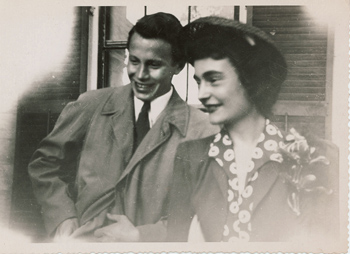
Richard and Charlee Wilbur getting married, 1942.

Death doesn’t offer many satisfactions, but there’s a notable one in the death of the late Richard Wilbur, the most perfect poet in the English language. I was gratified by the outpouring of love for his poetry from many unexpected quarters – one can’t quite call him “neglected,” but he certainly didn’t command the notice he merited. How often was he recognized as America’s foremost living poet? Moreover, he was as great a human being as he was a poet.

But one friend needed no selling, on that point in particular. Wrote Sam Gwynn: “I knew him for almost 50 years, and he was always the same–courtly, courteous, and civilized. He showed a lot of us how to live as both a person and as a poet.”

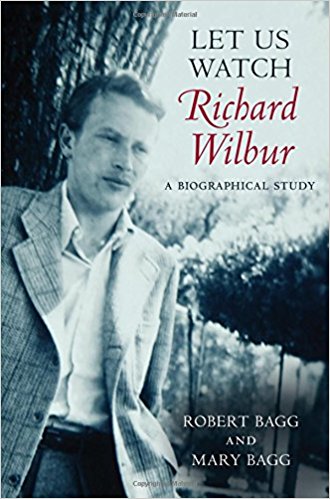
The praise continues over at First Things, where a friend A.M. Juster (we’ve written about his translations of Petrarch here) has written (not entirely warmly) about  Robert Bagg and Mary Bagg‘s new biography, Let Us Watch Richard Wilbur: A Biographical Study.  From the essay, “To Imagine Excellence”:

Although friendly with most of his poetic contemporaries, Wilbur resisted the trendy temptations of his time. Unlike Adrienne Rich, Louis Simpson, Donald Hall, and many others, he did not succumb to the pressure to abandon formal verse for free verse. Like Elizabeth Bishop, he refused to put his life on display in the manner of Robert Lowell, Sylvia Plath, Anne Sexton, John Berryman, and the “confessional” poets who were his peers. His work often displays joy and optimism, qualities in short supply among contemporary poets..

Juster: a Petrarch lover, too.

These qualities caused him to be largely ignored, and occasionally criticized, by the academy and the poetry establishment. In 1964 Leslie Fiedler complained that “there is no passion and no insanity” in Wilbur’s verse. Adam Kirsch, a critic whose work I usually admire, criticized Wilbur’s Collected Poems, 1943–2004 for employing “a style so elaborately formal that the most awful subjects are sublimated into irony, or even black comedy.”

These charges of bloodlessness and clumsiness lack merit. Even in the gorgeous “Love Calls Us to the Things of this World” is the unexpected violence of the phrase “the punctual rape of every blessèd day.”

Well you can read that whole poem here. It is gorgeous.

The Baggs’ new biography won’t change the perceptions about Wilbur’s “almost suspiciously normal life,” he writes, “although it should dispel the sense that he shared none of the horrors and despair of his more self-revealing peers.” The biography documents his combat experience in World War II, when he witnessed the death of friends and nearly died himself.  “The book discloses early financial difficulties and the autism of one of his four children. It also reveals that he and his devoted wife went into rehab for overuse of sleep medications and maybe alcohol.”

He was throughout, writes Juster, “a singularly humble and self-effacing member of a generation of competitive and catty poets.” He continues: “When Wilbur won the 1957 Pulitzer Prize for Poetry, a disappointed John Berryman sent him a sarcastic telegram so subtle that he missed the barb entirely. (Berryman later both clarified and apologized.) Robert Lowell, Elizabeth Bishop, and others frequently denigrated Wilbur in order to lift themselves up in rankings of the greats.”

However, he bristles at the the Baggs’ speculation that Wilbur had an affair during the war years, “simply on the basis of one photograph of him posing with a woman that someone in France had sent to his wife.”

And here’s the money shot: Charlee Wilbur’s “feisty and forgiving 1945 letter” that she sent to her husband, after he warned her of the photo’s existence:

You’re a dolt! Did you really think you had to forewarn me about that picture of you and that sexy-looking French Frail? Even if I saw a picture of you actually in bed with such a babe, I shouldn’t think any other thought than—“god, I’d like to be in her shoes!” (Or out of them as the case might be.) You must remember that I have tremendous respect for your essential taste. And I also have great faith in and dependence upon our common love so that whatever you did couldn’t possibly touch the good that ties us irrevocably together.

Read the whole thing here.

Having a Rilke moment? The great poet on “the difficult work of love”

Share

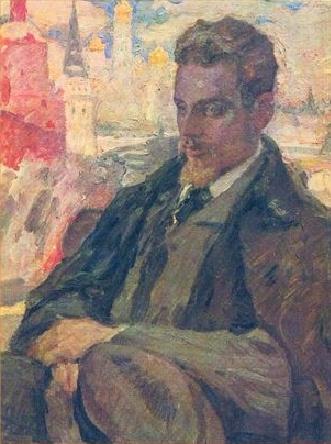
A portrait of Rilke by Leonid Pasternak (Boris’s dad)

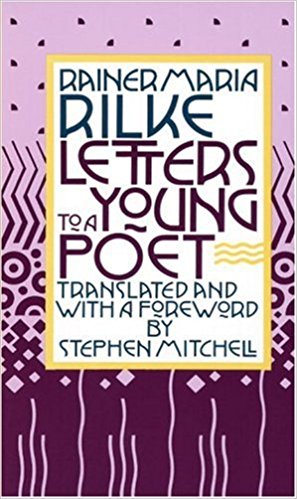
A dear friend referred recently to having “a Rilke moment.” That returned me to Rainer Maria Rilke’s Letters to a Young Poet (trans. Stephen Mitchell), perhaps the most famous and most treasured letters of the last century. The ten letters were written to Franz Xaver Kappus, a 19-year-old cadet at the Theresian Military Academy. He was seeking advice from the young Rilke, who was less than a decade older, for guidance on writing his own poetry. He got advice on a lot more than that.

An excerpt from the seventh letter, written on May 14, 1904:

It is also good to love: because love is difficult. For one human being to love another human being: that is perhaps the most difficult task that has been entrusted to us, the ultimate task, the final test and proof, the work for which all other work is merely preparation. That is why young people, who are beginners in everything, are not yet capable of love: it is something they must learn. With their whole being, with all their forces, gathered around their solitary, anxious, upward-beating heart, they must learn to love. But learning-time is always a long, secluded time, and therefore loving, for a long time ahead and far on into life, is –: solitude, a heightened and deepened kind of aloneness for the person who loves. Loving does not at first mean merging, surrendering, and uniting with another person (for what would a union be of two people who are unclarified, unfinished, and still incoherent –?), it is a high inducement for the individual to ripen, to become something in himself, to become world, to become world in himself for the sake of another person; it is a great demanding claim on him, something that chooses him and calls him to vast distances. Only in this sense, as the task of working on themselves (“to hearken and to hammer day and night”), may young people use the love that is given to them. Merging and surrendering and every kind of communion is not for them (who must still, for a long, long time, save and gather themselves); it is the ultimate, is perhaps that for which human lives are as yet barely large enough. …

Whoever looks seriously will find that neither for death, which is difficult, nor for difficult love has any clarification, any solution, any hint of a path been perceived; and for both these tasks, which we carry wrapped up and hand on without opening, there is no general, agreed-upon rule that can be discovered. But in the same measure in which we begin to test life as individuals, these great things will come to meet us, the individuals, with greater intimacy. The claims that the difficult work of love makes upon our development are greater than life, and we, as beginners, are not equal to them. But if we nevertheless endure and take this love upon us as a burden and apprenticeship, instead of losing ourselves in the whole easy and frivolous game behind which people have hidden from the most solemn solemnity of their being, – then a small advance and a lightening will perhaps be perceptible to those who come long after us. That would be much.

Roving photographer Zygmunt Malinowski spends a day with Henrik Ibsen in Norway

Share

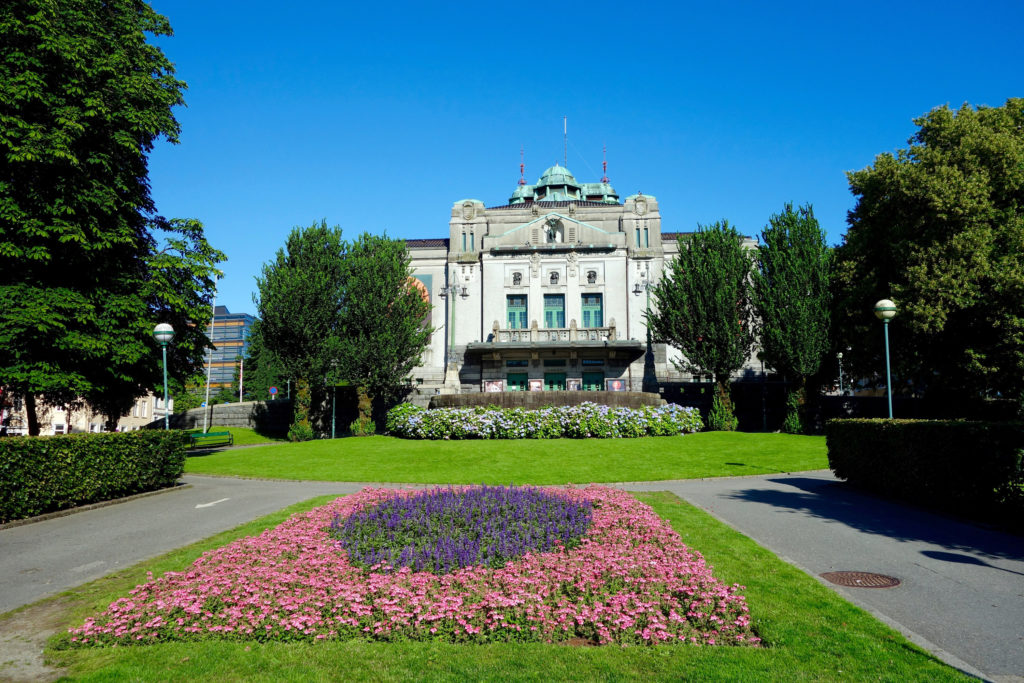
They know how to treat theater in Norway: the National Theatre of Norway in Bergen

The Book Haven’s roving photographer and reporter, New York City’s Zygmunt Malinowski, wrote to us following his recent visit to Henrik Ibsen’s Bergen – and, as always, he documents his journey with photos, which he generously shares with Book Haven readers. (Some of his previous photographic journeys are here and here and here and here, among other places.)

From Zygmunt:
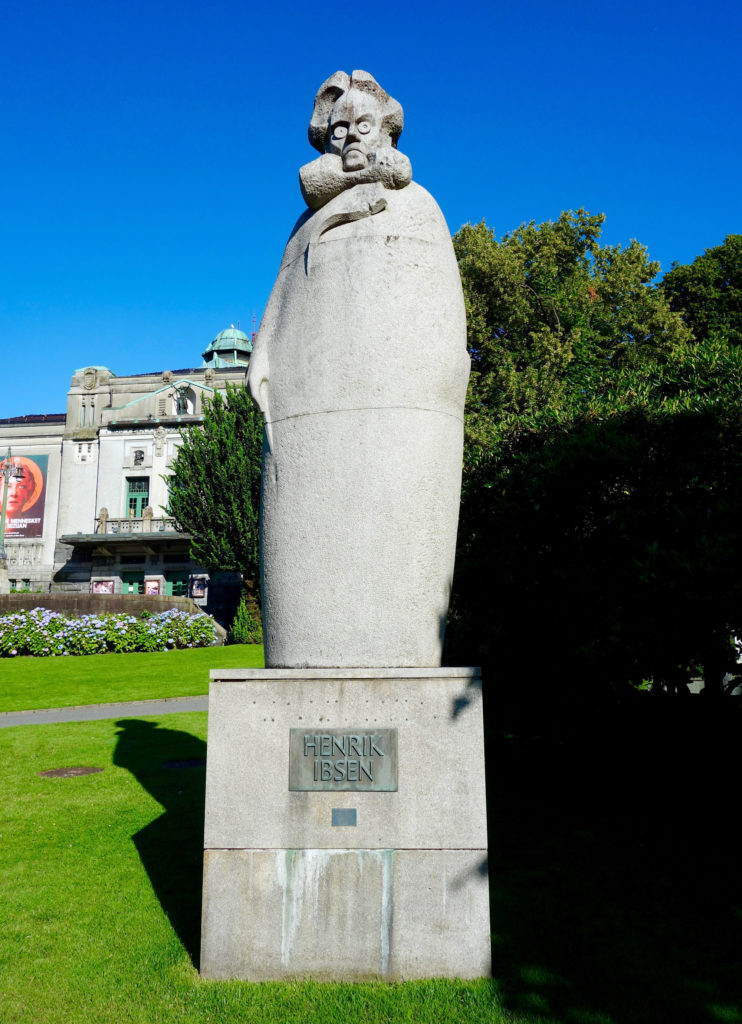
The man himself.

On the way to the northernmost part of Norway a few months ago, I had a stopover in Bergen. I was looking forward to revisiting “Bryggen,” a colorful waterfront historical area.

A few short blocks from my hotel, the street opened up into a wide plaza that ended with a stately building in art nouveau style – the National Theatre of Norway. A well-manicured lawn in front with planted flowers, shrubs, and trees on both sides added to its dignity. On one side of the green square, a large modern minimalist statue:  not surprisingly, Henrik Ibsen, the Norwegian playwright considered the father of modern theater, as well as the father of realism.

Ibsen was the first director and writer-in-residence of “Det Norske Theatre,” now the new National Theatre. He wrote several plays there, which did not earn acclaim, but nevertheless gave Ibsen much-needed experience in his craft. After he left for Italy and Germany, he wrote his most important works; Brand made him famous in his native country, and world success followed with among others: Peer Gynt, Pillars of Society, Doll’s House, Master Builder. He returned to Christiana (later, Oslo) during his late years.

In 2006, the centennial of Ibsen’s death, A Doll’s House was the most performed play for that year. Ibsen is said to be the most performed playwright after William Shakespeare.
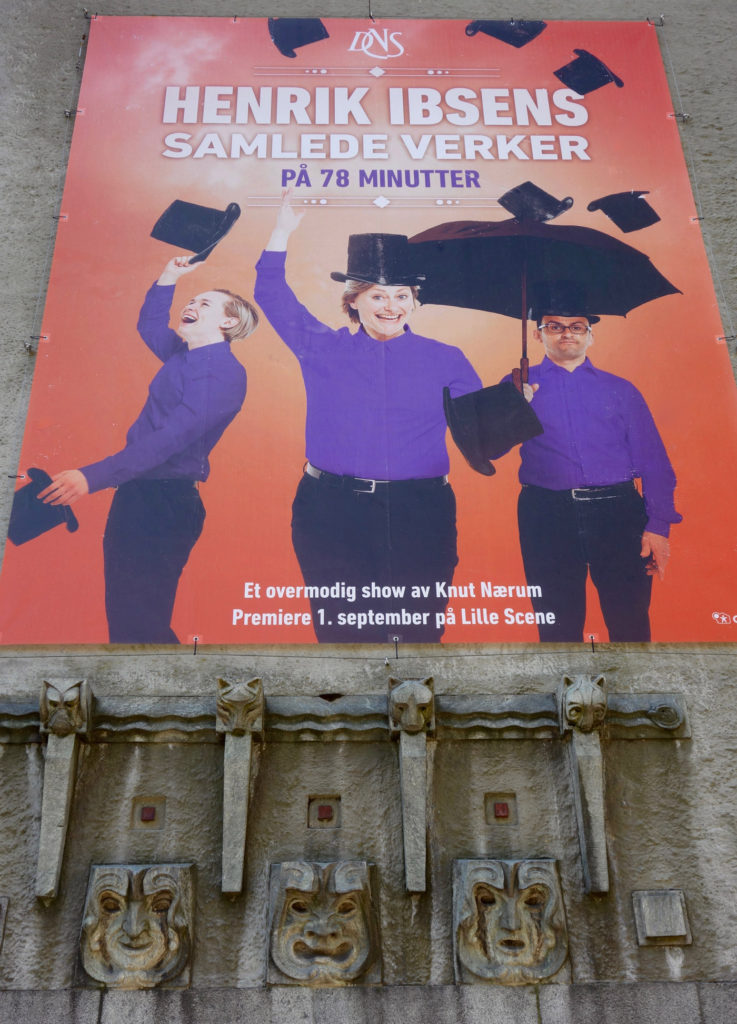
All of Ibsen in 78 minutes.

The Ibsen statue erected more recently was modern. The body was elliptical, only the head was more realistic and even here the eyes were circular, like two oval slices. The sculptor rejected the romantic ideals just as Ibsen did in his works.

On the facade of the building, two large placards announced the current offering, one was for a new Ibsen production: Henrik Ibsen’s samlede verker på 78 minutter performed in Lille Scene, one of the three theatre stages, an intimate setting situated on the east side of the building.

Combining 28 of Ibsen’s plays in 78 minutes seemed like a magic act – as suggested by the graphic depiction of actors juggling top hats in the poster for the event. According to reviews, it’s “a comic marathon by dramatist Knut Naerum that offers a chance to learn all about Ibsen in one evening.” Performances continue through December.

It was good to be back in Bergen, especially since my visit occurred during one of these pleasant sunny days that led many Norwegians to stroll the boulevards and linger outdoors. Across from the statue at the corner building, smartly dressed couples enjoyed a glass of wine with their late afternoon meal on the patio at the Theatro restaurant and bar, part of the boutique Hotel Oleana.

Photos copyright Zygmunt Malinowski.
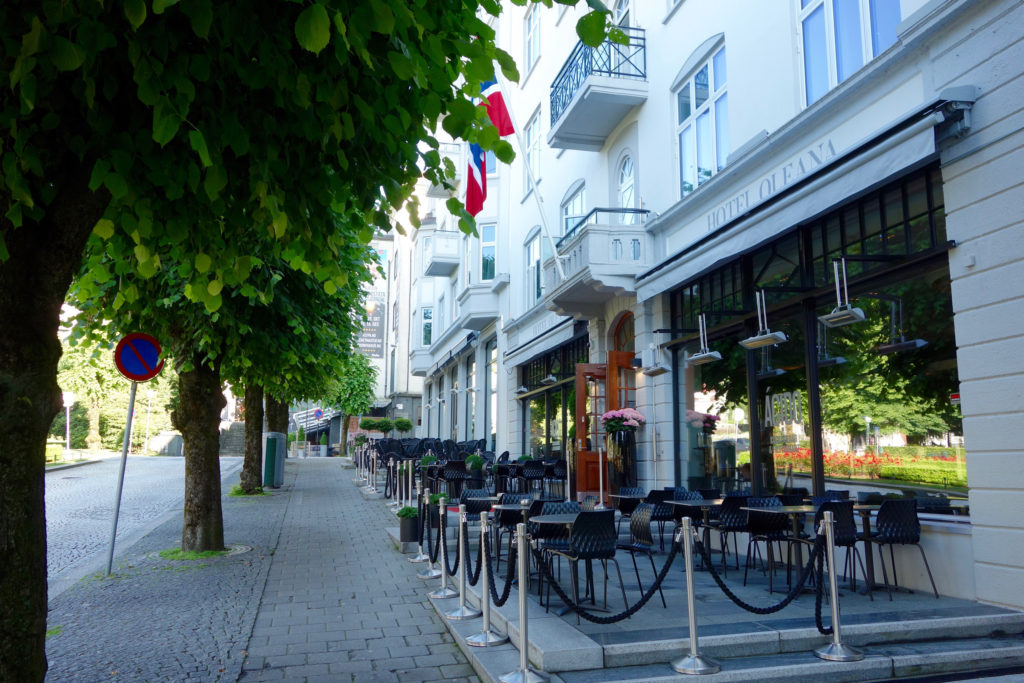
Hotel Oleana when it’s empty.
Mikhail Baryshnikov: “Water is his church, Brodsky’s church.”

Share

“I remember his voice, I remember the way he read.” Screenshot from Brodsky/Baryshnikov

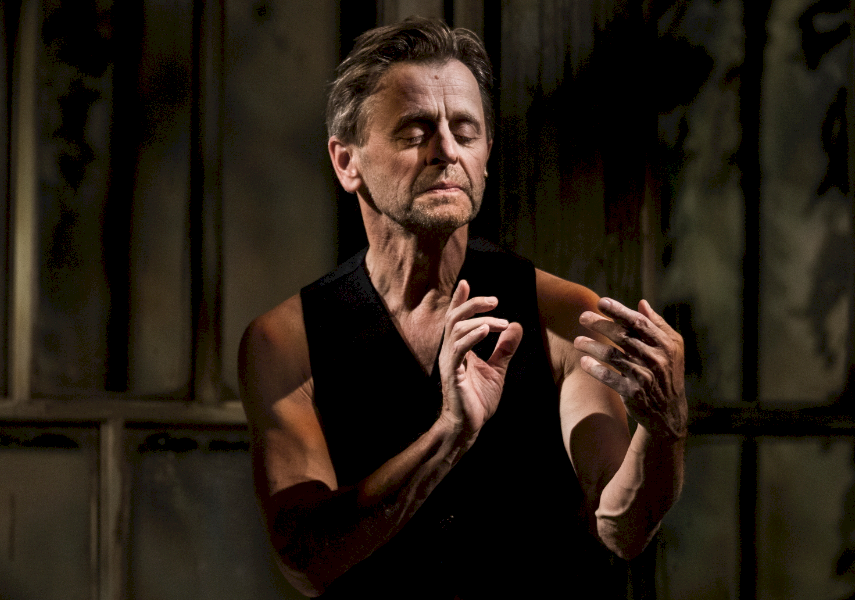
We’ve written before about Mikhail Baryshnikov’s acclaimed Brodsky/Baryshnikov show, which blends the renowned dancer’s movements with the poetry of his friend, the Nobel poet Joseph Brodsky. (I hear rumors that the show, which debuted in the dancer’s native Riga, is coming to Berkeley, but so far it’s not showing up on any websites so far.)

However, we missed Neil Munshi’s Financial Times of London’s article, “Poetry and motion: Mikhail Baryshnikov on Joseph Brodsky”, which describes the two Russians’ long camaraderie. An excerpt:

“He loved to be by the embankment, because it reminded him of Leningrad, with the water and perspective,” Baryshnikov says. “In his poetry, there are so many poems about water, from the north to Venice, to the Hudson, to the Caribbean. He really worked on a metaphysical level about the water: the proximity, and the colour, and the essence of it. Water is his church, Brodsky’s church, because he grew up [with the] Neva River.” Baryshnikov has referred to Brodsky as his “university”, the man who gave him the higher education his dancing prevented him from receiving. Brodsky introduced him to not just the work of writers but to the writers themselves.

Screenshot from Brodsky/Baryshnikov

“He said that he was surprised how much poetry I know, which was a total exaggeration. He was trying to pay me a compliment, I don’t know why. But I would rather sit and listen to his conversations with Derek Walcott, and maybe half of it, I couldn’t understand. Or with Stephen Spender, or Czeslaw Milosz. He’d just talk about politics with Susan Sontag,” he says. Baryshnikov moved on to reading “Walcott from St Lucia, and Seamus Heaney in Ireland, or Louise Glück, in the States, or Mark Strand”.

“One of the first books Joseph gave me was a book of Mark Strand,” Baryshnikov says. “He said, ‘Mouse, have this.’ And I said, ‘Joseph, I don’t speak a word of English.’ It was at the very beginning. He said, ‘You will, and very soon, and we will read this man.’ And he was absolutely right.”  And there was always Brodsky. Baryshnikov keeps a full collection of his friend’s work in all of his homes and offices. “I always travel with one or two [of Brodsky’s] books. And some of them are still too difficult for me. I’m not pretending that I know his work inside-out at all,” he says. “I remember his voice, I remember the way he read. Sometimes he asked me to read. He said, ‘I want to hear a different voice, can you read this?’ Sometimes, I was lucky to be the first person to whom he read.”

Read the whole thing here.

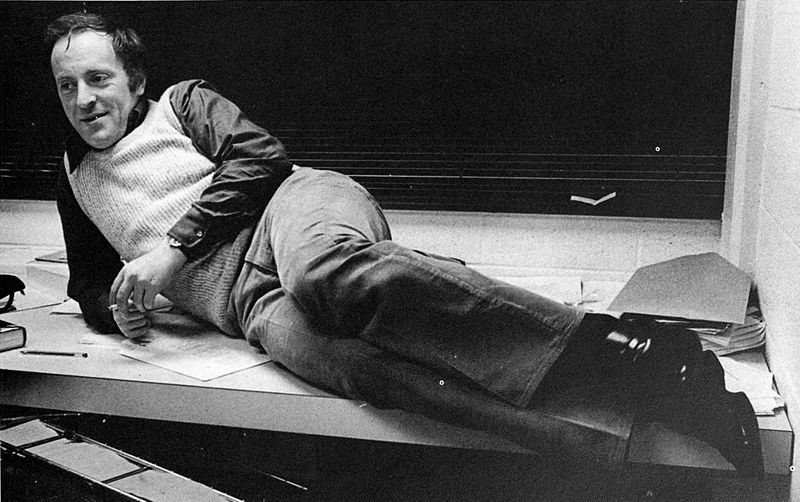
Early days: Joseph Brodsky in Ann Arbor in the 1970s.