
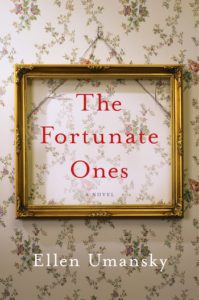
 When I was commissioned to write a story for the Poetry Foundation recently, I had the pleasure of working with Ellen Umansky, its features editor. She was terrific – but my pleasure is to be short-lived. She’s already left the foundation to pursue her own writing. So I googled, and found her first book, The Fortunate Ones, was favorably reviewed a few months ago in The New York Times.
From Sana Krasikov’s “A Painting Stolen First by the Nazis, Then by Persons Unknown”:
On the book:
Ellen Umansky’s first novel, The Fortunate Ones, borrows the architecture of the art mystery, but leaves aside the obligatory magic in favor of a quieter and more earthly examination of how art serves us in the here and now. The lost painting at the heart of the book is “The Bellhop,” a fictional amalgam of Chaim Soutine’s bellboys and hotel porters. In the eyes of 11-year-old Rose Zimmer, the boy in the painting “was too skinny in his red uniform, his face pasty and elongated. The paint was thick, thrown on . . . as if the painter couldn’t be bothered to slow down and pay attention. Rose didn’t understand why her mother loved it so.” (You can read more about Soutine on Ellen’s website here.)
The story:
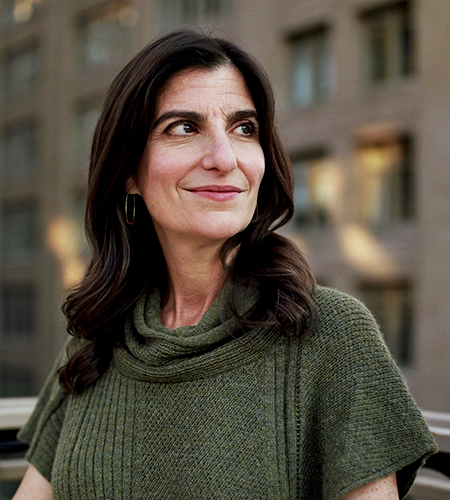
A winner. (Photo: Sam Zalutsky)
The canvas disappears when the Nazis plunder the Zimmers’ apartment in Vienna after the Anschluss. Rose and her older brother are spared their parents’ brutal fate, escaping to England on the Kindertransport. Sixty-six years later we encounter Rose in Los Angeles, now a chic, no-nonsense woman attending the wake of a friend, Joseph, who acquired her family’s lost Soutine after it mysteriously turned up in New York. But the painting no longer hangs on Joseph’s walls, having disappeared years ago on the night his rebellious daughter Lizzie threw a wild party in his absence. Lizzie, now 37 and at a crossroads in life, meets Rose at Joseph’s funeral, and feels a powerful affinity. As the two grow closer, Rose permits Lizzie to reopen the case of the lost painting. …
The takeaway:
On occasion, the novel falls into its own aesthetic traps. The dialogue sometimes feels too cinematically coy, and there is a veneer of politeness to the prose even in moments of conflict. But the ideas at its core are deceptively deep. The Fortunate Ones is a subtle, emotionally layered novel about the ways art and other objects of beauty can make tangible the invisible, undocumented moments in our lives, the portion of experience that exists without an audience but must be preserved if we are to remain whole.
Read the whole thing here.