
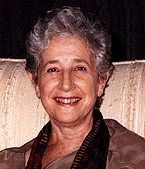
 A few weeks ago I wrote about the writer Neil Gordon, who died last month. In the course of writing about him, I found an Atlantic interview with his mother, the novelist Sheila Gordon, who died in 2013, also in May. Like mother, like son: “I’m interested in where the personal and the political touch each other, in how prevailing society affects people’s daily lives and relationships,” she said. “While growing up in South Africa I found myself observing an officially sanctioned unjust society, and I could see how everyday lives were shaped by the politics of apartheid. I suppose one’s political and moral commitments are intrinsic to what one writes about. I don’t feel writers are obliged to be more politically committed than other citizens.”
An excerpt:
Q: Do you choose your subjects or do they choose you?
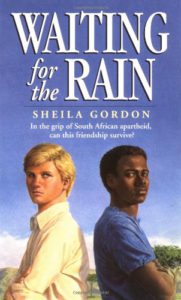 A: When I’m taken with an idea, I write. The length is dictated by the idea itself. Waiting for the Rain, for example, deals with how children regard the “Other,” or those who are different from themselves. The idea for the novel came as I watched on television a group of white soldiers riding into a township to quell an uprising of black schoolchildren. I saw how scared the white soldiers looked; the same fear was on the faces of the black children — who were the same age as the soldiers. I was moved to pity by the situation; these children were pitted against one another by the conditions adults had laid down for them. Out of this brief image the whole novel developed.
She suggested that “perhaps the place of one’s birth is stamped indelibly on one’s sensibility. Africa particularly: there’s something so vast, lonely, dramatic, and primal about that continent. One experiences it vividly and profoundly.”
She concludes, “I don’t think it’s the writer’s job to change people, although I believe that truly good fiction transforms, enriches, heightens awareness. When I write, I’m trying to tell a good story, to reflect on the pity and pain of how we deal with one another, and in a way that will engage the reader’s imagination and heart.”
Read the whole thing here.