

We have already rabbited on about the misuse of the word “literally,” especially when people actually mean “figuratively.” Don’t get us going about “hopefully.” However, Ben Yagoda doesn’t necessarily have a problem with these kinds of usages. Nor does he yawn at strings of passive voice sentences, or the misuse of the word “which” instead of “that.” We agree with him, however, that it’s okay to split infinitives. Read the rest of his views on “bogus grammar ‘errors'” here.
Wait! Don’t give up on him. He cracks down hard on some grammatical abuses: the misuse of subjunctive and bad parallelism, for example. However, we don’t agree with his tiff with the semicolon, a punctuation mark that we rather like. Read his take on the grammar rules he insists on here.
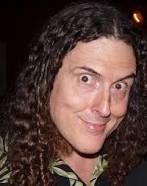
Or, if you prefer, you can enjoy the 3-minute version below by a fellow called “Weird Al Yankovic”:
Author: Cynthia Haven
Cynthia Haven has written for The Times Literary Supplement, The Nation, The Virginia Quarterly Review, The Washington Post, The Los Angeles Times, The San Francisco Chronicle, World Literature Today, and other publications. Her work has also appeared in Le Monde, La Repubblica, The Kenyon Review, Quarterly Conversation, The Georgia Review, Civilization, and others. She has been a Milena Jesenská Journalism Fellow with the Institut für die Wissenschaften vom Menschen in Vienna. Peter Dale in Conversation with Cynthia Haven was published in London, 2005. Her Czestaw Mitosz: Conversations was published in 2006; Joseph Brodsky: Conversations in 2003; An Invisible Rope: Portraits of Czestaw Mitosz was published in 2011 with Ohio University Press / Swallow Press. She is currently a visiting scholar at Stanford. Her biography René Girard, A Life will be published next year.
Join me at twitter: @chaven
View all posts by Cynthia Haven
2 thoughts on “Word crimes: irony is not coincidence, etc.”
I like this song, in part because I really dislike the sexism of Robin Thicke’s original, but also because I have been saddened by the misuse and abuse of language in recent years.
Linguists don’t like Weird Al’s indignant approach to what he thinks of as correct usage, but what they think are really class/status markers.
I’m not sure what I think. Formal writing requires certain usages, and IMO it is socially desirable for written and spoken language not to diverge too much.
I like this song, in part because I really dislike the sexism of Robin Thicke’s original, but also because I have been saddened by the misuse and abuse of language in recent years.
Linguists don’t like Weird Al’s indignant approach to what he thinks of as correct usage, but what they think are really class/status markers.
http://languagelog.ldc.upenn.edu/nll/?p=13521
I’m not sure what I think. Formal writing requires certain usages, and IMO it is socially desirable for written and spoken language not to diverge too much.