

Rose from obscurity…
Ooo! Ooo! Ooo! A cliché alert! Via Facebook, Jennifer Howard of the Chronicle of Higher Ed (and formerly one of my editors at the Washington Post Book World) alerted me to the Washington Post Outlook Section’s banned phrases. We’re happy to see “double down” made the cut; we’ve written about that here. It also nails the “not un-” formation, but George Orwell jeered at that one decades ago.
The list comes from Carlos Lozada, editor of the Outlook Section, who passed it on to Jim Romenesko‘s blog about the media. There are so many doozies, we can only list a few and refer you to the original source here. A sampling:
Imagine (as the first word in your lede)
Hastily-convened [which shouldn’t be hyphenated, anyway – ED]
Little-noticed (that just means the writer hadn’t noticed it)
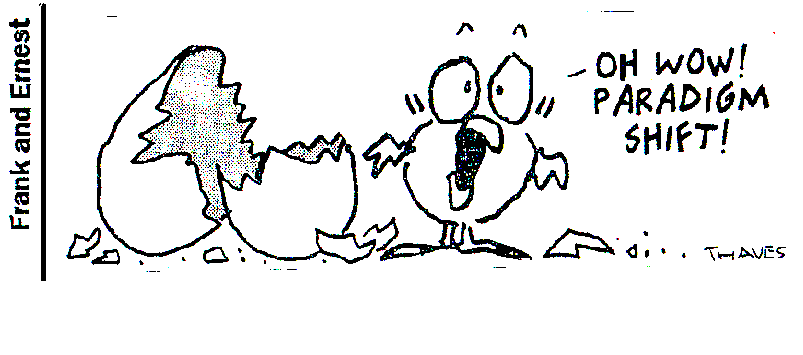
Paradigm shift (in journalism, all paradigms are shifting)
Unlikely revolutionary (in journalism, all revolutionaries are unlikely)
Unlikely reformer (in journalism, all reformers are unlikely)
Da Man
Grizzled veteran (in journalism, all veterans are grizzled – unless they are “seasoned”)
Manicured lawns (in journalism, all nice lawns are manicured)
Rose from obscurity (in journalism, all rises are from obscurity)
Dizzying array (in journalism, all arrays make one dizzy)
Withering criticism (in journalism, all criticism is withering)
Predawn raid (in journalism, all raids are predawn)
Ironic Capitalizations Implying Unimportance Of Things Others Consider Important
Provides fresh details
But reality/truth is more complicated (oversimplify, then criticize the oversimplification)
The proverbial TK (“proverbial” doesn’t excuse the cliché, just admits you used it knowingly)
One Facebook poster asked if we could add “perfect storm” to the list. A worthy suggestion. At the Romenesko’s website, someone suggested that one offender – “remains to be seen” – might be appropriate if you’re writing about an open-casket funeral.
Cat that heard “double down” once too often.
Lozada was prompted to send on the list when he read the blog entry about Milwaukee Journal Sentinel managing editor George Stanley‘s note to the newsroom (perhaps inspired by all the stories about Princess Diana‘s “iconic” dresses on the auction block this week:
Folks,
It has been brought to my attention that we are seriously over-using the word “iconic.”
I could provide examples but would rather not.
It’s not a bad word but it is becoming a cliché. Let’s try not to use it unless it is truly the best possible word for that sentence.
Thank you!
His warning was timely: a search turned up 29 stories, blog posts, and photo gallery descriptions using the word in the last seven days.
Of course, Orwell’s whole point was to show how language is used to obfuscate, deceive, and hide meaning. So here’s a stinker offered by Erin Belieu, an associate professor at Florida State University (she also has a fourth collection of poetry coming out with Copper Canyon Press). She’s written an open letter to editors who say that they aren’t publishing a representative percentage of women because they only publish “the best” work (and wow, look here, it’s pretty damning):
Dear Certain Editors, please stop saying in reaction to VIDA’s Count that you simply publish “the best” work. What you do is publish what you like. Both rhetorically and philosophically, my 5th grader can tell the important difference between these ideas. Either you actually don’t understand the difference or you choose not to. For your sake, I hope it’s the latter as the former isn’t something you can easily fix.
Good catch, Erin!
I liked this from the list: “Ironic Capitalizations Implying Unimportance Of Things Others Consider Important.”
This has become a Really Common Thing in blogging and social media. He should also ban using. Periods. For. Condescending. Emphasis.
Ouch, Jeff! Guilty as charged!
Sorry! For what it’s worth, I spotted a couple of my own venial sins on the Outlook list…