

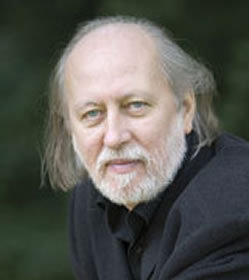
Justifiably nervous … and absolutely not normal.
Last month, I wrote about attending the László Krasznahorkai reading at the London Review of Books bookstore, with his translator George Szirtes and Irish novelist Colm Toíbín sharing the stage – it’s here.
On that evening, the Hungarian author read “a lyrical essay about the terrible meeting between boorishness and aggressiveness,” about the kind of guy who floods him with “the deepest personal anxiety.” It began this way:
I’ve been living in complete silence for months, I might say for years, with just the usual dull sounds you hear at the outskirts of town, the occasional echo of steps in the corridor and, further off, in the stairwell, someone dragging a sack, a carpet, a package, or a corpse, God knows what, along the ground; or the sound of the elevator as it slows, stops, opens, then closes and starts to rise or descend. Every so often a dog barks briefly, someone laughs or shouts. But everything dies away, soon lost in the constant low-level murmur of the street outside. That is what complete silence is like round here.
There are of course times I put on a Zelenka mass or listen to one of Schiff’s “Wohltemperiertes Klavier” interpretations, or take out Spoon, Karen Dalton or Vic Chesnutt, but after a few bars I turn it off so it may be quiet again, because I want to be ready and I don’t want anything disturbing going on when he arrives and finds me.
To be honest I wouldn’t have been surprised if he hadn’t knocked but beat at the door, or simply kicked the door in, but now that I hear the knocking, it’s clear there is no difference between his knocking and beating or kicking the door in, I mean really no difference, the point being that I am dead certain it is him, who else; he of whom I knew, and have always known would come.
The most tragic figure in history is the one in whom two terrible conditions meet. The two conditions that meet and combine in him are bottomless idiocy and unbounded aggression …
Now it’s in the New York Times. Read the whole thing here.