
TLS: When did Keats become a great writer? Ask Gigante.

Share

“What was he really like?”

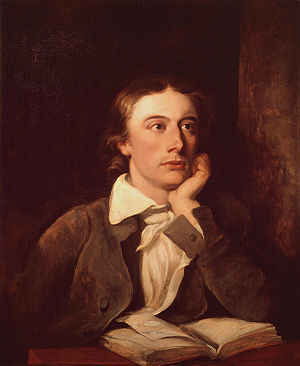
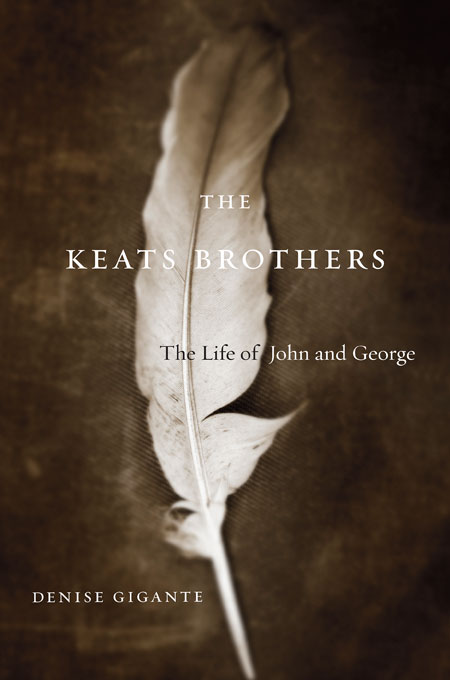
In case you missed it, a recent Times Literary Supplement article reviewed four new biographies of John Keats – one of them Denise Gigante‘s The Keats Brothers: The Life of John and George (we interviewed Denise here).

“What was he really like?” asks Jonathan Bate. “When, and under the influence of what shaping forces, did he become a great poet? Any literary biographer who can answer those two questions will have achieved the holy grail of Life-writing. The second will always be a matter of literary judgement, but the first becomes a great deal easier to explore when there is a cache of letters, diaries and intimate recollections.”

He concludes with special attention to The Keats Brothers:

But it is Gigante’s The Keats Brothers that comes closest to answering the question of when Keats became a great writer. It was in the summer of 1818, when he went north and began writing long letters, first to [brother] Tom and then to George and [sister-in-law] Georgiana. Previous biographers have recognized the importance of the walking tour with [friend Charles] Brown – the impressions of Wordsworth country, the visit to the tomb of Burns, the extraordinary vision of an old peasant woman, “squab and lean”, smoking a pipe as she is carried along by “two ragged tattered Girls” – “What a thing would be a history of her Life and sensations”. But Gigante’s method of writing the Lives of John and George in parallel allows her to bring into focus the key fact that other biographers sometimes forget: that the reason why Keats went north in the first place was to say goodbye to George as he set sail for America from Liverpool. George’s distance – and, soon after, the even profounder absence created by Tom’s death – was the primary force that shaped Keats in the year from the autumn of 1818 when he wrote his greatest poetry.
As Christopher Ricks reminded us nearly forty years ago in Keats and Embarrassment, John “always made an awkward bow” (that is the last sentence of his last surviving letter). The astonishing thing about the parting in Liverpool – and neither Nicholas Roe nor Denise Gigante dwells on this as fully as they might have done – is that he didn’t wait to see off the ship. He didn’t even know the name of the ship. Together with Brown, the surrogate brother, he slipped away at dawn. He couldn’t bear to say goodbye.

Denise’s fame has crossed the Pacific.  She sent us the review of a Chinese interview about her newest effort here.  The piece discusses her interest in association copies, and the way they intensify the bond among readers and writers.  As for the future of the book, it cites her earlier comment: “In the end, we will always be tactile creatures.”

Hey!  That’s exactly what she told the Book Haven here.
More on bad sex: “Eros calls for something better.”

Share

John Adams over at The Gentle Rereader offered such an elegant coda to our recent post on the Literary Review‘s bad sex award (we wrote about it here and here) that we couldn’t leave it alone in the comments section, where he had put it for us.  Here it is:

Barzun’s big thoughts on bad sex in books

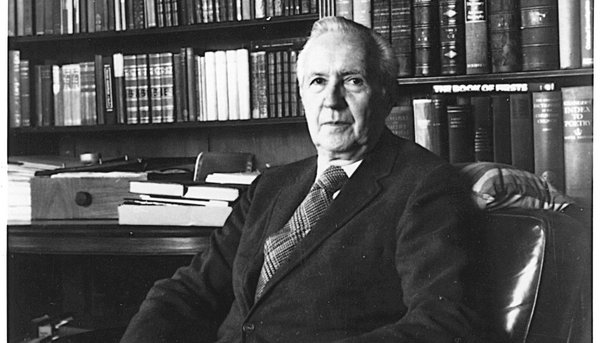
Prize-giving as ridicule doesn’t seem to be having the intended effect. Even badly written sex sells. Eros calls for something better. As ever, Jacques Barzun looks deeper into a question, in this case of sex scenes in books. In Venus at Large: Sexuality and the Limits of Literature he concludes:

“Since sexuality is of our very being, sex cannot be called illegitimate, immoral, or uninteresting. But it is terribly limited; and its appeal being unfailing, it is – or it ends by being – a cheap device. When, moreover, sex is present to make up for deprivations in the culture of a whole age, it becomes a burden to literature. As Shaw said in praising the purity of Poe, ‘Literature is not a keyhole for people with starved affections to peep through at the banquet of the body.’ One is permitted to think that the glut of sex in our prose and verse fictions will remain as the special mark of our work, the brand of the times on our genius; and one may perhaps imagine further that sooner or later a Cervantes will come, who in a comic saga of sex will bury our standardized bedroom adventures like so many tales of chivalry.”

Before reaching that conclusion, though, he surveys a broad array of literary sex examples before distinguishing those from sexuality:

“Sex – that is to say the particulars of the act – is an inescapably trite and insignificant event for literature. … Sexuality is on the contrary the very atmosphere in which all literature breathes and lives. But sexuality can be made palpable in thousands of ways, ancient, modern, and still to be discovered. There is surely more to the sexual instinct and its derivatives than the rapid mechanical transaction we have been given as its sum and summit. There are tendernesses and hesitancies, sensations and fantasies that are not of the readily nameable sort, and the language for them does not as yet exist. It is the business of art to create it.”

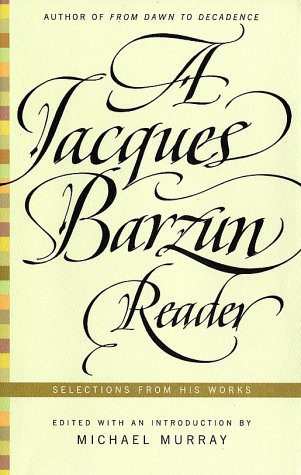
(Excerpted in A Jacques Barzun Reader, Michael Murray, ed., HarperCollins, 2002, pages 175–186; full essay in Encounter magazine, March 1966, pages 24–30.)

Thank you John and Jacques.  We couldn’t have put it better ourselves.  In fact, we didn’t.


George Szirtes and “a spirit of place”

Share

“My ancestors are an absence.”

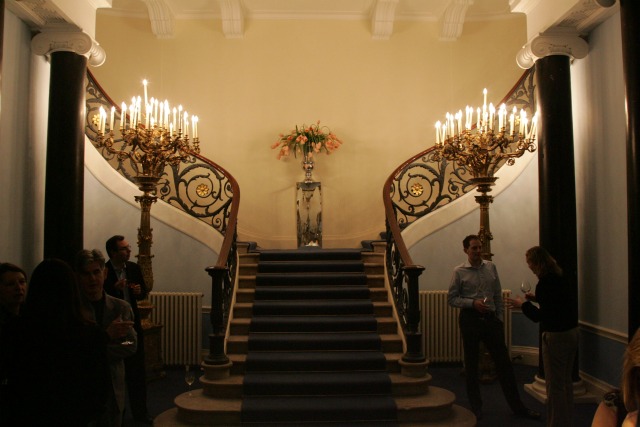
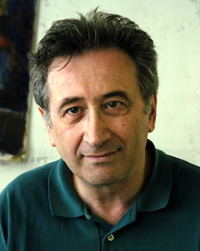
Poet George Szirtes and I have something in common, besides the memory of speaking about Czesław Miłosz last week at the glorious British Academy on Carlton House Terrace (the site a longtime residence of Prime Minister William Gladstone).

We share a heritage. The Szirtes family left Hungary in 1956, when George was an eight-year-old.  My family left a generation earlier, and it was only in recent years I had a chance to visit Budapest. He returned to Hungary in 1984, although “there had been a brief, curtailed family visit in 1968 when the invasion of Czechoslovakia sent us scurrying out.”  The 1984 return proved decisive in forming him as a translator – for which we are grateful, for not many venture into that alien tongue, whose closest antecedents are Turkish and Finnish.

He is mostly known, however, as an English-language poet, and has won a long list of awards, most notably the 2004 T. S. Eliot Prize.

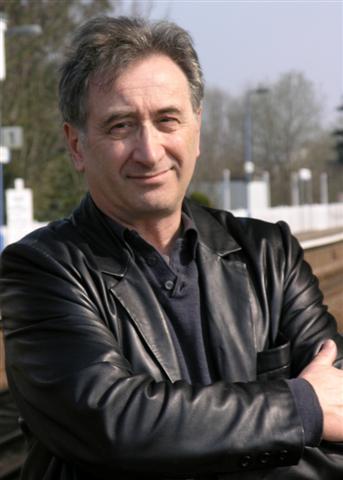
Author and poet Bethany W. Pope (a recent Twitter acquaintance of mine) interviewed the poet-translator for Quarterly Conversation.  Here’s a snippet:

B.W.P: Translation seems to me like something very similar to what I do when I write in the person of my ancestors. In my collection A Radiance, I wore their psyches as a way of inhabiting the people I love and bringing them closer. Has the fact that you were forced out of Hungary influenced your need to reconnect with your heritage in this way, and is that what you are doing when you engage in an act of translation?

G.S: It wasn’t so much the language I was reconnecting with back then as with a spirit of place that was, I felt, latent but unembodied in my own work. That is a more precise way of putting it than I felt at the time. The language was in the place. Since then I think it is likely that the language itself has reoccupied part of my neural system.

My ancestors are an absence. I never knew any of them as people and have no record of them in terms of documents. Two or three photographs, that’s all. I have no dynastic sense except in that I am of a race of people that have generally been chased from place to place and are occasionally murdered, which equips one with a vulnerability based on expectation. [Writer Gyula] Krúdy didn’t have that problem. He had a Hungarian version of it: the evanescence of location.

B.W.P: How has living and working so long in the UK influenced your take on Hungarian culture? I was wondering if existing for such a long time outside of it made it easier or more difficult to connect with the writers with whom you work?

Gladstone slept here.

G.S: I really only know Budapest culture at first hand. Capitals are not the same as the provinces. Budapest offered so many possibilities. There was a democratic resistance there before 1989 that was intelligent, deeply read, ironic, inventive, affectionate yet brusque. I think that culture has turned out to be more brittle than I thought it would be, but I could be wrong. In terms of their relationship to me, they were welcoming of me, but my nine months there in 1989, under the historical pressure of that year, showed me I could not be of them. In terms of my working relationship to them, they have given me far more than I could have hoped for. My “real” life is in my immediate family and in the English language. They have enriched that language for me, by entering it with me. They have expanded me. There’s nothing difficult about working with them.

Read the rest here – including an account of that 1984 trip.

An evening of bad sex…but is it bad enough?

Share

She’s honored. (Photo: Elena Torre)

Some time ago, we announced the Literary Review‘s finalists for the one of the world’s most dreaded competitions – a prize for the most embarrassing passage of sexual description in a novel.  The awards ceremony for the 20th annual award finally took place last week at the In & Out (Naval & Military) Club in St James’s Square, where 400 guests raised a toast to the winner.

And the winner is … Canadian writer Nancy Huston, with her novel Infrared.  I know, I know … you want me to deliver the goods.  Well, here’s the Literary Review‘s version of why they bestowed the award on Huston:

“Sentences from the novel such as ‘Kamal and I are totally immersed in flesh, that archaic kingdom that brings forth tears and terrors, nightmares, babies and bedazzlements’ caught the judges’ attention. One long passage in particular stood out:

‘He runs his tongue and lips over my breasts, the back of my neck, my toes, my stomach, the countless treasures between my legs, oh the sheer ecstasy of lips and tongues on genitals, either simultaneously or in alternation, never will I tire of that silvery fluidity, my sex swimming in joy like a fish in water, my self freed of both self and other, the quivering sensation, the carnal pink palpitation that detaches you from all colour and all flesh, making you see only stars, constellations, milky ways, propelling you bodiless and soulless into undulating space where the undulating skies make your non-body undulate…”

My goodness, I don’t think it’s all that bad.  Is that the worst they could do?  I think the other finalists were daffier – go here and see if you agree.  (By the by, John Updike received the lifetime achievement award in 2008.)

A friend recently protested against the Literary Review‘s anti-award, saying it inhibited writers from trying to describe sex at all.  I’m not so sure that’s a bad thing.  Gone are the days when a writer like Henry James could describe the sexual fever of a hand brushing across the back of another.  Gone are the days when Jane Austen could convey more passion with a blush more than most of today’s writers can express with an orgy.  We’ve lost the ability to describe the range of nuances in affection, love, devotion, rejection in our haste to describe the relentless interlocking of body parts.

According to Literary Review editor Jonathan Beckman, that’s exactly the reason why former editor Auberon Waugh founded the prize in the first place:  “He was genuinely convinced that publishers were encouraging novelists to include sex scenes solely in order to increase sales. The award’s remit was ‘to draw attention to the crude, tasteless, often perfunctory use of redundant passages of sexual description in the modern novel, and to discourage it’.”  I couldn’t agree more.

The Paris-based Huston has received more conventional awards, such as the Prix Goncourt des Lycéens and Prix Femina, but she seems to hold a special place in her heart for her newest distinction.  In a statement read at the ceremony, she announced, “I hope this prize will incite thousands of British women to take close-up photos of their lovers’ bodies in all states of array and disarray.”

To which we can only add:  Please no.  Not that.  Anything but that.

Huston is married to the philosopher Tzvetan Todorov.  On Twitter, Elif Batuman responded: “I just learned that the winner of this year’s Bad Sex Award is married to Tzvetan Todorov and it is ROCKING MY WORLD.”  No further explanation offered. After all, it was only a tweet.


László Krasznahorkai to Colm Tóibín: “I was absolutely not a normal child.”

Share

A place for “Literary Friendships.”

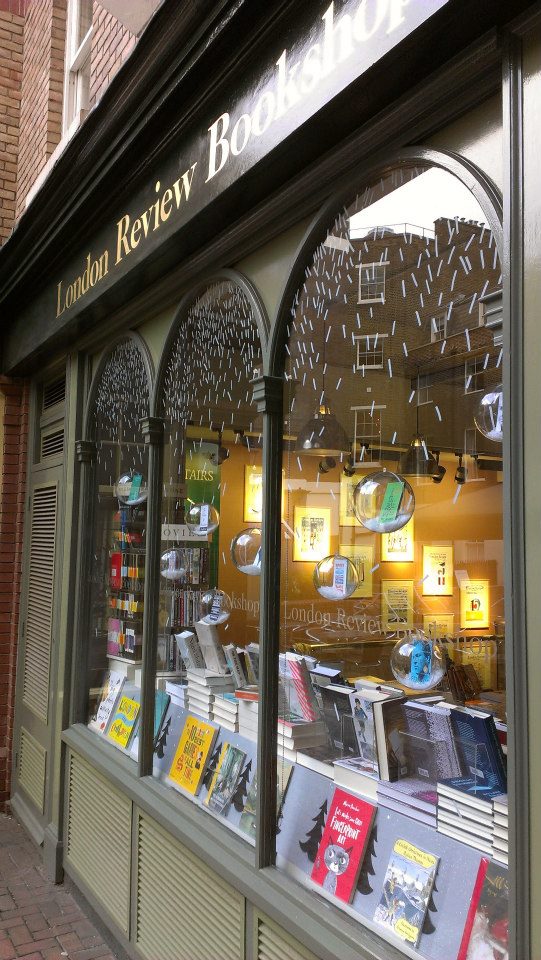
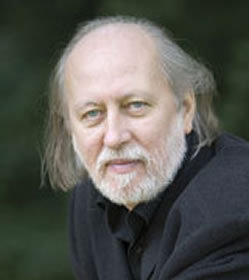
It was not an easy interview, but Colm Tóibín did his gamely best to interview László Krasznahorkai at the London Review of Books inaugural event for “Literary Friendships” last week.

The event was sold out and crammed into the LRB bookshop on Bury Lane,  which were already with crammed with books.

Until recently, Krasznahorkai was better known by reputation than by output in the West.   Susan Sontag called him “the contemporary Hungarian master of apocalypse who inspires comparison with Gogol and Melville. W. G. Sebald said, “The universality of Krasznahorkai’s vision rivals that of Gogol’s Dead Souls and far surpasses all the lesser concerns of contemporary writing.”

Satantango, first published in Hungary in 1985 and now regarded as a classic, was finally published in English this year, translated by the Hungarian-born English poet and translator George Szirtes.

“I had to write only this book and no more.  You try to write only one book and put everything you want to say in one book, to create my own literary world with my sentences,” Krasznahorkai told last week’s audience.

The Irish Tóibín made a stab at describing Krasznahorkai’s style, which he saw as “removing the need for objects in novel and seeing whether a novel can live in a different space.”

Tóibín described the novel as “a secular space,” yet this one “deals with spiritual questions rather than material questions.” God “interferes” with the novel and its characters.

“Bringing God into the novel, it’s dynamite,” Tóibín said.  Comment?

The Hungarian Krasznahorkai demurred.  “Hmmmm,” he said.  Then again, “Hmmmm…”  Finally, he concluded, “The question is wonderful, but I couldn’t answer. It’s too difficult for me. I’m not that clever.”

Maybe Tóibín should have read last August’s Guardian article for a clearer, post-communist spiritual statement from Krasznahorkai:

He gestures to the computer sitting on the table at his elbow. “This is the result of 10,000 years? Really? We have microphone, laptop, this technical society – that’s all? This is sad, and very disappointing. After so many geniuses in the human story from Leonardo to Einstein, from the Buddha to Endre Szemerédi, these are fantastic figures, and their work is unbelievably important and we cannot do anything with it – why?”

According to the LRB website touting the event, he remains an optimist: “You will never go wrong anticipating doom in my books, anymore than you’ll go wrong in anticipating doom in ordinary life.”

Krasznahorkai was born in Gyula, close to the Romanian border.  Tóibín quoted Auden saying that a writer’s childhood should have as much neurosis as a child can take.  “I was absolutely not a normal child,” replied the Hungarian writer.

“I chose that.”

For awhile, he lived in a village in the countryside “very far from Budapest, very far from the next village,” a place that was filled with “houses with peasants and tiers,” he said, switching briefly to German to refer to the cows and livestock that cohabit the spaces.  “Rain and an absolutely hopeless sky. … no heaven, no questions about heaven.  Only how can I drink the next pálinka?  What can we eat?”

“I had the feeling that this kind of people only lived down below.  They were not 30 or 60 years old, but 6,000 years old, without names. Everyone was the same, every fate was the same – like rain.  A drop came down, and then another.”

“I chose that. I was 19 years old.” He compensated by reading Dostoevsky, Dante, and ancient Greek literature.

Before 1989, he said, “Hungary was an absolutely unreal, crazy country.  Abnormal and unbearable.  After 1989, it became normal and unbearable.” In what he called “Old Hungary,” there was “very big misery – the mood was unbelievably sad and hopeless.”

He’s not worried about finding readers.  “Most of us need only ten, maybe six on a bad day,” Tóibín agreed.

He knows his place.

George Szirtes was in attendance (in fact, it was the night before our talk at the British Academy), and the affable translator was invited up to the podium for a few words:

“It was slow. I had headaches regularly,” he said describing the process of translating Krasznahorkai’s work.  He thought it would take a year and a half.  It took four.  His first words on meeting Krasznahorkai were an apology.  Not to worry, said Krasznahorkai, “it took me six years to write.”

As he’s translating, Szirtes asks himself, “What is this sentence up to?  What is it looking for? … When you turn it into English, what kind of noise is it?”  The noise in translation is not the same as the noise in the original: “The noise is distinctly related, but transplanted.”

And, after four years of translation, he tackled Tóibín’s questions:  “I know that world more, but it’s a visionary world – a visionary world looking for order. The characters are not looking for God, but looking for their place.”

The session continued with questions from the audience, but Krasznahorkai made a plea to the audience as he asked for questions.

He put his hands together, prayer-like, “Only I beg you, nothing about God.”


Christmas present for everyone: “This is the story of how culture saved a nation.”

Share

Can culture save a people from annihilation? It did.  (Photos from the film.)

Can culture make a difference?  It did once upon a time…

In a Christmas season where war is all around us, I have a gift recommendation that celebrates the power of non-violence – a Gandhian update for the 21st century.

I’ve become friends with Estonia, thanks to the savvy and sophisticated Estonians I’ve met in the course of my work, the Estonian president Toomas Hendrik Ilves‘s witty Twitter spat with Paul Krugman (I wrote about it here), and my article on the Estonia’s Museum of Occupations – though I’ve only been as close as neighboring Lithuania and had a quick drive through Latvia.

Nevertheless, I attended a recent Stanford screening of The Singing Revolution, a 2007 documentary film by James Tusty and Maureen Castle Tusty, from a sense of solidarity and duty, rather than any real enthusiasm. I thought it was going to be, well, a bit drippy.  I was wrong.

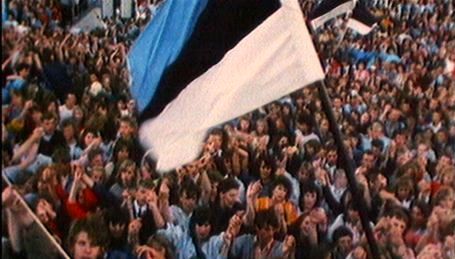
It was sensational – powerful, moving, uplifting, with an absolutely gripping storyline.  And the music is downright addictive.

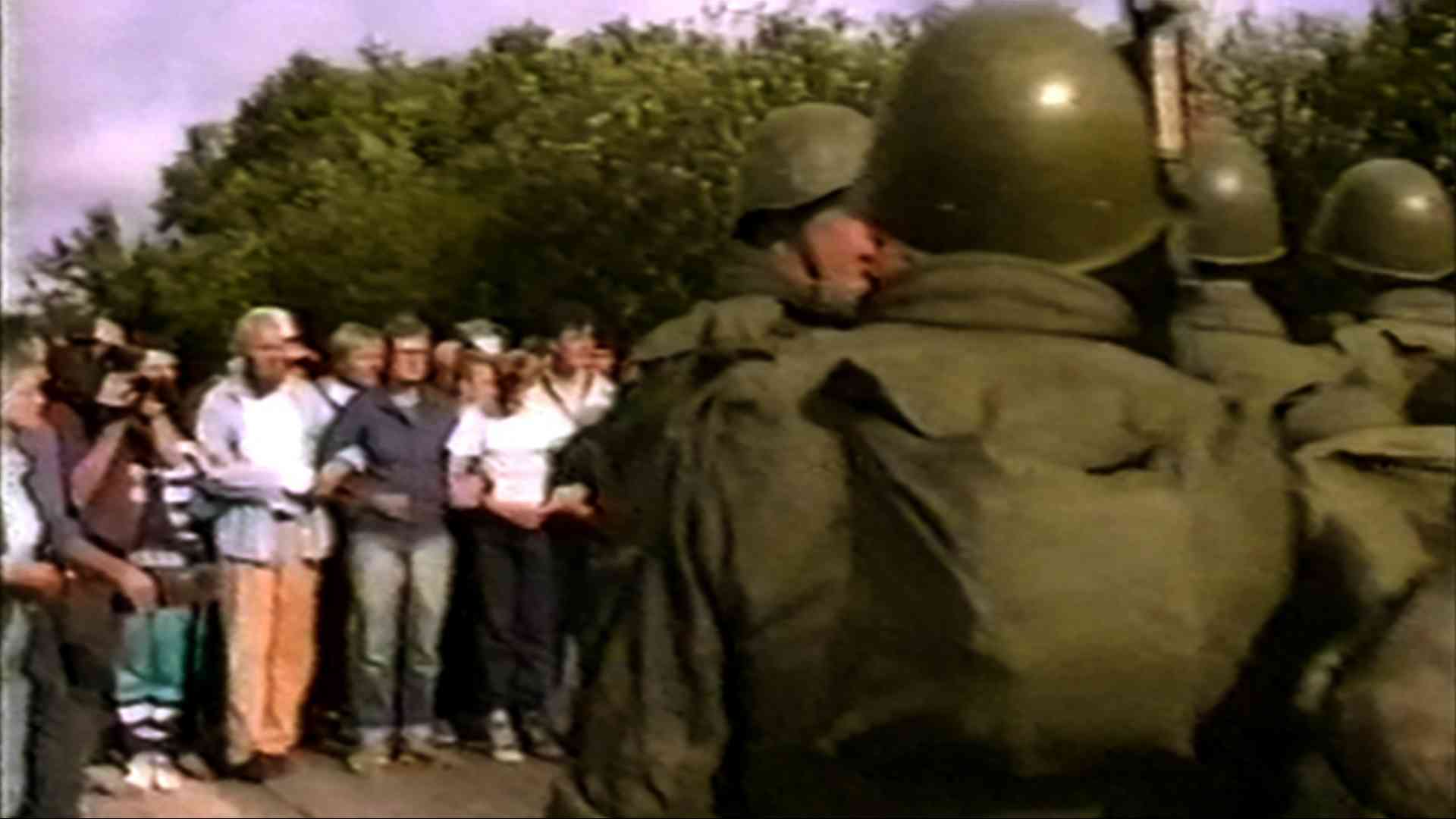
Estonia, a nation of about 1.3 million people, is one of mankind’s oldest residences, yet has lived under almost continuous occupation in modern times, with the Swedes, the Poles, the Danes, the Russians, and others taking turns.  In the 20th century, the Soviets, then the Nazis, and then the Soviets again, swallowed the small nation that had enjoyed a brief, interwar independence.

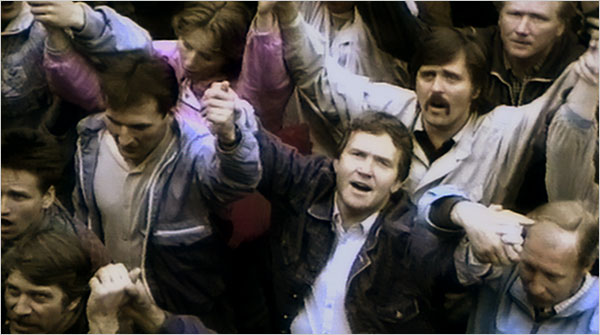
What did the Estonians have to resist such a brutal and murderous totalitarian power?  Their weapon of choice was song.  Estonians like to sing.  Obviously, not everyone is a singer, but training in choral music is pretty much nationwide, and everyone is at least exposed to it.  And after all, most people can sing, even if badly.  It’s better than baseball.

Even the New York Times was impressed:

Under the Soviets, especially, Estonian culture was brutishly suppressed, but it welled up every five years in July, when Estonians gathered in Tallinn for the Estonian song festival, which often drew upward of 25,000 people. The images of these festivals are moving already; the force of the singers and the precision of their conductors are stunning to behold.

But the emotion swells further when Estonians defy their occupiers by singing nationalist songs. This bold act reclaimed Estonian identity and set the stage for a series of increasingly daring rebellions under the Soviet President Mikhail S. Gorbachev, who advocated glasnost and got more than he bargained for.

“If 20,000 people start to sing the same song, then you cannot shut them up. It’s impossible,” said one participant in the uprising.  The New York Times again:  “Imagine the scene in Casablanca in which the French patrons sing “La Marseillaise” in defiance of the Germans, then multiply its power by a factor of thousands, and you’ve only begun to imagine the force of The Singing Revolution.”

The DVDs are available here (and if you recognize a familiar voice in the narration, it’s Linda Hunt).

Meanwhile, please do yourself a favor.  Watch this video. It will make you happy.  Promise.