
Memorial reading for Morton Marcus on Nov. 6: a literary “bright spot” on West Coast

Share

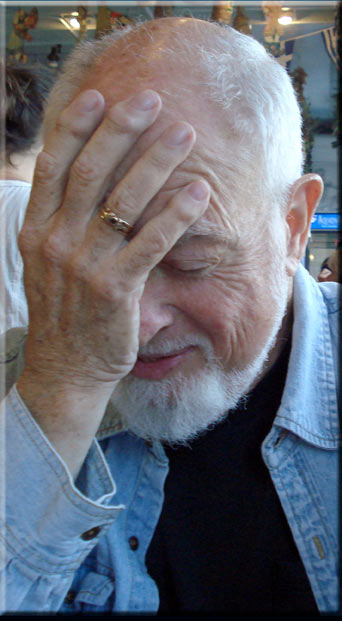
At Vasili's Greek Restaurant, 2009 (Photo: Valerie Marcus Ramshur)

“If you were going to make a literary map of America, there would be a bright spot on the map at Santa Cruz,” said Robert Hass, who will be the keynote speaker at the first annual memorial for poet Morton Marcus tomorrow night at 7.30 p.m., at the Cabrillo College Music Recital Hall, 6500 Soquel Drive in Aptos.  (Gary Young, Stephen Kessler, Joe Stroud will also read.  Tickets are gone — arrive at 6.30 for no-shows and returns.)

Perhaps Mort is a bright spot on the bright spot.

“He was larger than life,” said Santa Cruz poet Stroud, who knew Marcus for more than 40 years. “Mort loved nothing more than to have a meal and to have a conversation. I think of him as a conductor almost, eating and drinking and driving the conversation this way and that. It was an unforgettable experience.”

I met Morton Marcus via the world wide web — and our relationship, alas, remained an epistolary one.  Poet Jane Hirshfield brought my attention to his remarkable memoir of Czesław Miłosz in his autobiographical Striking Through The Masks, and I approached him about contributing to a book I had in the back of my mind.  (The book, An Invisible Rope: Portraits of Czesław Miłosz, will be out soon — really it will.)  He wrote a note back in September 2006, with some evocative thoughts about Prague:

I’m back now. It was my second trip. This time I was there to teach a poetry composition class in the Prague Summer Program. It really is an incredible city, but a far as I’m concerned not for the reason other people are so enchanted by it. The Renaissance and baroque buildings are masks that cover centuries of suffering which are marked by the extraordinary number of memorials that dot the city. If one looks, one sees a microcosm of all cities in Prague, and one experiences the timeless misery and joy of being alive. Then going to Prague becomes a pilgrimage to pay homage to all our ancestors.

I’m not a professor, by the way. I’ve taught classes at UC, but mainly I taught Literature and Film for thirty-two years down the road at Cabrillo College.

Thanks for your interest, and I hope we’ll meet one day.
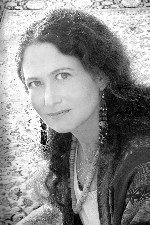
Jane Hirshfield

We didn’t.  But in a book that was filled with a not-always-harmonious assortment of contributors, he was one of the most easygoing of the bunch.   Good natured.  Not a prima donna.  It was appreciated.  As we were finishing up in June 2009,  he wrote to me the terrible news:  “I’m glad the book is coming out. When will that be? Since last year, my life has drastically changed: I’ve been diagnosed with terminal cancer. So before I go I have to get as many facts down on paper about new work coming out as quickly as I can.”

He sent me a brief bio for the book, and ended with the comment:  “I’m still standing.  Regards to all.”

I’m told he sank into pain, but never into less than good spirits.  I asked him about second opinions:  “It’s all through my bloodstream with growing tumors in my lungs and liver verified again and again. Second, third and fourth opinions, too. No problem; I’ve had a great life,” he wrote with daunting equanimity.  I offered at last to visit — but thought he might be less interested in meeting pen pals than gathering himself into himself.  I guessed right.  His last note to me said:  “Thanks so much for your thoughts, Cynthia, and the offer of a visit, but as you’ve guessed I’m more interested in solitude.”

Jane wrote to me to tell me he had died on October 28 last year.  His final words were, “I’m ready.”

Two poems from his last collection, The Dark Figure in the Doorway: Last Poems

ALL WE CAN DO

All we can do on this earth is step into the future
with a sense of the many people behind us,
the living and the dead, as if we carried our bodies
like amphorae filled with sunbeams into each new day,
continually reaching inside ourselves
to scatter golden butterflies over the land before us,
or to fling them against the night, not like tears, but like stars
that will guide those who follow across the darkness.

WHAT IS ALIVE IN US

What is alive in us, what vibrates
in our animal skins, is a harp string
that is never still, a harp string
tuned to the drone of silence.
It is the single thread, the radiant filament,
that sews us to our coat of darkness,
the umbilical that holds us
to the planet each of us is
yet allows us to wander among the stars —
the guy rope that secures us
to ourselves, yet lets us venture
into the darkness all the way
to the planet of someone else.

One can see why Miłosz liked him.
I’ve looked at clouds from both sides now

Share

Everyone is still talking about politics today, while I’m muddling along with page proofs and correspondence.  But let me join in the fun for a moment with a few “word clouds.”

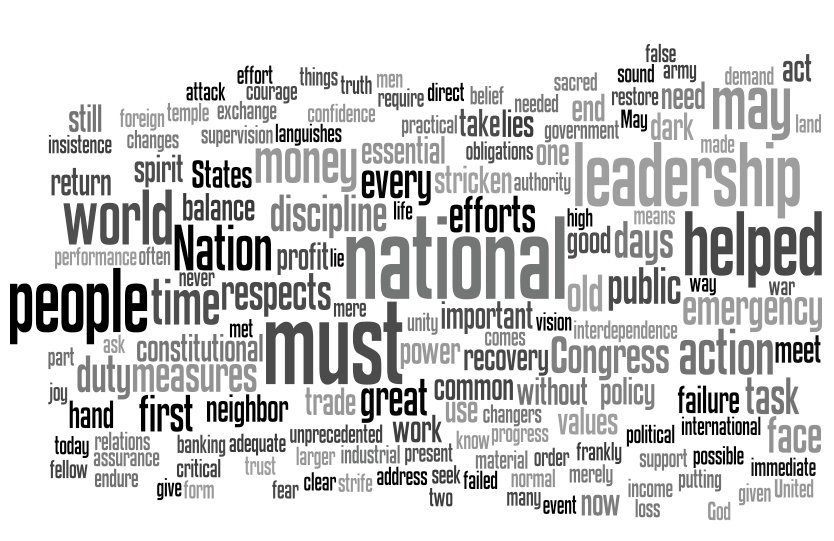
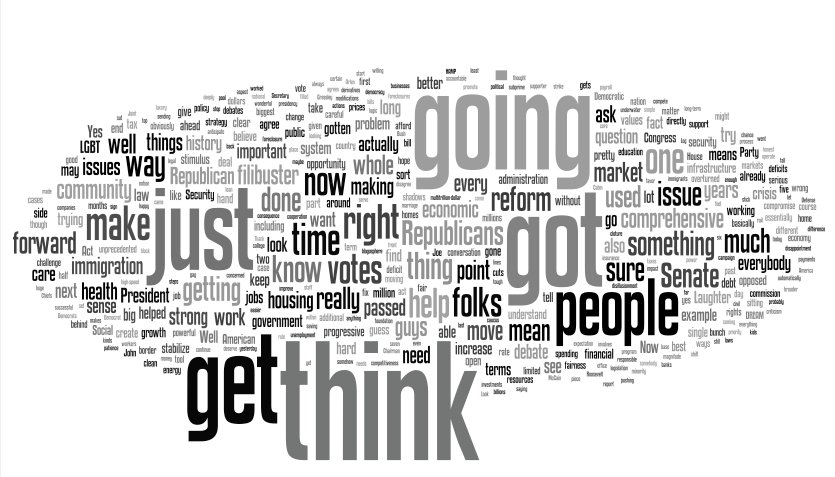
Perhaps I am the last person in the Western world to discover wordle and software-generated word clouds.  I’d seen them before, but wasn’t sure exactly what they are supposed to do or mean.  The folks over at Corrente compared Franklin D. Roosevelt‘s inaugural speech with Barack Obama‘s remarks on October 27 address to bloggers:

Here’s Obama:

And here’s FDR:

Interesting discussion about the two here — but really, it’s hard to be too shallow with this stuff.  One of the punters on the site thought the analysis was unjust — after all, why compare a conversation with bloggers to a formal inaugural address?  Point taken, however,  I thought his case would be more persuasive if the wordler hadn’t written “inaugeration.”  In any cases, the image is tiny — click on it for a larger version:

Wordle: Obama Inaugeration Speech

Thought I’d try my own hand at this.  I took no chances, and chose a post that would make me look smarter.  I used my Halloween text, which included excerpts from Nobel laureates J.M. Coetzee and Mario Vargas Llosa to spruce up my own humble words.  Click on the image to see a less lilliputian version:

Wordle: "Dostoevsky, Coetzee, Vargas Llosa, and Paul West on evil"

Now.  Back to silver linings.

It gets worse: More from Salman Rushdie

Share

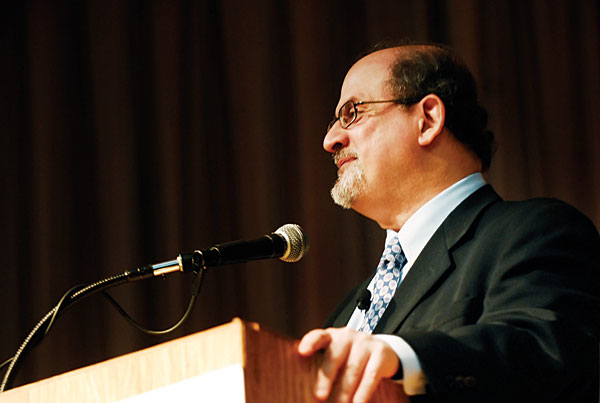
Understandably depressed (Photo: Mae Ryan)

I posted yesterday about the appearance of Yusuf Islam — formerly Cat Stevens — at Jon Stewart‘s weekend rally (read it here).  Nick Cohen at Standpoint posted about Salman Rushdie‘s surprise that Stewart “had given a starring role at his ‘Rally for Sanity’ to a crooner who had previously opined that Rushdie deserved to die for deciding of his own free will to abandon Islam and criticise its texts.”  Actually, I thought the 1989 fatwa was specifically for Satanic Verses, but be that as it may…

Rushdie messaged him with more today:

I spoke to Jon Stewart about Yusuf Islam’s appearance. He said he was sorry it upset me, but really, it was plain that he was fine with it. Depressing.

We’ve come to a strange point when we have to explain the need to defend fundamental freedoms, such as non-violent freedom of expression.  Free speech begins where you offend me.  Otherwise it means nothing.  And it doesn’t matter whether Rushdie is past his prime, whether you ever liked his books, or whether you find his attitudes repugnant (in many cases, I do, though I find him brilliantly provocative, as well.)  And no one “asked for it” when it comes to a fatwa.

So I continue to link arms with Susan Sontag, Joseph Brodsky, Andrei Voznesensky, and others.

It’s sad that this kind of point even has to be explained in our “whatever” times, when lives are at stake.

Postscript on 11/14: The Atlantic weighs in — more here.

Salman Rushdie speaks out: The troubling case of Cat Stevens (a.k.a. Yusuf Islam)

Share
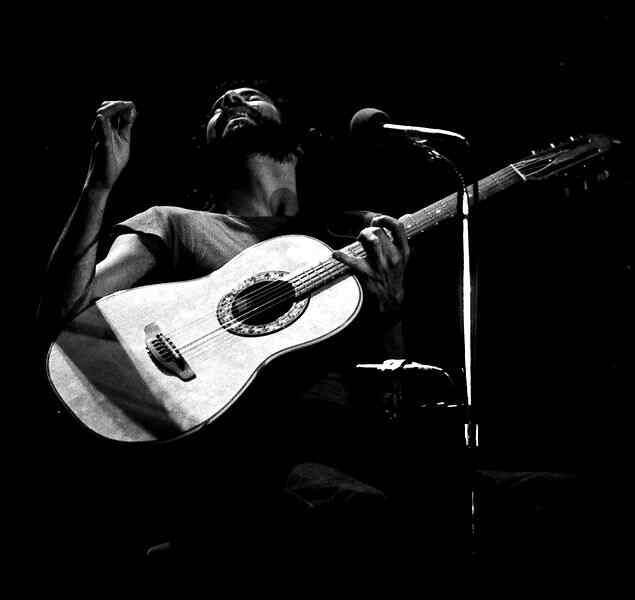
The Cat in ’76

[Film clip above deleted from Youtube for “copyright infringement.” Ummmm… how much “copyright infringement” can you have in 10 seconds?]

Salman Rushdie has spoken out against the appearance of Yusuf Islam (a.k.a. Cat Stevens) at a weekend rally: “I’ve always liked Stewart and Colbert but what on earth was Cat Yusuf Stevens Islam doing on that stage? If he’s a ‘good Muslim’ like Kareem Abdul-Jabbar then I’m the Great Pumpkin. Happy Halloween.”  You may recall that the popular singer supported the fatwa against Rushdie, way back when.

The case of Cat Stevens/Yusuf Islam is a troubling one.  He was one of my favorite singers in my misspent youth — one of those cases where I don’t want to believe the truth, either.  I applaud his charity work for UNICEF, Palestinian refugees, and the children in Gaza. But the data on basic human freedoms are pretty damning.

This from the Observer‘s Andrew Anthony: “He told me in 1997, eight years after saying on TV that Rushdie should be lynched, that he was in favour of stoning women to death for adultery. He also reconfirmed his position on Rushdie. He set up the Islamic school in Brent, which is currently undergoing council-backed expansion. Its mission statement three years ago explicitly stated that its aim was to bring about the submission of the individual, the community and the world at large to Islam. For this aim it now receives state funding. Its an incubator of the most bonkers religious extremism and segregation, and is particularly strong on the public erasure of women. Why do people go to such lengths to ignore these aspects of Yusuf Islam’s character and philosophy?”

A recap: While I don’t care for the hectoring tone of the BBC inquisition by Geoffrey Robertson, Queen’s Counsel, the 1989 grilling is here.  An excerpt:

Robertson: You don’t think that this man deserves to die?
Y. Islam: Who, Salman Rushdie?
Robertson: Yes.
Y. Islam: Yes, yes.
Robertson: And do you have a duty to be his executioner?
Y. Islam: Uh, no, not necessarily, unless we were in an Islamic state and I was ordered by a judge or by the authority to carry out such an act – perhaps, yes.
[Later, Robertson discusses a protest where an effigy of Rushdie is to be burned]
Robertson: Would you be part of that protest, Yusuf Islam, would you go to a demonstration where you knew that an effigy was going to be burned?
Y. Islam: I would have hoped that it’d be the real thing.

Troubling, also, is the disappearance of Rushdie’s youtube comments here and here and here, due to “copyright claims by Yusuf Islam.”  How much of a copyright infringement can you do in 10 seconds?  (Isn’t ten seconds of anything fair use?)

I’d like to believe that the singer’s objections to these youtube clips signals a reconsideration of views.  But a low-key objection (let alone legal threats) is not enough at this point; what is needed is a full repudiation.

In 2007, Rushdie wrote a letter to the Sunday Telegraph:

However much Cat Stevens/Yusuf Islam may wish to rewrite his past, he was neither misunderstood nor misquoted over his views on the Khomeini fatwa against The Satanic Verses (Seven, April 29). In an article in The New York Times on May 22, 1989, Craig R Whitney reported Stevens/Islam saying on a British television programme “that rather than go to a demonstration to burn an effigy of the author Salman Rushdie, ‘I would have hoped that it’d be the real thing’.”

He added that “if Mr Rushdie turned up at his doorstep looking for help, ‘I might ring somebody who might do more damage to him than he would like. I’d try to phone the Ayatollah Khomeini and tell him exactly where this man is’.”

In a subsequent interview with The New York Times, Mr Whitney added, Stevens/Islam, who had seen a preview of the programme, said that he “stood by his comments”.

Let’s have no more rubbish about how “green” and innocent this man was.

All in all, his Saturday appearance was a strange way to revel in sanity. His appearance in a rally to celebrate post-modern irony goes beyond irony — especially remembering the solidarity of Susan Sontag, Joseph Brodsky, Andrei Voznesensky, Tariq Ali, Adam Michnik, Harold Pinter, and many, many others in 1989.  Mr. Yusuf, I still love your music, but… I’ll stand by Rushdie, even though I don’t like him much.

Am I missing something in this picture?  Please let me know.

Cat Stevens/Yusuf Muslim sings “Peace Train.”  Rushdie remains in hiding.

Postscript on 11/2:  More dispiriting news from Rushdie posted above, here.

Postscript on 11/14: The Atlantic weighs in — more here.

Dostoevsky, Coetzee, Vargas Llosa, and Paul West on evil — just in time for Halloween!

Share

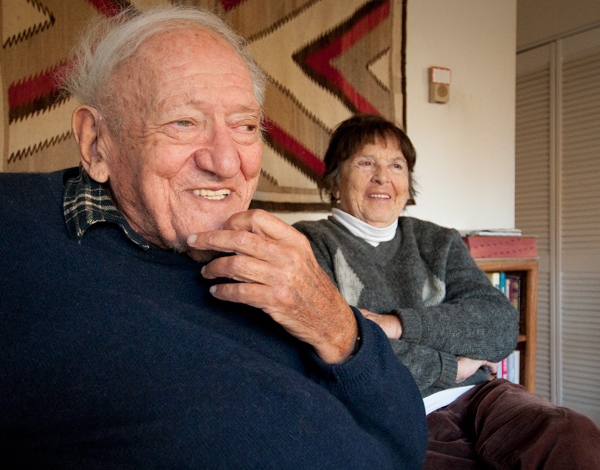
In their book-crammed flat (Photo: L.A. Cicero)

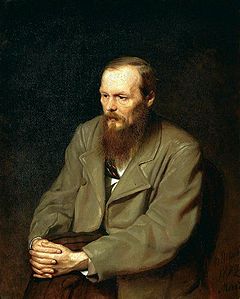
Still thinking about evil after my post a few days ago, in keeping with Halloween.  Where better to turn than a Dostoevsky scholar?

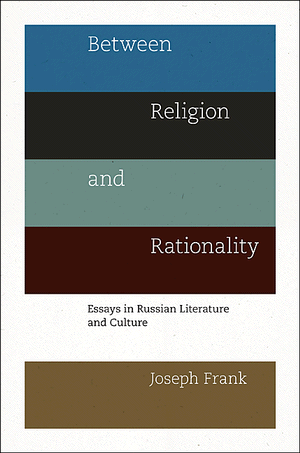
Joseph Frank sent me his book Between Religion and Rationality some time ago.  Morgan Meis over at The Owls would have found the cover sexy.  My tastes, alas, are a little more flashy and vulgar.  I found it too sedate.  Perhaps that’s why the book remained in a pile of books I meant to read.  But I picked it up at last for his chapter on “Dostoevsky and Evil.”

I was pleased to see Joe’s essay style is lucid and unaffected — and as digressive and roundabout as he can be in conversation.  So the effect is halfway between formal essay and a conversation in Joe and Marguerite’s book-crammed campus flat.

He opens with J.M. Coetzee‘s Elizabeth Costello, discussing the title character’s revulsion at Paul West’s The Very Rich Hours of Count von Stauffenberg, which describes degrading,  obscene details of the execution of Hitler’s would-be assassins.  But the details recounted are fictional.  No one was there to say what had actually happened.

Not sexy

“What troubles her above all is that, while appalled and repelled by the book, she had not been able to push it away entirely. It had resisted her feelings of revulsion and disgust, and she feared that some of the ‘absolute evil’ it depicted had, as it were, also infected her; ‘she felt, she could have sworn, the brush of Satan’s hot, leathery wing.”

(The protagonist also shares Coetzee’s passionate vegetarianism: “If Satan is not rampant in the abattoir, casting the shadow of its wings over the beast … where is he?”)

Mario Vargas Llosa, author of The Feast of the Goat, another book that portrays evil in graphic detail, has a different take.  (And here’s where Dostoevsky comes into play.)  Joe quotes the Peruvian author:

“Perhaps we would be able to read what Mr. West wrote and learn from it, and therefore come out stronger rather than weaker. … The manner in which a poem, a novel, a play works on the sensibility or on a character varies to infinity, and much more as a result of the reader than rather than of the work.  To read Dostoevsky may, in some cases, lead to traumatic and criminal consequences, while on the other hand it is not impossible that the spermatic iniquities of the Marquis de Sade have increased the percentage of virtuous readers, vaccinating them against carnal vice.”

Sorry.  I’m with fellow vegetarians Coetzee and Elizabeth Costello on this one. I know what it is like to feel polluted even by a brilliantly written book (perhaps more so then).  But the good Prof. Frank has a different p.o.v. altogether:  “The details chosen to evoke the scene are his [West’s] own creation, and her [Costello’s] horrified response cannot simply be fobbed off as a private reader reaction.”  Recalling Dostoevsky’s murders in Crime and Punishment, he writes:

Pity, terror, and dinner soon

“One would be hard put to match such grisly details in either the European or the Russian novel of the same period, but their effect is ultimately offset by the intensity of Raskolnikov’s inner suffering and his final inability to endure his total estrangement from the rest of humanity.  …  One can find example after example in Dostoevsky’s works of the same boldness in depicting evil at work and the same effort to overcome its effects.”

He returns to Costello, Coetzee, and Paul West:

“… as author he [West] is responsible for the manner in which he depicts this episode; and there is no evidence here of pity, only terror and even horror.  It is such horror that leads Costello to level against him the charge of ‘obscenity,’ and to arrive at her extreme conclusion. ‘To save our humanity, certain things that we may want to see (may want to see because we are human!) must for ever remain off-stage.  Paul West … has shown what ought not to be shown.'”

Costello longs to argue with West, “some confrontation leading to some final word” — however, concludes Frank, “one cannot help thinking that the person Costello really wishes to meet, rather than Paul West, is an incarnation of Dostoevsky.”

And perhaps Charles Dickens, as well.  And Victor Hugo.  Maybe Lev Tolstoy, too. May I come to that dinner?  Soon?

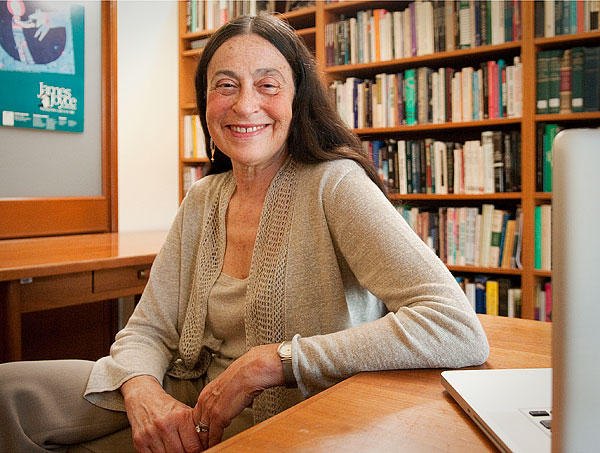
Why is this woman smiling? Carol Shloss, a year after the James Joyce lawsuit

Share

Why is this woman smiling? Click last year’s video to find out.

There is indeed life after lawsuit – although you may not believe it while the ordeal staggers on,  sucking the life out of everything around you.  Carol Shloss successfully slayed the notorious James Joyce Estate dragon last year.  So I had dinner with her last week to learn her latest ventures in her post-lawsuit life, and they are legion.

At the California Café, over gnocchi (for me), crab (for her), and a nice Ravenswood Zinfadel for both of us,  she told me she is negotiating a contract to edit The Collected Unpublished Letters of James Joyce for Oxford University Press. Asking for trouble?  Not likely.  The Joyce oeuvre at last lurches into public domain next year.

Carol is also busily working on Treason’s Child: Mary de Rachewiltz and the Real Estate of Ezra Pound The book will be the second volume of a projected trilogy.  (The first was the disputed 2003 Lucia Joyce: To Dance in the Wake about James Joyce’s daughter; the third will consider Anna Freud.)

Still smiling ... (Photo: L.A. Cicero)

That’s not all.  She’s also heading “The Stanford Finnegans Wake Visualization Project,” which involves computer graphing of 62 languages in the Wake.  She laid the groundwork for the project with a Modern Language Association presentation two years ago, and also spoke on “Geological Computer Tools in the Mapping of Joyce’s Texts” in Tours, France, about the same time.  With the project, she’s treating the layers of language in the book as if they were layers of the earth and its atmosphere.  I don’t quite understand  it … maybe it was the wine…

Meanwhile, at the Addison, Maine, cottage where she spent the summer and early fall, she also launched a project to teach some of the local disadvantaged kids via graphic novels.  We outline a little about how that works here. “In the university, graphic novels are trendy,” she said.  “In rural Maine, they help to overcome resistance to literacy for kids who can’t or don’t like to read.”

Worthwhile ventures, wonderful dinner. Life is good.  Especially over Zinfandel.