“Spoiled Avocado Professor” and the “six-foot tall first-generation Turkish woman”

Share

More reviews of Terry Castle’s The Professor and Other Writings and Elif Batuman’s The Possessed: Adventures with Russian Books and the People Who Read Them — in New York magazine here, and The New York Times here.

UPDATE:  Reviews of The Professor pouring from the MSM in a Vesuvial flow:

  • At the New Republic here.
  • At Canada’s National Post here.
  • And the Huffington Post picked up the San Francisco Chronicle review here.
  • And there’s a podcast from a Santa Cruz radio interview here.

(New Republic review off the “wow” meter: “The Professor goes places no book ever written about professors has ever gone. And it understands more about the academic vocation, and the art of self-examination, than the shelf of grave and socially responsible studies of and by professors that have appeared in recent years. It is a superb weapon for tearing up that soul-destroying cardboard figure of fun its title names.”)

Meanwhile, Elif Batuman is guest-posting at the New Yorker here.

UPDATE:

And … and … and … Batuman’s book is reviewed in the San Francisco Chronicle here:  ” … Batuman’s collection of ‘many unclear purposes’ is comic and baggy and wayward…”

ANOTHER UPDATE:

And here in the Christian Science Monitor:  “Part sleuth, part pundit, Batuman both plays the game of literary exegesis and skewers it”:

When a colleague maintains that Babel’s “Red Cavalry” cycle would never be totally accessible to her because of its “specifically Jewish alienation,” Batuman responds, “Right…. As a six-foot-tall first-generation Turkish woman growing up in New Jersey, I cannot possibly know as much about alienation as you, a short American Jew.” It goes right over his head.

Literary gerrymandering

Share
edelstein(2)

Edelstein (Credit: L.A. Cicero)

Interesting discussion at Inside Higher Ed about “Gerrymandering the Canon” here. Dan Edelstein decries a recent comment in a New York Review of Books article by Harold Bloom:

“’In the two centuries since Byron died in Greece […] only Shakespeare has been translated and read more, first on the Continent and then worldwide.’ Bloom does not cite any statistics, and one cannot help but wonder: Really? More than Homer and Dante, or, among the moderns, more than Sartre and Thomas Mann? Of course, what Bloom really means is that Byron was translated and read more than any other English writer, and he may well be correct on that count. Yet this omission is telling, as it highlights an unfortunate tendency (recently diagnosed by David Damrosch) among certain English professors to equate literature in general with literature written in English.  …  this pattern also raises a larger academic question: Why do we still partition the literary canon according to nationalist traditions? Is this really the most intellectually satisfying and authentic approach to literary studies?”

The letters are piling up for the piece — one raises the obvious rejoinder that translated works have been considered as the second-class baggage of lit courses, with too much lost in translation to make the effort worthwhile.  And of course foreign language departments often refuse to teach works of world literature other than in the target language — in other words, you have to learn Japanese to get Tale of Genji.

Cheer up.  It could get worse.  Robertson Davies satirized “Amcan” literature programs across his native Canada. The literary Balkanization has not gotten as bad as that.  At least not yet.

(By the by, I’ve written about Edelstein’s “Mapping the Republic of Letters” project here.)

Never knew literary conferences could be so lively…

Share
babel

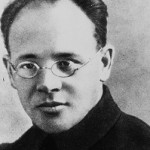
Isaac Babel

Literary conferences are mostly staid affairs, opportunities for academics to exhibit themselves.  But not always.

I discussed Elif Batuman’s book a few days ago here.  Her new book, The Possessed: Adventures With Russian Books and the People Who Read Them, was reviewed yesterday in the Los Angeles Times here.  Clearly, I should have made an effort to attend The Enigma of Isaac Babel: International Conference, held almost exactly six years ago.  A few highlights from that memorable event:

“Babel in California” tells how Batuman fell in love with Isaac Babel, the most electric of Russian writers, then shows that idealized literary love bumping up against actual life in the hilarious, chastening shape of a Babel conference at Stanford organized by her mentor, the great Babelogist Grisha Freidin. Batuman helps with an exhibit and discovers in the bowels of Stanford’s Hoover library a true wonderland of previously hidden connections between Babel and the 1933 movie “King Kong.” She’s sent to the airport to pick up Babel’s second wife and one of his daughters, two tired Russian women who keep firing questions about the McDonald’s Happy Meal toy, a tiny stuffed Eeyore wearing a tiger suit, hanging from the mirror of the car that Batuman is driving.

Conference panels end in pandemonium; Russian scholars, upset by the presence of two Chinese filmmakers preparing a script from Babel elif2stories, mutter “We don’t mess with your ‘I-Ching’ “; and there’s a dinner “straight out of Dostoyevsky” in which Batuman and Freidin get the evil eye from a vain English translator in whose acclaimed Babel collection edition they have discovered mistakes. Yet even this isn’t the marvelous climax of the dinner, which comes when Babel’s daughter by his first wife stares at Babel’s second wife and shouts “THAT OLD WITCH WILL BURY US ALL.”

The writer, Richard Rayner, describes Babel as “the most electric of Russian writers.”  Not sure it’s the adjective I would have chosen (more electric than, say, Tsvetaeva?)  I wrote about Grisha Freidin’s work on the doomed Soviet writer today here.  See what you think.

The upshot:  Rayner praise’s Batuman’s “dazzling flair and originality”:  “If Susan Sontag had coupled with Buster Keaton, their prodigiously gifted love child might have written this book.”

When writers are sued, who pays? (cont.)

Share

Some of you may recall my post about Carol Loeb Shloss, author of Lucia Joyce: To Dance in the Wakehere.

Shloss was triumphant in her David-and-Goliath case against the James Joyce estate, which I wrote about here.  The battle-scarred, but victorious scholar wrote an article in the Chronicle of Higher Education that, in part, argued that universities might consider footing the tab when their scholars face fair-use  lawsuits for their scholarship.

In two letters, academia responds.  The lawyers at the University of North Florida argued that university undertake legal defense when they have a stake in the output — for example, when they own patents.  Hence, the question is one of ownership.  Similarly, Pennsylvania State University Press argues that scholars might reconsider whether they want to risk having their output classified as “works made for hire” by the university. Sandy Thatcher, of the press, also had a lively role in the comment section of the Chronicle of Higher Ed article.

In any case, the Florida law folks agree that the situation is “lamentable” for scholars who face litigious literary behemoths.  So we’ll probably be hearing about the issue for some time to come.

Don’t “murder your darlings”

Share

elifElif Batuman describes her circuitous literary career path in “Confessions of an Accidental Literary Scholar,” here, in the Chronicle of Higher Education.

Her comments on the state of the American short story:

I realized that I would greatly prefer to think of literature as a profession, an art, a science, or pretty much anything else, rather than a craft. What did craft ever try to say about the world, the human condition, or the search for meaning? All it had were its negative dictates: “Show, don’t tell”; “Murder your darlings”; “Omit needless words.” As if writing were a matter of overcoming bad habits—of omitting needless words.

I thought it was the dictate of craft that had pared many of the Best American stories to a nearly unreadable core of brisk verbs and vivid nouns—like entries in a contest to identify as many concrete entities as possible, in the fewest possible words. The first sentences were crammed with so many specificities, exceptions, subverted expectations, and minor collisions that one half expected to learn they were acrostics, or had been written without using the letter e. They all began in medias res. Often, they answered the “five W’s and one H.”

This month’s article in Stanford Magazine describes how the editor of the prestigious magazine n+1 asked her to write after reading her piece in the Harvard Advocate. When “Babel in California,” about a conference at Stanford, appeared in 2005, it caught the attention of Slavophile David Remnick, editor of the New Yorker, who commissioned her to write a piece on Thai kickboxing.

elif2Describing her turn to the ivory tower, she writes: “I stopped believing that ‘theory’ had the power to ruin literature for anyone, or that it was possible to compromise something you loved by studying it. Was love really such a tenuous thing? Wasn’t the point of love that it made you want to learn more, to immerse yourself, to become possessed?”

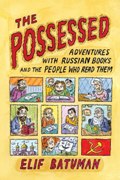
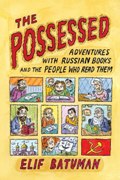
Not surprisingly then, her new book is called The Possessed: Adventures With Russian Books and the People Who Read Them, published by Farrar, Straus & Giroux this month.

She’ll be giving a reading at 7.30 p.m. on Thursday, March 11, at Kepler’s.  You can read a bit from her new book — “The Old Uzbeks Had a Word for It” — at the bottom of the page here.

Reading at Kepler’s: Forever seeking Susan Sontag

Share

SMallPosterThere’s no escaping Susan Sontag.

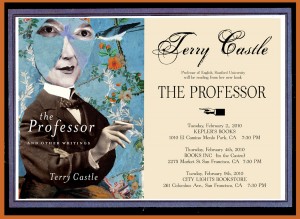
Terry Castle, author of The Professor and Other Writings (she was also introduced as a “miniature dachshund enthusiast”), gave a reading of her new book at Kepler’s on Tuesday night.  Or rather, she gave a reading of her book’s deathless essay, “Desperately Seeking Susan.” (The London Review of Books carries the 2005 Sontag anti-memoir here.  By the by, Slate has an excellent Q&A interview with Terry online here.)

We are all desperately seeking Susan.  “All of the reviews of this book keep going back to it,” Terry admitted.  The vivacious former “towel girl” for Susan may never live it down:  She had been invited to Sontag’s memorial service, “and disinvited the day after this piece came out.” She received a nasty email from Sontag’s son, David Rieff.

Why did she write it?  “The obituaries had not, and did not, capture whole facets of her personality,”  Terry said diplomatically.  The reading, attended by about 50, was punctuated by knowing laughs from the audience.  Even the question-and-answer period, following the reading, was stuck on Sontag.

Perhaps it was the locale – Kepler’s — that inspired this week’s reminiscences.  Castle said she first encountered Sontag in 1995 at this very bookshop.  Sontag’s eye fell on book by Temple Grandin,  a high-functioning autistic author who advocated more humane treatment for animals, and whose book, Thinking in Pictures, was all the rage at the time.  “Somebody’s got to take that woman on,”  Terry recalled Susan saying, aggressively.  It was as if Sontag had threatened to take on Mother Teresa, Terry added (“I myself am not a vegetarian…” said Sontag, while going on to tout vegetarian ethics.)

We could never quite be Sontag, though a generation of women mesmerized by her tried and tried and tried.  And perhaps the relief Castle’s short anti-memoir provokes is the realization that, well, Sontag couldn’t quite be Sontag, either.  But the knowing laughter had a bit of unpleasant smugness below the surface.  Was it Sontag’s fault we felt short?   After all, she didn’t ask for the idolatry  … did she?

Castle’s essay inspired more than ire – it inspired international catharsis.  Castle received grateful comminiqués from “people all over the world who had been “insulted, dissed” and had been on the receiving end of “unbelievable” rudeness.

“Desperately Seeking Susan” mentions a beautiful, fawn-like assistant named Oliver – but he was only one in a series.  Another one sent Terry a “stream of consciousness email” that almost jammed Castle’s electronic inbox because of its size.  She learned that Sontag’s former assistants even “had a support group to deal with their emotions.”

One told Terry he had watched Sontag open the envelope with her million-dollar advance for The Volcano Lover.  “It was the first time she had real money,” said Castle. “She collapsed on the floor saying, ‘I don’t deserve this, I don’t deserve this…’”

After “sobbing violently for a minute or so,” the assistant “heard and saw her say, ‘Yes, I do,’ ‘Yes, I do,’ ‘Yes, I do,’ picking herself up off the floor.”

As the Kepler’s kaffeeklatsch broke up, I cornered poet Ken Fields (he, too, had been laughing).  Did he think the merriment had, perhaps, a bit of a bitter  edge?

Instead of answering directly, Ken launched into a story about a young Stanford-based journalist who had been assigned to interview Sontag.  At one point in the interview, she asked him to turn off the tape recorder.  Off the record, she suggested he ask her if she thought The Volcano Lover, the novel that had become her obsession, was a feminist novel.

The journalist played along and asked the question.  And got a Sontag outburst as a reward. “That is the stupidest question ever heard!  Of course not!” she exploded, and launched into a tirade.

The interview nevertheless continued.  Again she asked him to stop the recorder.  She suggested he ask a second question.  It was another set-up, with a Sontagian outburst.  It happened a third time to the (by then) hapless, hopelessly browbeaten interviewer.

Ken Fields finished by recounting when Edmund White was a visiting lecturer at Stanford.  During refreshments after a colloquium, Sontag’s name came up in a discussion among White, Fields, and Castle.  Castle described herself as a former friend of Susan.

The visiting author corrected her at once:  “We are all former friends of Susan Sontag.”  Perhaps another support group is needed?

Terry will give another reading tonight, at 7:30 p.m., at Books Inc. in the Castro, and another, at 7:30 p.m. on Tuesday, Feb. 9, at City Lights. Just don’t ask about Susan.