
Joseph Brodsky: “If we have all this here, why do we need Europe?”

Share
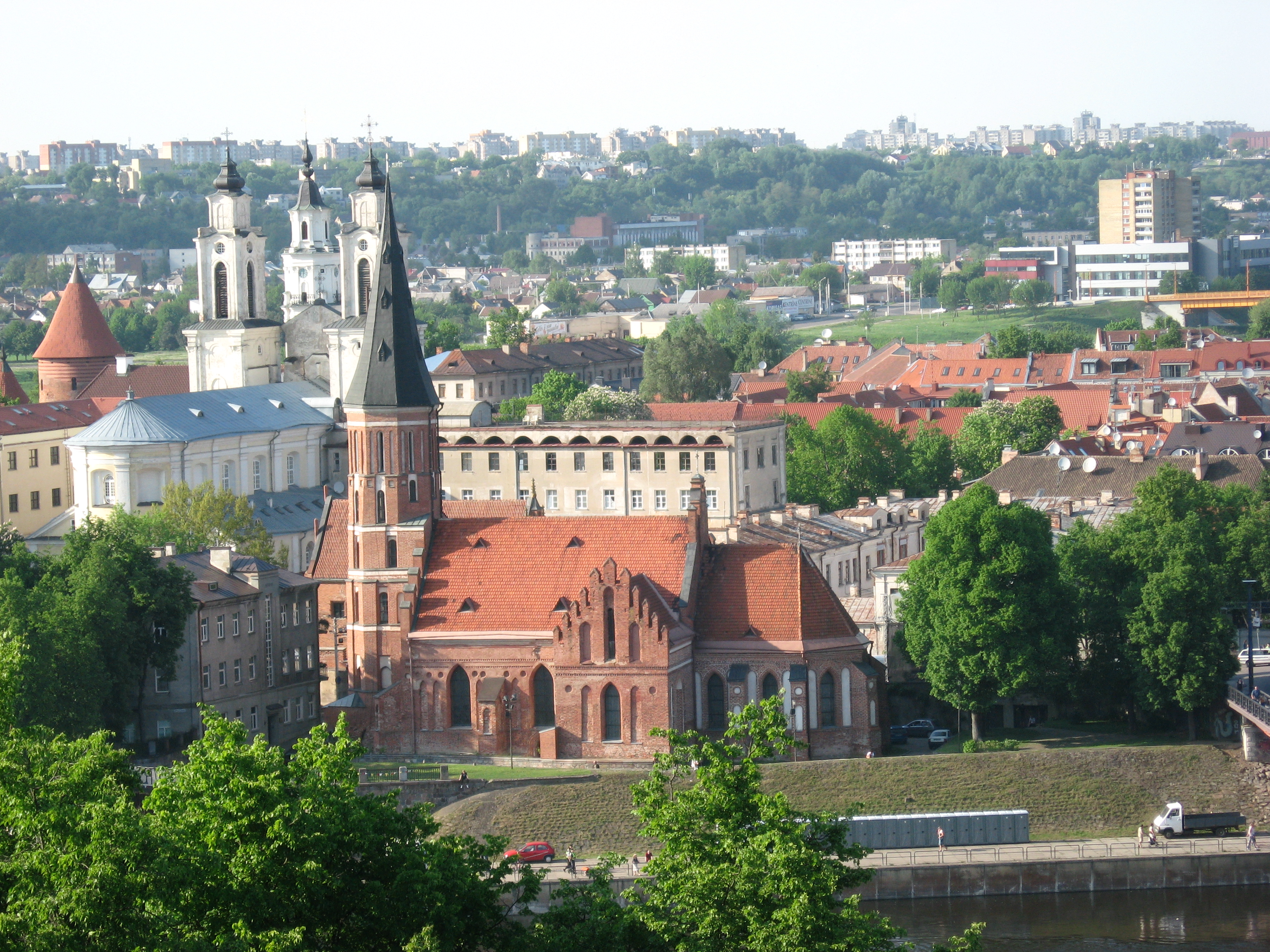
The city where Adam Mickiewicz taught secondary school. (Photo: C. Haven)

“If we have all this here, why do we need Europe?”  That’s what Joseph Brodsky reportedly said in 1966 when he surveyed not Rome, not Athens, but humble Kaunas, Lithuania’s second largest city.

The words come from Ramūnas Katilius, fils, quoting his father, Ramūnas Katilius, père, from this vantage point overlooking the city.  The elder Romas, a physicist, was one of the poet’s greatest chums, sometimes seeing the poet several times a day when they were in Leningrad.  Romas was in the photos of Joseph Brodsky departure from the Soviet Union forever in 1972.

Both Romas and Algirdas Avižienis, professor emeritus at director of the Czesław Miłosz Birthplace Foundation, hosted my visit to Miłosz’s Issa Valley.  I’ve just returned to Poland.

While much of my discussion with Romas was about his friend, Tomas Venclova, the physicist was interested when I told him that I had been a student of Joseph’s (he called me part of “the family”) – and hence our discussion returned to his memories of Leningrad, and J.B.’s time in Lithuania. There’s even a plaque in downtown Vilnius where the Russian Nobel poet stayed.

Admittedly, the quote I have cited above is secondhand, but it’s suggestive of how much the poet liked Lithuania. You could guess that, perhaps, from his poem “Lithuanian Divertissement.”
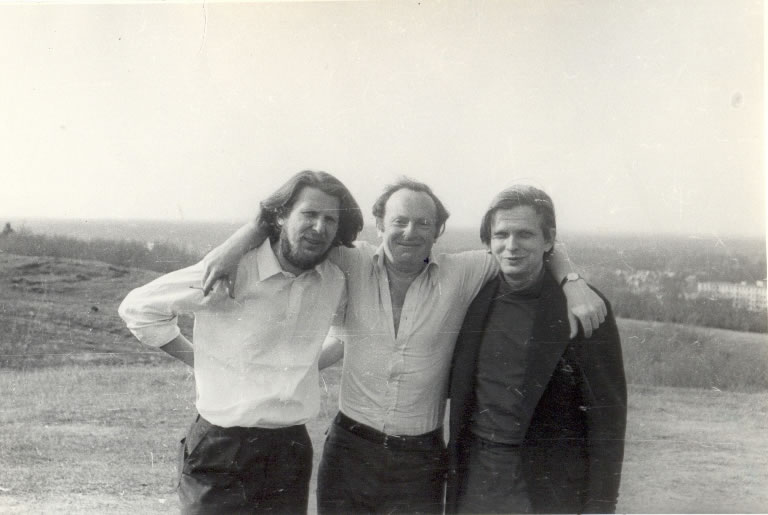
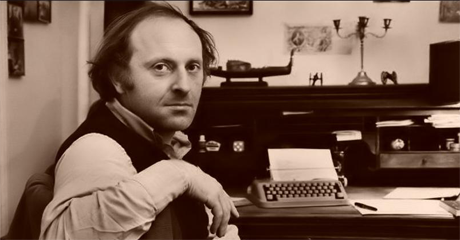
Ramūnas Katilius, Joseph Brodsky, Tomas Venclova in 1972 (Photo by Marija Etkind from the archive of Ramūnas Katilius and Elė Katilienė)

This remote and stunning little city was the temporary capital of Lithuania, when the Polish army occupied Vilnius in 1920.  The Nazis occupied it during the war, of course, and it was a Soviet Socialist Republic at the time Joseph Brodsky visited.

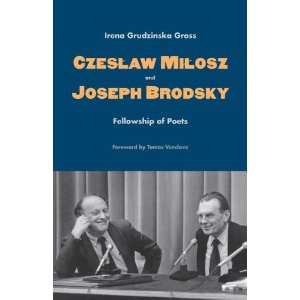
It’s also very early evidence, before he had seen Venice, Paris, or New York, of his early partiality of the cozy places on the outskirts of empire.  He was later to defend Russia’s historic hegemony in an acrimonious exchange with Miłosz, Derek Walcott and Susan Sontag, as described in Irena Grudzińska Gross‘s Czesław Miłosz and Joseph Brodsky: Fellowship of Poets.

I’m in Poland right now, and obviously don’t have access to Irena’s book or anything else in my library, but a Keith Gessen’s piece in today’s New Yorker (with a dynamite photo by Irving Penn) makes the same point:

Poetry was immortal, he argued: “That which is being created today in Russian or English, for example, secures the existence of these languages over the course of the next millennium.” But this wasn’t true, as Brodsky eventually acknowledged in a great and furious late poem, “On Ukrainian Independence,” in which he berated the independence-minded Ukrainians for casting aside the Russian tongue. “So go with God, you swift cossacks, you hetmans, you prison guards,” it says, and concludes:


Just remember, when it’s time for you, too, to die, you bravehearts,
as you scratch at your mattress and visibly suffer, you’ll forget
the flatus of Taras, and whisper the verses of Alexander.

Alexander Pushkin, that is. Despite itself, the poem is an anguished admission that a Russian state and Russian-speaking subjects are still vital to the project of Russian poetry.

Now.  Here’s an interesting bit about the photo above.  See the white double spires?  That’s the Jesuit church.  Now take a look at the rather nondescript yellowish building in front of it.  That’s where Adam Mickiewicz, the Polish language’s ur-poet (and, like Czesław Miłosz, he was born in Lithuania) taught at secondary school to pay off his university tuition  at the Jesuit’s Vilnius University.

Note to self:  Must read Mickiewicz when I get back to California.  Anyone know the best translations?
Rescued from behind a paywall: “No Other Place, No Other Time”

Share
"Hurry sickness."

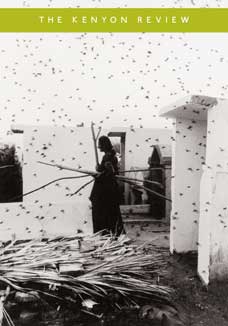
My Kenyon Review piece, “No Other Place, No Other Time” in the spring issue of the Kenyon Review, was selected as  feature-of-the-day in Poetry Daily — it’s here.  And now you can read it for free.

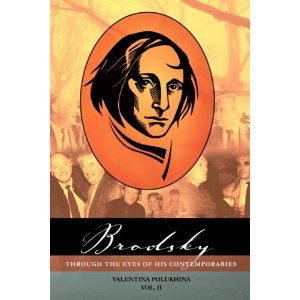
In it, I review two books: Irena Grudzińska Gross’s Czesław Miłosz and Joseph Brodsky: Fellowship of Poets (Yale University Press) and Brodsky Through the Eyes of His Contemporaries, vol. 2, edited by Valentina Polukhina (Academic Studies Press).  I wrote about the piece a few weeks ago here.

“No Other Place, No Other Time” — I discuss Miłosz, Brodsky in the Kenyon Review

Share

In the spring issue of the illustrious Kenyon Review, I review two books: Irena Grudzińska Gross‘s Czesław Miłosz and Joseph Brodsky: Fellowship of Poets (Yale University Press) and Brodsky Through the Eyes of His Contemporaries, vol. 2, edited by Valentina Polukhina (Academic Studies Press).

That’s the good news.  The bad is that you are only allowed to read the first page online.  It’s here.

So here’s a little more from the piece, for free:  Joseph Brodsky‘s reading style has been much remarked upon, and I open my article with Brodsky’s first engagement outside Russia, at London’s 1972 Poetry International Festival, in the first few dizzying weeks of his exile: “the poet poured out his poems in the hypnotic incantation that was to become his trademark: an archaic sound — a lament from a lost civilization, an ancient prayer, or simply a metronomic wail.”

Daniel Weissbort remembers Brodsky reading this way:

“ . . . his hands straining the pockets of his jacket, his jaw jutting, as though his attention had just been caught by something and he were staring at it, scrutinizing it, while continuing to mouth the poem, almost absent-mindedly, that is, while the poem continues to be mouthed by him. His voice rises symphonically: ‘syn ili Bog’ [‘son or God’], already on the turn towards an abrupt descent; and then the pause and a resonant drop, a full octave: ‘Ya tvoi’ [‘I am thine’]. As the poet, with an almost embarrassed or reluctant nod, and a quick, pained smile, departs his poem”.

I continue:

Gross recounts that Brodsky was asked about his declamatory bent during his triumphant tour of Poland, and landed this punch: “Today’s poet is afraid of the sardonic laughter of his reader, and because of it he tries to soften his poems . . . This is a mistake. The poet should charge his public like a tank, so that the reader has no escape. Poetry is an act of metaphysical and linguistic attack, not of a retreat. If a poet wants to be modest and nonaggressive, he should stop writing.”

Not Miłosz’s style, to put it mildly, and so he gently chastised the younger poet. Miłosz also lamented Brodsky’s poetry in English: “The resistance against writing poetry in other languages should be considered a virtue. . . . We are born in a concrete point of the Earth and we have to remain faithful to this point, restrained in our following of foreign fashions.”

This was more than a case of brass meeting polish. Miłosz saw history as a horror he wished to escape, but in a larger sense, he was also at home in the wider story of centuries. He was a son of the Polish-speaking landed gentry in Lithuania and had a law degree from Stefan Batory University. The urbane elder poet had the educational context lacking in Brodsky, the defiant autodidact who dropped out of school as a teenager. When cornered on an error or a prejudice, Brodsky covered himself by firing off a belligerent blast; Miłosz could put his views into a historical framework, whether by referring to pronouncements of the medieval popes or the legal system of the Res publica. History, language, tradition connected with Catholicism because, writes Gross, “Without God there is no history.” But where Miłosz turned to tradition and his Catholicism, Brodsky was in a tailspin and could not find peace.

From Irena’s book, I recount this devastating story:

Few have written about solitude and time with Brodsky’s urgency, before he was finally felled, at fifty-five, by the heart ailments that had dogged him for decades. “Miłosz was very busy, yet he sounded like a person who was not pressed for time. Brodsky ran against time,” writes Gross. “In that fight he was not supported by religion or by history — national or private.” Time was truly his enemy.

Gross recounts this riveting anecdote: “In 1994, when he was forced to visit a cardiologist during his stay in Sweden, he told him that he felt like a wounded animal who simply tried to survive. He expected to die at any time; when leaving his hotel room, he would put his papers in order. ‘Hurry sickness’ was the diagnosis of the psychologist who interviewed him on that occasion”.

The Kenyon Review can be ordered online here.


Walcott to Europe: “What is the meaning of your empires?”

Share

Rush Rehm‘s kind comment on yesterday’s post, “From Troy to the Caribbean: Homer onstage,” returned me to another passage from Irena Grudzińska Gross‘s Czesław Miłosz and Joseph Brodsky: Fellowship of Poets.  The passage occurs after an acrimonious confronation between Miłosz, Brodsky, and Susan Sontag on the nature of empire.  Walcott “rejects linear thinking, the straight line linking today to the past. Because the straight line, in the words of Peter Viereck, ‘is the longest distance between two points. And the bloodiest.'”  She continues:

Walcott "rejects linear thinking"

“During the conference in which Miłosz debated Brodsky on the matter of Central Europe, Walcott also spoke.  He had been hesitating, he began, before speaking: ‘I’ve a very great difficulty here between friendship and ideology. And I think that’s a penalty of ideology.’ This conflict causes in him ‘flashes of rage and an alternation between that and nausea. … The imperial voices dominates this conference and its range increases with every representation by European tribe, by European nation. This is not merely a historical posture of ancestry and tradition which goes under the general name of “civilization.” I am talking about tone … about a linear concept of progress and experiment in literature which I find no different from the presumptions of the priest and the conquistador. You writers of Europe continue that tone, that responsibility of carrying the banner and the cross or the book.  I have found no breadth, no expanse of imagination and, even at the risk of sounding corny, no evangelical vision.  What is the meaning of your empires? To hear all this from contemporary writers is only to deepen my conviction that for all its wars, its museums, its literatures, its revolutions, the provinciality of Europe and of Russia increases. Writers are not inheritors of history.'”