

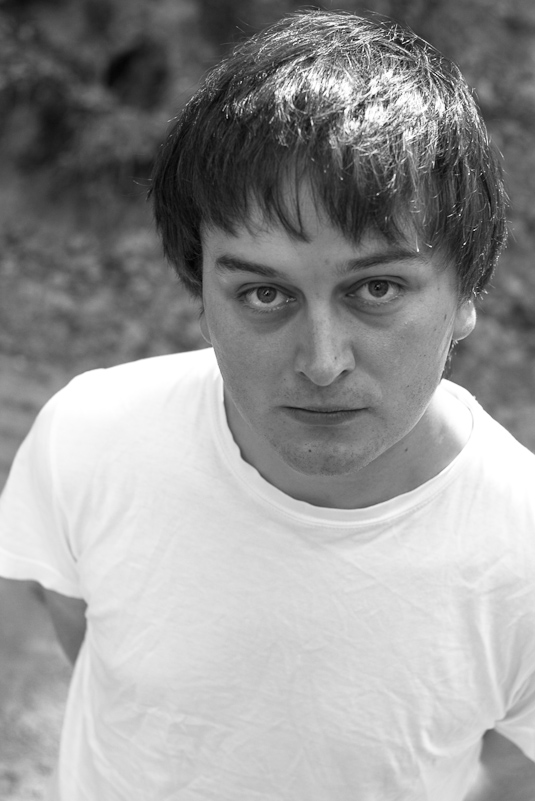
Grzegorz Kwiatkowski is fast becoming one of the most vital poetic voices from today’s Poland, with six volumes of acclaimed poetry and translated editions on the way. He is also celebrated as a musician: his internationally known post-rock band Trupa Trupa has been featured on NPR, The Guardian, Rolling Stone, and elsewhere. At noon, on Friday, October 8, I’ll be having a zoom conversation with him, sponsored by CREEES (the Center for Russian, East European & Eurasian Studies). The link to register is at the bottom of this page.
Kwiatkowski’s minimalist poems explore not only conflicted pasts of Eastern Europe – for example, the Nazi “Aktion T4” euthanasia program – but also the paradoxes of contemporary genocides. As he said, “I’m intrigued by the combination of ethics and aesthetics in one person, one life, one story.” His poems have been perceived as quasi-testimonies, provocative and lyrical utterances delivered by the dead.
“My grandfather was a prisoner in Stutthof, the Nazi concentration camp east of what used to be the Free City of Danzig. Later he was forced to become a Wehrmacht soldier,” Kwiatkowski said. His poems also explore the paradoxes of contemporary genocides, for example in Rwanda. “I am not a moralist – as the third generation, I am simply trying to understand what happened in the past and what is increasingly happening around me now.”
Yale critic Richard Deming said that Kwiatkowski’s work “reveals that the unforgettable is also the undeniable. Is it beautiful? I say it is powerfully necessary, unrelentingly direct. I say it burns.”
Kwiatkowski has hosted workshops at the University of Oxford, and lectured at the University of California (Berkeley), the University of Chicago, Johns Hopkins University, and others.
This zoom discussion will be moderated by Cynthia L. Haven, a National Endowment for the Humanities Public Scholar. Her Czesław Miłosz: A California Life will be out with Heyday Books in October.
Register here: https://stanford.zoom.us/webinar/register/WN_LxeMQGD0TR6axiTNg76L-g
Music and the search for philosophical wisdom have a long association – from the medieval canticles of Hildegard von Bingen and Schubert and Mahler’s settings of the poetry of Goethe and Nietzsche, to the songs of artists such as Leonard Cohen, Nina Simone, Paul Simon, Laurie Anderson, and Talking Heads and classic concept albums such as Tommy, The Dark Side of the Moon, and Tales from Topographic Oceans.