
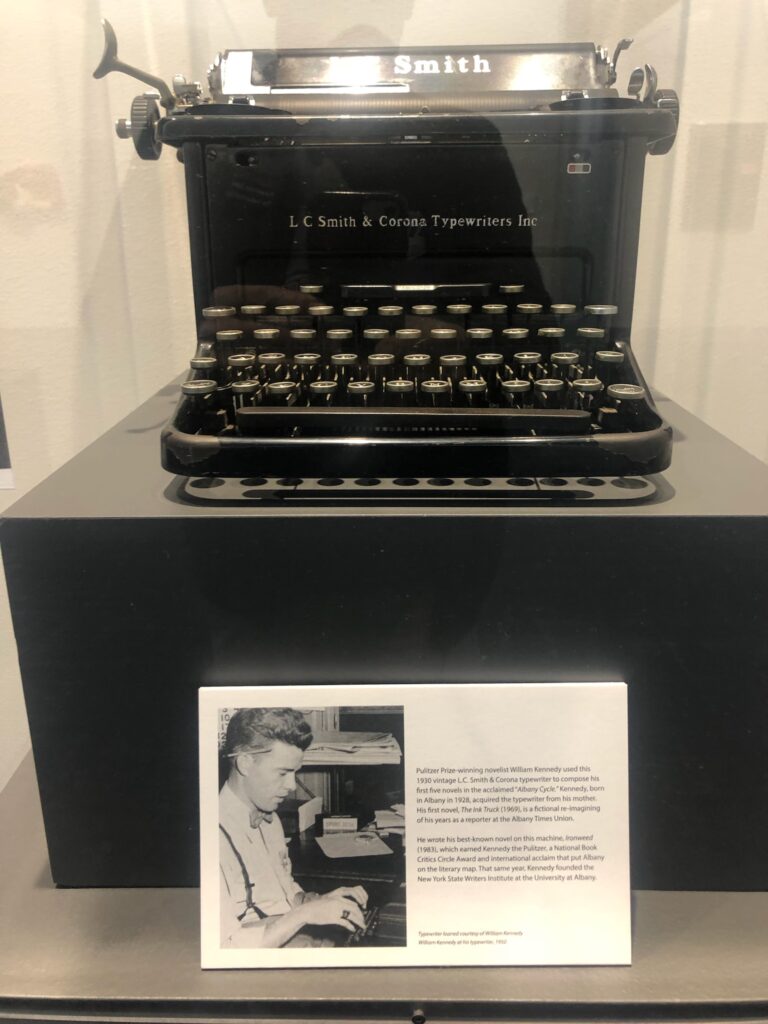
William Kennedy has been called the “Bard of Albany” – and the city returns his love. Most recently, it did so via a display at the Albany airport terminal, part of the Albany Book Festival. The Irish-American author kindly loaned his vintage 1930 L.C. Smith and Corona typewriter for the occasion. (If you’re a Boomer who doesn’t think that’s a big deal, a manual typewriter is one of the star exhibits for today’s students visiting Stanford’s Green Library. They keep looking for the “on” switch.) We’ve written about vintage typewriters and the authors who owned them before, here.
This particular typewriter came from his mother, and Kennedy wrote the first five novels of his renowned Albany cycle on it. In particular, he wrote Ironweed on it, and that’s the book that brought him a Pulitzer Prize and a National Book Award. The photo with the typewriter was taken in 1950, when he would have been 22 – only two years older than the typewriter – and a budding reporter at the Albany Times Union.
Some of you will remember I interviewed Bill for the Los Angeles Review of Books – “‘At the Mercy of My Passions and Opinions’: A Conversation with William Kennedy” – and some of you attended Another Look’s recent event for his book, Billy Phelan’s Greatest Game.
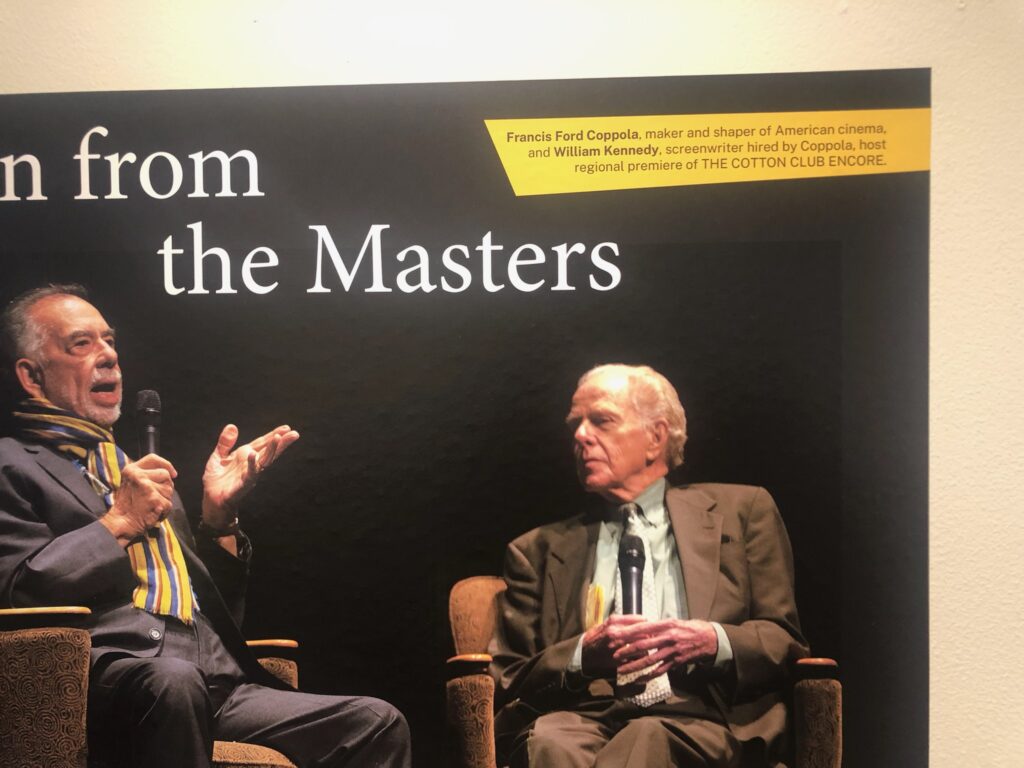
Our roving ambassador in Albany last week was Roger Winkelman, the technical wizard and reliable deity who produces videos and podcasts for Another Look’s literary offerings. He managed to take a few quick photos for the Book Haven. He also took a quick partial shot (below)of a poster from the 2019 onstage discussion with Director Francis Ford Coppola, as the two discussed their work together on the 1984 film The Cotton Club, which the pair co-wrote. (Read more about it here.)
That was all Roger had time for. Then our man in Albany hopped on a plane and headed back home for Stanford.
Update: A quick correction from Richard Polt of The Classic Typewriter Page (more on that later) about the make of William Kennedy’s typewriter – maybe it’s not an 1930 L.C. Smith after all: “The typewriter Kennedy is using in the photo is not this one; it has a rounded top, whereas the L. C. Smith’s top is flat. It looks like a Royal KMM.”
Update on July 29: Not so fast! I contacted Bill Kennedy himself for a definitive reply. Here’s what he said today:
“Richard Polt is correct that the typewriter I’m using in the 1949 photo is not an L.C. Smith, and he’s probably also correct that it’s a Royal, though I don’t really remember. I never had any particular admiration for that machine the way I did for my LCS, Our city editor (the photo is from my first job, assistant sports editor of the Glens Falls NY Post Star, number two man in a two-man department) had an Underwood of similar vintage and that was vastly superior to Royals and LCSs alike. The Underwood was built for speed, and I recall being clocked typing 125 words a minute on one when I was in the army. I loved all those machines, but I now view them as marvelous sculptures.”
The typewriter Kennedy is using in the photo is not this one; it has a rounded top, whereas the L. C. Smith’s top is flat. It looks like a Royal KMM.