
.
.“This is something that one cannot speak about. And Dante is going to speak about it.”
“All the people who end up loving The Paradiso understand the great daring poetic achievement of the poem,” says Dante scholar Rachel Jacoff of Wellesley. Entitled Opinions host Robert Harrison, a Dante scholar himself, joins his colleague and former mentor for a final discussion of The Divine Comedy — more specifically, of The Purgatorio and The Paradiso. It’s up at the Los Angeles Review of Books here.
Harrison notes that “Dante’s Paradiso is the last full-bodied vision of paradise in Western literature. It’s all been Hell or Paradise Lost since then.” They explore the role of the Roman poet Statius in Purgatory, the disappearance of Virgil, the “tough love” of Beatrice, the nature of time in heaven, and Dante’s elusive attempt to express the inexpressible.
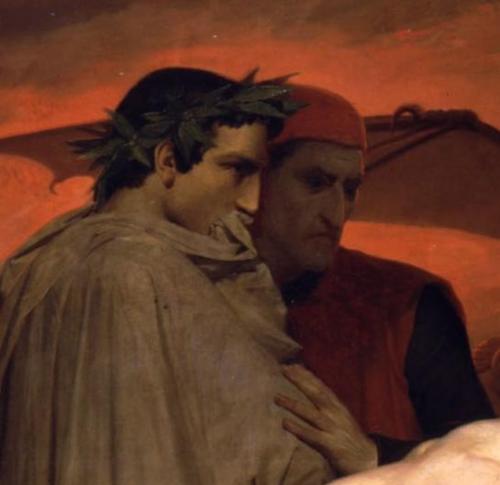
He’s gone at the end.
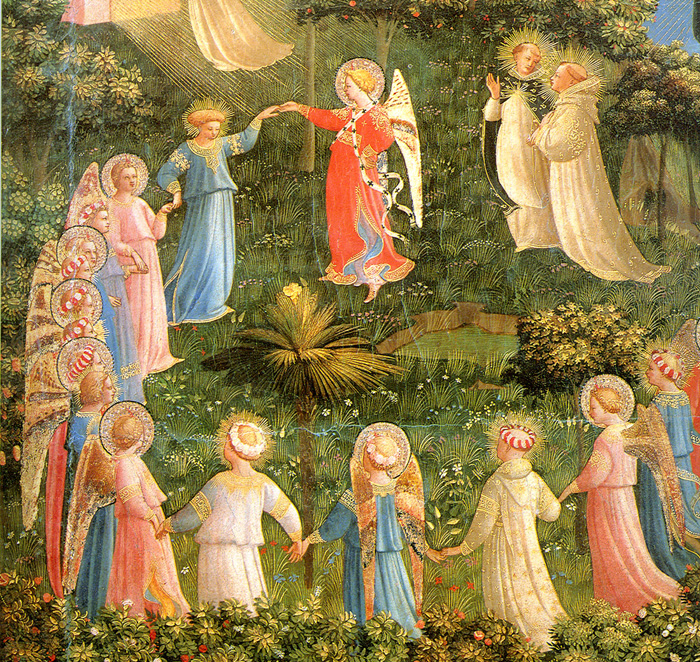
Jacoff compared Dante’s dilemma to Fra Angelico’s painting of “The Blessed Entering Paradise.” The souls dancing in a circle seem to represent paradise, but at the upper left is a white gate with light shining through it. “That’s the real thing out there, and he can’t paint it.”
When Harrison asked the Jewish Dante scholar whether the Christian theology of Dante’s masterwork created a barrier for her love of the poem, Jacoff replied:
Many great readers of Dante are not Christians. I think everyone has to answer this question for himself or herself. I find that it is one of the great works of art that I return to and it’s helped me understand all kinds of things. Clearly, much in it is alien to me, and always will be — but no more than Handel’s “Messiah” or Bach’s “Mass in B Minor.” These are foundational in my aesthetic experience — and it can’t only be just aesthetic. There has to be some way the spirituality of these works can be available to anyone.
This is the final interview of the three-part series with Rachel Jacoff on Dante. Parts 1 and 2 are here and here.¨
“Virgil is the tragedy within the comedy. Virgil’s fate is the thing that haunts the comedy.”
“People who end up loving The Paradiso understand the great daring achievement of the poem… It’s the greatest challenge that the poet takes on.”
.
More potent quotes:
“It’s always magical to me: we have known since the beginning of the Inferno that Virgil is not going the whole journey. … yet at the moment Virgil actually disappears, it’s always a shock. It takes one’s breath away.
“Paradox is so built into everything in the Paradiso, because it’s so central to Christian theology.”
“I think the difficulty people have with the Paradiso isn’t the theology – there is much more made of it than is really there. The theology is not overwhelming – however, the continual carrying on about how terrible things are on earth might be the thing that overwhelms people. Sometimes it overwhelms me.”
“I think the Paradiso is informed by a profound historical pessimism. Dante was living in a great crisis of authority.”
“The only time I ever quote Heidegger is with that great line, ‘Only a god can save us.’ I think that’s where Dante is at the end, in terms of history. There’s nothing that he imagines that we can do. If it’s going to happen, it’s going to happen by divine intervention.”