
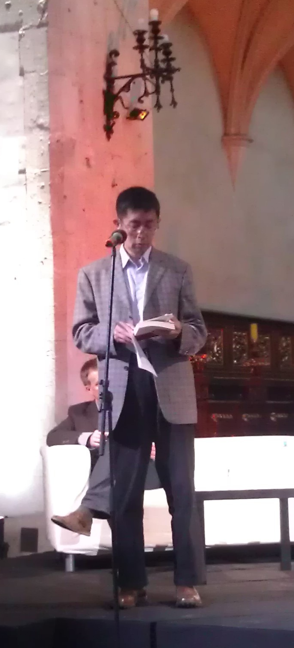
Reading in Kraków (Photo: Droid)
Protesters once shouted his poems in Tiananmen Square. Now the 62-year-old poet lives quietly in Hong Kong with his wife and six-year-old son.
I wrote about Bei Dao at May’s Czesław Miłosz Festival in Kraków. According to an article in the China Daily, he returned to mainland China this month, for the second time in 20 years. The first time was the occasion of his father’s death in 2001.
The occasion this time was the opening ceremony of the festival in Xining, capital of northwest Qinghai province. The poet, whose real name is Zhao Zhenkai, wore a brick-red jacket and grey pants as he made a short speech. Although he was quickly surrounded by fans clamoring for his autograph and hoping to be photographed with him, he seemed to retreat to the inner solitude I observed in Poland.
At Stanford over a decade ago, he described himself as “a man to whom the whole world has become a foreign country.” In Kraków, he said, “Materialism and consumption destroyed Chinese culture.” His visit to mainland China continued those themes:
In his eyes, compared to the prosperity in the 1970s and 1980s, today’s Chinese literature is uninspired. “It’s true not only in China but also across the world, and it’s related to many factors, like materialism oriented by consumption, the nationwide trend of seeking entertainment, information dissemination brought by new technologies. All these things are making bubbles in language and literature,” he said.
He pointed out that previously a clear-cut division existed between “vulgar” culture and “serious” culture, but today vulgar culture is swallowing serious culture like a black hole, and unfortunately, many writers are forced to lower their writing standards to cater to vulgarity in today’s society.
There are other reasons for the devolution of Chinese poetry, Bei Dao said, such as the absence of a system of construction.
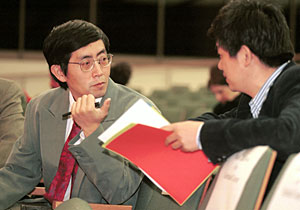
In 1999 at Stanford (Photo: L.A. Cicero)
“Poetry needs good guides, and a good critic is a good guide who can lead or shape a group of well-educated readers through unscrambling and analyzing poets.”
He said that college students and scholars who used to read poetry have lost their enthusiasm for it amid China’s social transformation, and now poetry only evokes nostalgia for them.
Meanwhile, the poet noted, the young generation of readers who grew up in the era of commercialization could not escape the impact of the times on them.
Pingback: Bei Dao on literary black holes and cultural vulgarity | The Book Haven : GEA News