

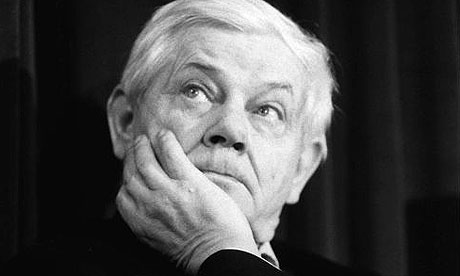
Poet
Poland’s biggest postwar literary fight erupted not in Warsaw or Kraków, but in an otherwise quiet Berkeley home one evening in the summer of 1968, after some serious drinking.
During the Columbia University launch for An Invisible Rope: Portraits of Czesław Miłosz on Monday night, noted translator and scholar Bogdana Carpenter departed from the planned script to break her silence on the event – for the second time ever.
She ought to know. She was not only there, she and her husband and fellow translator John Carpenter hosted the dinner, which included poets Czesław Miłosz and Zbigniew Herbert. She said distorted versions of the event that have left the Polish intelligentsia bickering ever since.
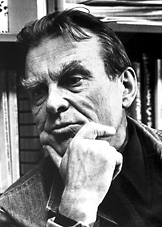
vs. poet
“It started out happy and gay,” she recalled of the evening — a pleasant, spicy meal with plenty of wine. After dinner, Herbert’s tone became “harsher and harsher,” Bogdana recalled. “When he was drunk he tended to be aggressive – and this time it was too late.” Herbert’s thoughts turned to the German occupation of Poland during World War II.
“He viciously attacked Miłosz – he reproached him for his lack of participation in the Polish resistance,” said Bogdana. The evening was so acrimonious that Janina Miłosz forbade Herbert ever to enter the Miłosz abode again.
However, “it’s become known in a distorted version,” Bogdana said of the story. Typically, it is claimed that Miłosz provoked the incident by suggesting that Poland be added to the Soviet Empire as the 17th republic. Bogdana said this comment never happened. The provocation was invented by Herbert twenty years after the event, she said.

Correcting the record
For Miłosz, questions of patriotism were always sensitive – both because of his position with the Communist government as a cultural attaché, and then again because of his 1951 defection in Paris, which meant he was barred from Poland until the 1980s.
The basis of the dispute, said Bogdana, was the two poets’ notion of homeland, and what it required from them.
Herbert believed one should be willing to “sacrifice one’s own happiness and life,” she said. While some have attributed Herbert’s position to the “Polish Romantic paradigm,” Carpenter said its roots are “further back – in the Hellenistic tradition.”
“Miłosz differed diametrically.” For Miłosz, loyalty had its limits – “when the price was other people,” she said, he could be “scathingly critical.” His position was that “loyalty is not enough – one seeks logical justification” for self-immolation. Miłosz’s defined his “homeland” as the Polish language. “Miłosz’s chosen weapon was the word, not the sword,” said Bogdana. “Language defined him.”
Bogdana Carpenter pointed out that “Herbert was not in Warsaw in 1939, 1942, or 1944.” Milosz witnessed the destruction of Warsaw firsthand. Patriotism was not the question. She pointed out that during Nazi occupation, Miłosz compiled an anthology of anti-Nazi poetry – An Invincible Song (1942) – “for which he easily could have lost his life.”
I’ve just come to Herbert recently, and am really enjoying his work! I wrote a little about that here:
http://theoncominghope.blogspot.com/2011/07/poem-of-day-of-soul-by-zbigniew-herbert.html
Awesome entry. To this coming year was a lot better than what gives.
Two fine poets. I prefer herbert (his poems (translated by john gogol as well as the carpenters) knocked me out! So somebody can write so incredibly about his time and place! But if I had to agree with one of the two on this matter, I would agree with milosz.
This comment got tangled in a spam folder – apologies for the delay posting.
There is a basic difference between the two poets. Miłosz thinks that man lives for himself, for long, healthy, happy life.
Herbert says: head up and stay, you should sacrifice for freedom, for others. Not run away.
That’s why Herbert will live forever and Miłosz fade away.
Pingback: Zbigniew Herbert Tempers the Rational Fury | Cosmos the in Lost
Sorry for the delay in getting this up, Andrzej. It got caught in a spam filter.
Although loaded with prestigious prizes Herbert deserved but never received a Nobel prize. Milosz was honoured too, but not until he became a Nobel laureate was he acknowledged absolutely first rate. Personally I am thrilled when reading Herbert. I enjoy Milosz, but Herbert wins me over every time I read him. Thank goodness we have a world which has such great writers in it as the contrary but always complementary poets as Milosz and Herbert. In plurality we have riches.
The tragedy here is that these artists, and everyone else, were caught by the lords of “the Ring.” Both poets are right, of course. What else should one do when facing barbarism but fight or flee? Herbert and Milosz entered the worlds of their own poetry and those of the other writers they admired and loved. Such escapism is rightly called survival. And it is why they turned out be be who they are: poets whose works are so good, there are none better.
Milosz realized that, as he was to say later, nobody could escape the horrors of that time with a clear conscience. It is not for anyone else to judge the actions of those who seek to survive in extreme circumstances. Both poets followed their consciences and we have to respect that. In any case we who come after them, “Shall never see so much, nor live so long.” Our luck is that their poetry lives after them.
That’s the point. People who tried to survive those horror times with a clear conscience were most likely killed or suffered great consequences. Tribute to Herbert’s way of life should be much much more greater.