

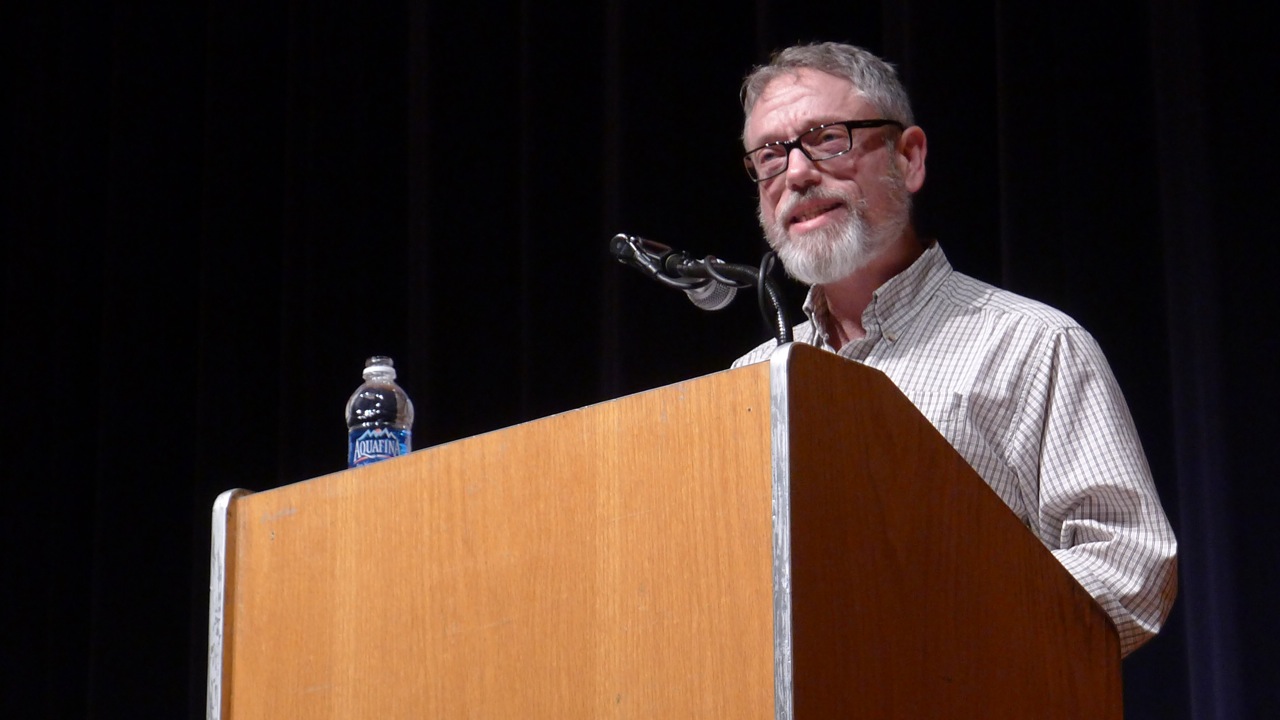
D.A. Powell: Career as playwright nipped in the bud (Photo: Ken Fields)
Poet D.A. Powell didn’t begin as a poet. Early on, he said, “I conceived of myself as a budding playwright.” He told a noon gathering at Stanford today that he “has some sense of pride” in getting a “D” in his collegiate playwriting class — “but I may have gotten an ‘F,'” he admitted ruefully.
At that time, he was into “absurdist drama” — “plays where people sat around and talked about nothing — and talked about how nothing nothing was.” The feedback: his plays lacked conflict.
Powell recalled that Sergei Eisenstein learned while editing and cutting his films that he needed to use first person, second person, and third person — something Euripides accomplished with a chorus. He recalled a portion of Eisenstein’s Battleship Potemkin that shows, in the first shot, meat full of maggots, in another shot men looking through the entryway at the chef, and in the third shot, a bubbling caudron, to show the meat “is being cooked for consumption of sailors who are angry. It’s emotional equivalent is anger coming to a boil.”
“The poet needs something else that balances the drama,” he said. “You have to be willing to be the scenery and the antagonist as well.” He quoted Robert Hass saying “a good poem contains its opposite.”
Powell’s first three books — Tea (1998), Lunch (2000), and Cocktails (2004) — have been considered a trilogy for the AIDS pandemic. His most recent book, Chronic (2009) received the Kingsley Tufts Award and was nominated for a National Book Critics Circle Award. He’s working on another, which he read from last night. The photo comes to me courtesy of Ken Fields, who sent it to me after after Powell’s reading. Alas, some other deadlines had consumed my evening, so I couldn’t attend, but I was able to catch a few minutes of today’s colloquium. As I left, he was responding to a student who asked him about the distinction between art, popular culture, and camp in his work.
“When you’re being completely camp, you’re not completely aware of it,” he said.
He discussed the “doubt and mystery of one’s own aesthetics” and “finding note of authenticity within the detritus of society.”
Pay It Forward was a “terrible, terrible film,” he said — yet he recalled crying while watching it. “Instead of being embarrassed by it, why not celebrate it?”